Shelter, the duo of Mark Bebb and Rob Bradley, have consistently proven themselves capable of producing understated, appealing electronic pop music. Whether on the upward-pointing arcs of their 2016 album Ascend or their celebrated collaboration with Erasure’s Andy Bell on iPop, Bebb and Bradley have a tight handle on how to make music that grabs you, lifts you up, occasionally gives you a firm, emotional shake and generally leaves you feeling just a bit more optimistic than you were before you started listening to it.
Third album Soar builds where Ascend left off with a collection of ten songs variously trading in thudding euphoria, fragile balladry and glossy synth pop. What works so well about the music these electronomads create is the humanising quality that vocalist Bebb brings to Bradley’s electronic templates. A track like ‘Touch’ ripples forth on a rich bed of synths, dark-hued rhythms and mesmerising melodies, but it is Bebb’s singular vocal that wreaks havoc with your emotions, adding a tenderness and delicate edge amid the alien, robotic sounds his voice weaves around.
One of the standout tracks here is ‘Karma’, which opens with a stern, angular bassline reminiscent of Fad Gadget’s ‘Back To Nature’ that is promptly overwhelmed by regimented rhythms and layers of icicle-sharp synth tones. Bebb here is the dramatic, finger-pointing sage, explaining pointedly to the listener that no action is without consequence, a note of empathy the only relief from an otherwise sinister delivery. Opener ‘Electronica’ is a bold, techno-infused paean to the electronic music of the last forty years, the line ‘Microchips and wires made us who we are,’ being just about the most pointed description of why so many of us remain fascinated by this enduring, constantly-evolving music.
It’s the album’s title track and ‘1984’ that steal the show here, though, both being brittle, heartfelt songs wrapped tightly in classic electronic pop blankets, all perfect melodies and propulsive rhythms. On these tracks the Shelter sound is reminiscent of Bright Light Bright Light, carrying the same dizzying ability to spin your emotions around full circle and leaving you uncertain whether you should be upbeat or miserable. (Anyone who’s spent any time with my reviews will recognise that as a songwriting quality that I fall in love with much more than is good for me.)
Soar is currently being crowdfunded and will be released as a two disc album complete with 12” mixes of each track. Head to Crowdfunder to show your support, where you’ll find a range of pledge options, including a special edition of iPop.
Prefacing her seventh album, You Are Here, Piney Gir’s new single finds the Kansas-born, London-residing Angela Penhaligon embracing warm, fuzzy analogue synths and angular pop that nods to the likes of Roxy Music, all bleached into haziness by Malibu evening sunshine.
‘The Great Pretend’ was inspired by one of those nights you look back on and wonder whether it really happened. In this instance, it was a trip to the home of author Neil Strauss, an evening filled with celebrities, connections and conversation that at the time felt utterly normal but which took on a strange otherness after; sufficiently so to give ‘The Great Pretend’ – with its languid bassline, wayward guitars, layers of analogue loveliness and rousing (yet muted) chorus – a strange feeling of opaqueness, like the true meaning behind the words is elusive, personal and known only to its creator.
The single is rounded out by two B-sides, the jangly and uplifting, slightly glam ‘Spirited Away’ and the cover of The Paragons’ reggae track ‘Happy Go Lucky Girl’. The latter is delivered in a style that Piney says is a nod to Julee Cruise and Twin Peaks, but which to me sounds like a serene bit of unused Latin-infused background music from Dirty Dancing (this is meant as a compliment). But hey, Piney used to live in the place where Twin Peaks was filmed, North Bend, WA so she definitely knows the weird atmosphere of that place better than most.
Who is she? I am HER is Julie Riley, lately of Crown Estate and formerly of Mute sub-label 13th Hour’s Rosa Mota.
I am HER is also her three daughters – Hope, Elkie and Ruby – whose initials begat the capitalisation in Riley’s project’s name; they don’t appear on the record, at least not in a recorded capacity, but they are there in spirit. “I am what I am now as a result of making these fine young women,” says Riley. “I am HER.”
Musically, I am HER is a very different proposition from Crown Estate, her distance collaboration with fellow Rosa Mota survivor Sacha Galvagna. Where Crown Estate relied on loops and electronic composition, I am HER finds Riley on guitar, delivering compelling six-string tracks with occasional piano and the addition of drumming accompaniment from the highly adaptable Jeff Townsin of fellow 90s group Submarine. One might call this music lo-fi, but somehow these songs sound much larger than the sum of their parts, despite the intimacy of Riley’s delivery.
The feisty ‘Harpy’ is immediately connected to the mid-90s alternative rock scene that Rosa Mota emerged into. A varispeed number, it is at once wild, raw and shouty, yet reveals itself as it progresses to be utterly beholden to a folk and early rock ‘n’ roll tradition. The standout ‘Heretic’ does something similar, a roll-call of feelings and emotions amid what sounds like a turbulent, volatile relationship, its linear guitar riffs and forward motion reminiscent of the most focussed Sonic Youth material, its urgent chorus plea of ‘Don’t make love a dirty word,’ delivered both as a challenge and a reflection on today’s more impermanent approach to dating. ‘Blue’ has a Jesus And Mary Chain stateliness, carrying that sort of fragile, melancholic, world-weary tone best heard in the early morning’s reflective hour, while the clever poetic wordplay of ‘Heroine’ is the Velvets’ ‘Heroin’ transformed into a love song for life instead of nihilistic impulses.
If Crown Estate presented Julie Riley as a singer and composer with abundant musical dexterity, the songs on Herstory serve as a reminder that her heart and soul reside in rockier territories. Those who, like me, fell in love with Rosa Mota across their two albums are well versed in the story of how that group fell apart following the disappointment of how their second album, Bionic, came together despite brilliant songs and a brilliant producer. Herstory is like the Rosa Mota album that never was, but which could have been if they hadn’t imploded; a mature, clever record full of emotional depth and considered lyric writing.
VERYRECORDS is pleased to announce the release of Hello Science, the second album from New York and Berkeley electronic duo REED & CAROLINE. The album will be released on JULY 6 2018.
“Formulate hypotheses and gather all the facts – it’s science! It’s all about science!”
— Reed & Caroline, ‘It’s Science’
Reed Hays and Caroline Schutz will release their second album through Vince Clarke’s VeryRecords on July 6 2018. Titled Hello Science, the album is the follow-up to 2016’s Buchla & Singing. For clarity, this record also contains plenty of Buchla and singing. And a cello. Oh, and a Vako Orchestron too.
If the title of Reed & Caroline’s debut made it completely clear what it was all about, the subject matter of Hello Science is again immediately apparent. Consisting of twelve songs written by Reed Hays and sung by Caroline Schutz, the inspiration behind the album can be summed up by the album’s grandiose centrepiece ‘It’s All About Science’, because it literally is all about science – at least on the surface.
Hays, who grew up in Huntsville, Alabama, a town where rocket scientists decamped from Europe after the Second World War, fills these songs with intensively-researched references to science and technology – the good, the forgotten and the downright frightening – but he does so in a way that reveals their underlying meaning to be something altogether more profound. Themes of grief, loss, the squandering of the Earth’s resources, our diminished personal privacy, data manipulation and exploiting web-connected home appliances prevail in the album’s songs, but yet they’re disguised as accessible pop tracks.
“Somewhere along the line I realised that my love of science is something spiritual and optimistic,” explains Reed Hays. “In these troubling political times, people are putting science into question. It’s almost like a faith that’s being outlawed. Because of that ‘Hello Science’ became really personal for me.”
The album opens with the contemplative electronics and strings of ‘Before’, a timely treatise on the finite nature of everything on this planet we call home, as well as playfully reminding the listener of their very corporeal impermanence. The urgent post-punk / New Wave-influenced ‘Dark Matter’, featuring bass and vocals from Ayse Hassan and Kendra Frost of Kite-Base (supporting Nine Inch Nails this fall) comes with a succinct enquiry of a chorus – “Does dark matter matter?” – while the ominous, prowling synths of ‘Entropy’ shroud the anguish of a departed friend in chaos theory.
“Reed really uses science as a way to cope with things,” says Caroline Schutz. “It’s a way of making yourself feel better about those issues by looking at them from a scientific perspective.” The exception to such deep catharsis is the blissfully upbeat ‘Ocean’, co-written with Schutz’s pre-teen daughter, a track filled with fluid synths and euphoric Buchla 100 handclaps.
Hello Science is an album rich with contradictions, where contemporary concerns are executed with decades old (and centuries old) musical equipment, where songs that celebrate the overlooked women computers that powered NASA’s early space endeavours and songs that celebrate the perforated printer paper you drew on as a kid can coexist. Yes, it’s all about science – but it’s also human too.
Reed & Caroline will support Erasure on all dates of their North American tour, which commences in Miami on July 6.
Hello Science will be released as a download, stream and CD via www.veryrecords.com.
Track listing
1. Before
2. Dark Matter
3. Buoyancy
4. Another Solar System
5. It’s Science
6. Digital Trash
7. Ocean
8. Entropy
9. Computers
10. Internet Of Things
11. Continuous Interfold
12. Metatron
13. Before (Vince Clarke Remix)
Credits
Caroline Schutz – vocals
Reed Hays – Buchla, Orchestron, cello
Ayse Hassan & Kendra Frost – bass and background vocals on ‘Dark Matter’
Harriett Hays – Russian vocals on ‘Internet Of Things’
Synth corner: Reed Hays on the Orchestron
It may not look like much, but the Vako Orchestron was intended as a portable alternative to the Mellotron. This thing was more the size of an organ and instead of tapes it uses clear plastic discs, and each concentric groove on the disc is a different note.
Kraftwerk used an Orchestron on three of their albums. It creates a very scratchy, low-bandwidth sound. It’s the source of the strings on ‘Trans-Europe Express’ and the the choir on ‘Radio-Activity’, both of which are very unique sounds. They were the only band to really run with it.
The Orchestron is basically a turntable with a lightbulb inside, and a motor. Every key you press opens a little window and a light shines on part of the disc. It’s got such an eery, haunting sound. It’s just so kooky, a technology that’s so linked to one tiny little era in the mid-70s.
For Hello Science Caroline sang every note on the keyboard, and we made a bunch of optical discs from those recordings using the original Orchestron factory equipment through a guy called Pea Hicks. It’s truly amazing that he’s kept that equipment alive. That opened up all sorts of possibilities for adding really interesting vocal sounds to some of the tracks by reducing Caroline to little optical floppy discs. I told Vince about it and he thought I was completely insane, like ‘Can’t you just get samples of all that instead?’.
Reed & Caroline biography
Reed Hays first used the Buchla Electric Music Box after hiding in an empty harp case in the basement of Oberlin College and sneaking into the electronic music lab after hours. Caroline Schutz, an art major, became an accomplished singer and musician in her post-Oberlin days with her bands Folksongs For The Afterlife and The Inner Banks. By sheer chance, Reed and Caroline’s first synthesizer and vocal collaboration became the score for a number of L’Oreal hair commercials.
Their first album, Buchla & Singing was released by VeryRecords in October 2016.
About VeryRecords
VeryRecords was founded in Brooklyn by Erasure’s Vince Clarke in 2016. We are a small record label dedicated to releasing very fine electronic music. The label was launched with 2 Square by Vince Clarke and Paul Hartnoll, which was then followed by releases from Reed & Caroline (Buchla & Singing, 2016) and Alka (The Colour Of Terrible Crystal, 2017).
“Shaping up as a label to keep a serious ear on.” – Electronic Sound
VeryRecords artists Reed Hays & Caroline Schutz have unveiled the first track to be taken from their second album Hello Science. The album will be released by Vince Clarke‘s VeryRecords on July 6 2018.
Bryan Michael, better known as Philadelphia electronic musician and vintage synth restorer Alka, has remixed ‘This Grey Morning’ by Cure keyboard player Roger O’Donnell. The track originally appeared on O’Donnell’s 2005 album The Truth In Me.
Whereas O’Donnell’s original was all weightless, occluded synth texture and ethereal vocal dreaminess, in Alka’s hands the track becomes a brooding, edgy cut driven by fat low-end and a mechanical rhythm. Listen to the remix on Soundcloud here or below.
It isn’t the first time that Alka and O’Donnell have collaborated. “During his time away from The Cure, Roger started his own label and was looking for tracks for a compilation,” recalls Michael. “This was back in the MySpace days. I sent him a couple tracks and he loved them, and even bumped some folks off the album so that he could include me.” Bryan Michael went on to work with O’Donnell on his 2008 album Songs From The Silver Box, contributing synths and drum programming to three tracks on the Moog-laden LP. The pair have also worked on other tracks together more recently which have not yet seen the light of day.
Alka’s critically-received third album, The Colour Of Terrible Crystal, was released by Vince Clarke’s VeryRecords in 2017. Listen to The Colour Of Terrible Crystal on Spotify here.
My interview with Alka about The Colour Of Terrible Crystal can be found at the VeryRecords website.
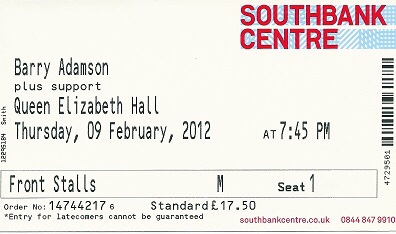
To support the release of I Will Set You Free, Barry Adamson played a show at London’s Queen Elizabeth Hall on 9 February 2012. Adamson and his band – Ian Ross on drums, Nick Plytas on keys, Bobby Williams on guitar and Maxwell Sterling on bass, with the Trinity Strings and Steve Hamilton’s horn quartet – tore through tracks mostly taken from I Will Set You Free and its predecessor, Back To The Cat. Support came from The Gilded Palace Of Sin and comedian Simon Day reading poems as Geoffrey Allerton.
I reviewed the concert for Clash‘s website with photos by Andy Sturmey. The full review can be reached by clicking here.
Thanks to Stuart Kirkham for confirmation of the setlist.
setlist:
1. Destination
2. I Will Set You Free
3. Whispering Streets
4. You Sold Your Dreams
5. If You Love Her
6. Turn Around
7. Black Holes In My Brain
8. Looking To Love Somebody
9. The Power Of Suggestion
10. Psycho_Sexual
11. Civilization
12. Straight ‘Til Sunrise
13. Stand In
14. Jazz Devil
(c) 2012 Mat Smith / Documentary Evidence for Clash // photo (c) 2012 Andy Sturmey for Clash
Note: this was my first piece written for Clash. Up to that point, everything I had ever written had been for Documentary Evidence or its predecessor blogs.
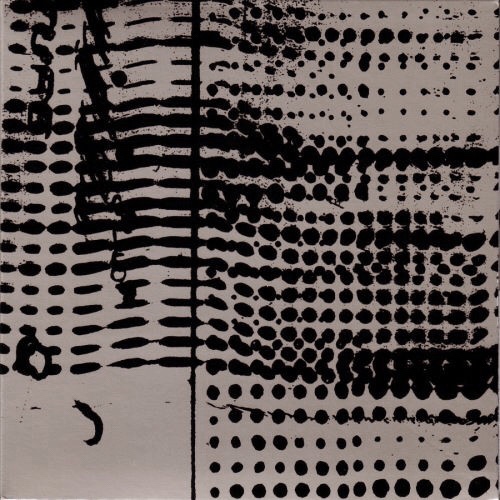
Translated, literally, as From The Inside Out, Simon Fisher Turner‘s De Dentro Hacia Afuera was issued as a white cassette on the consistently interesting Tapeworm label in an edition of just 250 copies in 2009.
The pieces on the cassette date back to 2002 / 2003 and the pieces fill a side apiece of the cassette. Side A (‘Outside’) consists of a field recording made by Fisher Turner of the procession of the Virgen del Carmen at Carboneras in 2002. The B-side (‘Inside’) consists of piano improvisations for the soundtrack to I’ll Sleep When I’m Dead, which Mute released as a download in 2003. Both pieces were edited, with Fisher Turner’s full blessing, from the original recordings by Tapeworm’s founder Philip Marshall.
The procession of the Virgen del Carmen takes place on 16 July each year in many Spanish towns, and also in other Spanish-speaking countries, marking the day of the appearance of the Virgin Mary to St. Simon Stock in Cambridge. Stock was the head of an order of the Catholic church which had fled from persecution where they were quartered in Monte Carmelo, now Israel, to Europe. The appearance of Mary to Stock in 1251 was not the first time the Virgin had appeared in the history if the order; in fact, the order was established because of Mary’s likeness in a cloud to some men investigating two prophets. Though some have subsequently cast doubt on Stock’s claims, the reassurance that Mary purportedly gave him, namely that those who wore the traditional scarpel – a cloth garment more or less in the shape of the Cross – would be freed from the fires of Hell has stuck and developed into the festival of divine celebration it has today.
Not that you’d necessarily deduce any of that in the recording Fisher Turner made on 16 July 2002. Here there are segments of chattering crowds milling and thronging around; a rousing brass marching band fades in and delivers a particularly uplifting song that feels like the soundtrack to some sort of Andalusian black and white movie (‘It would be great to play this tune to mum,’ someone is heard saying) before slowly moving out of focus; children chatter; babies cry; birds whistle, so does a man; a lone trumpet lets out a solitary blast before another rousing processional starts up, this one containing a funereal, maudlin middle section and a slightly wonky, out of tune tone; someone speaks above the crowd, prompting others to join in rapturously; what could be a piano pings out a brief high-pitched note; fireworks thunder in the sky; street sellers proffer their wares with repeated and insistent cries; a Latin pop song drifts in and out of focus with a singer sounding suspiciously like Andy Bell from Erasure; a cycle of strange industrial clanking rhythms and atmospheric drones and echoes is unfathomable as a source; someone’s shoes squeak playfully on a pavement.
Divorced from any obvious religious essence, the processions recorded here could have been captured anywhere in the Spanish-speaking world. The only real connection to divinity is the uplifting music, but none of those songs are exactly hymnal, and the church bells that toll at the very end of the piece. From the outside listening in, it feels like a public holiday that’s more or less forgotten why it was established, a bit like May Day, an excuse to kick back and unwind without knowing what you’re celebrating exactly. It all sounds pleasant, fun, the general buzz of people having a good time.
In 2003 Fisher Turner recorded the soundtrack to British director Mike Hodges’ I’ll Sleep When I’m Dead, starring Clive Owen. When I interviewed Simon just after the release of that album he advised that his process of creating the soundtrack involved getting on set, hitting props, talking to the actors, recording stuff and generally making a nuisance of himself to try and capture the essence of a scene.
‘I’ll Sleep When I’m Dead was pretty much improvised from my end,’ Fisher Turner explained to me back in 2004. ‘As they shot the film I worked at home on material that the editor was able to put in as a rough guide for the scenes. I had a good budget so I could test things out in the studio, bring them home, and rework them on the laptop, and then send them to the editor. I think finally I’d made up 9 CDs’ worth of music for the film. A lot of it is very atmospheric and distant, more ‘sound design’.’
The final soundtrack would contain familiar Fisher Turner elements in the form of tapes and contributions from the likes of former Blockhead Gilad Atzmon, but at its core were segments of noirish piano playing, the improvisations for which are documented on the second side of De Dentro Hacia Afuera. In recent times we’ve become used to Simon Fisher Turner almost dispensing with melody completely, but gathered here are a variety of modes and themes that evidence a unique skill at creating filmic moods with a minimal, discreet set of notes. Styles here range from tentative jazz to experiments that appear to involve sliding objects along the strings, clusters of evocative notes and ominous chords.
‘Solo Piano Improvisation #54’ is remarkable in two senses – first, as a piece of music (as opposed to considering it an assembly of sketches), it works just as dramatically as the fully realised soundtrack even without its additions and processing; second, it gives a rare insight into the early workings of a Simon Fisher Turner piece. Fisher Turner has himself said that his pieces are never really ever finished, often continuing to evolve further beyond the point where they’ve been submitted to a director and used in the finished film. The distance between early ideas and finished piece is thus immeasurable, making this document all the more intriguing. Though edited sensitively into a sequence and narrative by Philip Marshall, the result is still a recording of a work at its earliest stages, yet still capable of standing up as a complete work in its own right.
Related:
Interview with Philip Marshall from The Tapeworm about the label’s formation, ethos and ongoing exploration of the cassette format over at my other blog, Further.
Thanks to Philip at The Tapeworm and Simon Fisher Turner.
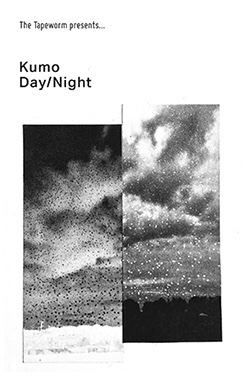
The Tapeworm imprint has always had an unerring capacity to release interesting sounds from interesting artists, and Day / Night by Kumo is yet another fine cassette among many. Kumo is the alias of Jono Podmore, a multi-disciplinary talent known on this blog for his work with Spoon on the Can back catalogue, the book he is assembling on sorely-missed Can drummer Jaki Liebezeit, the very fine Metamono albums and the Kumo and Cyclopean releases issued by Mute over the years.
For Day / Night, Podmore began with two field recordings taken from the balcony of his flat in South East London, adding synths and theremin later to the sounds he’d captured by chance – cars starting, dogs barking, planes droning overheard, snippets of conversation and so on. One recording was made during the day, one during the night. The effect is like listening to a microcosm of urban London life, never quiet for sure, but perhaps more peaceful than one might imagine.
Podmore’s electronic responses to the field recordings vary from sinewy synth arpeggios that wobble and flutter around the ambience to spooky, dead-of-night bursts of drones, tones and bleeps that feel like the soundtrack to existential dread. There is a certain muted quality to the sounds he added to his balcony recordings, as if he wanted the two components – the organic and natural and the composed and artificial – to live in harmony with one another, and neither has the capacity to overburden the other.
Day / Night is the embodiment, for me, of what Brian Eno conceived of for ambient music when he was laid up in bed listening to classical music and environmental sounds together. Podmore’s approach has a delicateness of touch, a sensitivity to his natural surroundings and a powerfully imaginative way of electronically responding to the sounds he hears.
Tapeworm releases are always issued in limited runs – get it now from the Touch shop before it’s gone for good.
Postscript: this review was finalised somewhere over the Atlantic as my overnight return flight home from New York approached the Cornish coast. It was started on the flight to JFK earlier in the week, probably in roughly the same place but during the day. Philip from Tapeworm asked me whether ‘Day’ or ‘Night’ worked best for the night flight. My response was thus: ‘Night’ made me more edgy as we came into land. ‘Day’ made me yearn for home after the best part of a week away from my own familiar daily environmental soundtrack.
“We were naive, innocent, adventurous and we didn’t expect anything in return,” is how onetime NovaMute artist Caroline Hervé described her partnership with Michel Amato, which formed after the pair met at a rave in 1996. Better known in the French dance music scene as Miss Kittin and The Hacker respectively, the duo wrote irreverent, sexually-charged music together that had techno as its foundation but which was just as influenced by the likes of D.A.F. and other early Eighties acts operating at the vanguard of electronic music.
Lost Tracks Vol. 2 compiles together four previously unreleased tracks from 1997 / 98, just before their debut EP and some three years ahead of their album releases for DJ Hell’s International DJ Gigolo imprint. On the fidgety opener ‘Upstart’, you can hear that soundclash between late Nineties techno and early Eighties synthpop with a sequenced bassline and icicle-sharp monophonic melodic clusters that sound like an offcut of François Kevorkian’s celebrated remixes of ‘Situation’ by Yazoo. ‘Love On 26’ deals with millennium angst over a bed of jerky electro and squelchy 303 hooks, while the grubby ‘Snuff Movies’ is The Normal’s ‘T.V.O.D.’ recast with the protagonist watching grim underground VHS tapes instead of Fifties road movies.
Closing track ‘The Building’ is a thudding acid house number with industrial edges, devoid of any human feeling whatsoever, complete with a spoken vocal from Hervé that’s as cloying as that deployed by Flying Lizards on ‘Money’. Truly fine lost gems from this inventive pairing.


 Who is she? I am HER is Julie Riley, lately of Crown Estate and formerly of Mute sub-label 13th Hour’s Rosa Mota.



 Documentary Evidence