William Orbit (1956 – 2026)

I was sad to read today about the passing of William Orbit.

I first came across Orbit’s name on remixes for Erasure and Depeche Mode, and then found his name popping up all across my record collection. Orbit’s Guerilla Studios was used extensively by Mute, and its engineer, Rico Conning, would later defect to Mute’s own studio at 429 Harrow Road.

I interviewed Orbit in 2019 for Clash about his beautiful collaborative album, The Painter, which featured contributions from Mute’s Polly Scattergood.

Orbit only had the sweetest things to say about Scattergood. He singled out her work with Simon Fisher Turner as some of his favourite music of hers that he’d heard.

After the interview Orbit and I exchanged Instagram messages about Scattergood’s cover of ‘Puff The Magic Dragon’, which I had as an mp3 and which I had intended to send him but never did.

He was a wonderful person to talk to – lively, honest, open and extremely generous with his time. I could have spoken to him for hours, and we made tentative plans to talk again but never did.

My interview for Clash can be found below.

https://www.clashmusic.com/features/in-conversation-william-orbit/

Rest in peace William.

Words: Mat Smith

(c) 2026 Documentary Evidence

A Tale Of Two T-shirts

24 May 2018, evening.

I walked south from my hotel on W57 Street in Manhattan. I was wearing a Jason Laurits-designed t-shirt from his Paste gallery. It carried a print of the outline of a t-shirt emblazoned with the ubiquitous I Heart NY logo. A t-shirt, with a print of a t-shirt.

My destination was Chelsea Market, where I’d bought the t-shirt the year before. My route took me through Times Square. I tried desperately to make out the drones of Max Neuhaus’s sub-sidewalk installation beneath the louder drone of tourism and commerce, but failed. I’d visited Neuhaus’ ‘Times Square’ early one morning with my friend Reed the previous year. Coincidentally, I was walking downtown to watch Reed & Caroline, Reed’s duo with Caroline Schutz, perform at Pianos on Ludlow Street in the Lower East Side.

At Chelsea Market, I ate a vegan burger from Creamline and, with time to kill, wandered into the Posman book store. I bought a copy of ‘Howl’ by Allen Ginsberg and Jonathan Lethem’s survey of Talking Heads’ Fear Of Music.

“Neat shirt,” said the cashier. “Where did you buy that from?”

“At a shop on the ground floor,” I replied. I think I may have made a downward pointing gesture as if trying to make her see the Paste gallery that was literally below where she was standing.

“Neat,” she said again. “That’s so meta.”

I had no idea what she meant.

I mulled this over while walking to a sports bar a couple of doors down from Pianos, where I met V for a couple of pints of Stella before the gig. The lady behind the bar pouring our drinks was wearing the same grey Muppets t-shirt that I’d bought from Walt Disney World on a family vacation maybe a couple of years before. I contemplated saying, “Nice shirt,” but decided that maybe that would be perceived as flirtatious.

V and I went down the street to Pianos. I offered him a drink, noting that the bar served Stella.

“The Stella’s not good here,” he said. “It tastes sort of soapy.”

We had a pint each anyway.

After the gig, V and I helped Reed pack his equipment into an Uber. While Reed went back inside to grab his cello, I asked V if he ever got recognised at gigs like this.

“Nah,” he said.

Moments later, someone tapped him on the shoulder with a pile of records to sign with a Sharpie. Perhaps fearing that another fan would collar him for autographs, we walked back down to the sports bar, leaving Reed to wonder where his assistants had disappeared to. We had another drink at exactly the same spot where we’d stood before Reed & Caroline’s set. The lady with the Muppets t-shirt was still serving behind the bar. I don’t think she had even noticed we’d left.

V’s Uber arrived and I headed back uptown on the Subway, still a little confused by what the cashier in the bookstore had meant by her assertion that my t-shirt was “meta”.

At the hotel bar, I took a stool and ordered an Old Fashioned, and then a second, and then a third. The third one tasted weird – not soapy, just weird – and I asked the server to check it. It turned out that she had made it with iced tea instead of whiskey. I ordered a fourth one, even though I really shouldn’t have. I sank that just as a massive crowd came in, and went to my room.

After opening the door, my room promptly span violently and I vomited into the toilet. For some reason, in that moment while I was bent over the toilet, my dad’s Alzheimer’s diagnosis forced itself into the forefront of my thoughts. He had been diagnosed in the January of that year but I realised, there and then, that I hadn’t accepted it, or even begun to process it, or remotely acknowledged what it meant. The journey to come to terms with it all began in that hotel bathroom, in New York, there and then.

Whenever I see either that Jason Laurits or grey Muppets t-shirt in my wardrobe, I’m reminded of that night.

Both t-shirts mentioned in this piece form part of ‘All The T-Shirts I Wore In Lockdown’, a Mortality Tables collaboration with the superpolar Taïps label and anonymous sound artist Xqui.

Available on limited edition cassette single from superpolar.bandcamp.com, with digital editions from mortalitytables.bandcamp.com and xqui.bandcamp.com

All proceeds from sales of this release will go to CALM – the Campaign Against Living Miserably – and Kölner Tafel.

Words: Mat Smith

(c) 2023 Documentary Evidence

Maps – Lack Of Sleep (Short Story, 2023)

To coincide with the release of Counter Melodies by Maps earlier this year. I wrote a short story inspired by the track ‘Lack Of Sleep’. You can read this here.

This is the third short story I’ve written inspired by Maps tracks, following ‘Sophia’ (2019) and ‘A.M.A.’ (2013).

‘Lack Of Sleep’ refers to a storm which adds to the insomnia that the narrator experiences. This was Storm Eunice. In parallel to writing the story, I made some field recordings of the storm, initially from the top floor of our house and then as I repaired the damage to our shed in its aftermath.

These recordings, along with several others, were then used as the basis for The Naming Of Storms by Audio Obscura (Neil Stringfellow).

This is the 11th release in the LIFEFILES series, part of the Mortality Tables collaborative project that I began in 2019. The LIFEFILES series has also included four pieces from Mute artist Simon Fisher Turner.

The Naming Of Storms by Audio Obscura was released September 15 2023. Listen, download and follow Mortality Tables at mortality-tables.com

(c) 2023 Documentary Evidence
Si Begg – miscellaneous

Lamb ‘Gabriel (Si Begg’s 5.1 Futures Remix)’ (from ‘Gabriel’ single, Mercury (2001))

Sometime NovaMute artist Simon Begg remixed this single from Lamb’s third album, What Sound (2001). The mix finds Begg in wild trip-hop style, delivering a relentlessly chunky break positioned just fast enough to straddle the frontier with drum ‘n’ bass. Over that beat, Begg drops in abruptly obscured vocals from the original, randomised sounds and whooshing filtered synths to create a sense of urgent euphoria. The mix was available on limited 12-inch and CD formats of the single, and can also be found on the 2CD collection Lamb Remixed from 2005. The mix was titled 5.1 Futures, which was presumably an error given Begg’s use of the name S.I. Futures for a slew of memorable NovaMute releases. 

Words: Mat Smith

A work in progress (c) 2021 Documentary Evidence

Andy Bell Is Torsten – Queereteria TV – Audio Highlights From The Theatre Show

(c) John Bradfield

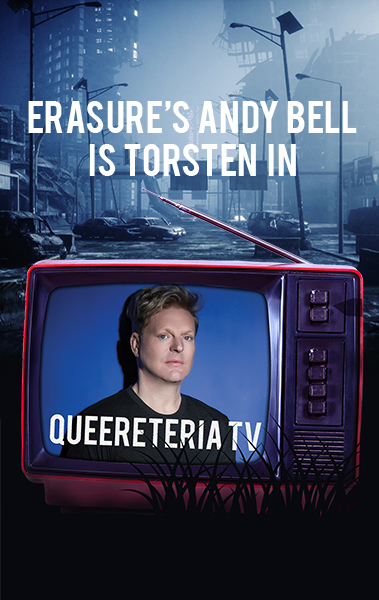
Queereteria TV was last year’s third (and hopefully not final) part of Barney Ashton-Bullock and Chris Frost’s Torsten series. Starring Erasure’s Andy Bell, Ashton-Bullock and West End legend Peter Straker alongside a cast of bawdy accomplices, Queereteria TV imaged a post-apocalyptic (post-pandemic?) world of really, really bad TV and morals gone savagely to hell. It was a show of raucous, vivid brilliance featuring some of Ashton-Bullock and Frosts’ finest songs in the Torsten series and powerful, often heart-wrenchingly poignant performance from Andy Bell. 

I watched the show at the series’ spiritual home of the Above The Stag Theatre in Vauxhall on April 24 2019 with Richard Evans from the Erasure Information Service, and it was one of the best nights out in London I’d had in a long, long time. Alongside some brilliant and truly memorable performances by the three principal vocalists, I remember alternately laughing uproariously and wincing uncomfortably at the antics of the show’s villainous Lady Domina Bizarre (brilliantly executed by Matthew Baldwin). 

Etched in my memory those performances are, a convenient memento of the live Queereteria TV performances is now available in the form of an eight-song EP through Bandcamp, featuring recordings from the final three night’s of the show’s run. Here you will find stunning live versions of songs that appeared on the accompanying Andy Bell album, including his stirring duet of ‘Lowland Lowriders’ with Ashton-Bullock and his mournful, haunting solo piece, ‘A Hundred Years Plus Today’. The EP can be found at Bandcamp here

“It’s so lovely to hear these songs again,” reflects Ashton-Bullock. “It made me very proud to be a part of such a pioneering, cult, theatrical production.” 

Barney Ashton-Bullock and Andy Bell in Queereteria TV

For fans of Ashton-Bullock’s incredible vocabulary and borderless approach to poetry, two of his ruminative pieces on the topic of fame were recently published in Scottish periodical Dreich (‘Made in Scotland from words’). The ‘Fame’ edition can be purchased here

Queetereria TV – Audio Highlights From The Theatre Show is released November 27 2020 through Bandcamp: https://andybellistorsten.bandcamp.com/album/andy-bell-queereteria-tv-the-live-stage-show-highlights 

Words: Mat Smith 

(c) 2020 Documentary Evidence 

Andy Bell – Judgement (from Variance III – The ‘Torsten In Queereteria’ Remixes)

andybell_varianceiii

Erasure’s Andy Bell releases Variance III – The ‘Torsten In Queereteria’ Remixes as a limited edition CD through Strike Force Entertainment / Cherry Red on December 6th.

The counterpart to the music from this year’s sensational third part in Barney Ashton-Bullock and Christopher Frost’s visceral musical about the semi-immortal polysexual Torsten, Variance III includes brilliant, shimmering remixes of tracks from Torsten In Queereteria by Bronski Beat and Matt Pop. Tangerine Dream’s Jerome Froese delivers a thunderous, dark-edged version of ‘Lowland Lowriders’, one of the most poignant moments from the show and Andy Bell’s accompanying soundtrack album, while Shelter reprise their work with Andy Bell on their joint iPop album from 2014 with a stunning mix of the ordinarily wistful ‘We Hadn’t Slept For Twenty Years’.

The collection also includes a solo version of the standout nod to Bertolt Brecht and Kurt Weill, ‘If We Want To Drink A Little’, originally recorded for the Torsten In Queereteria album by Bell and Hazel O’Connor, various single edits and radio-friendly versions of tracks from the original album.

Variance III also includes two new, unreleased tracks from the third instalment of the Torsten series, ‘Judgement’ and the lurid lounge jazz-funk of ‘Lead Me’. Documentary Evidence is today delighted to share the exclusive first play of the anguished, beautiful ‘Judgement’. The song is accompanied by previously unseen stills from the photo shoots for Torsten In Queereteria, finding Bell effortlessly evoking the essential inner turmoil of a character that he has made his own since he first took it on for a limited run at the Edinburgh Fringe in 2014.

Watch the extract of ‘Judgement’ below. Order Variance III from Cherry Red.

Related: Andy Bell – Torsten In Queereteria : Redux (interview)

Sincere thanks to Barney Ashton-Bullock.

(c) 2019 Documentary Evidence

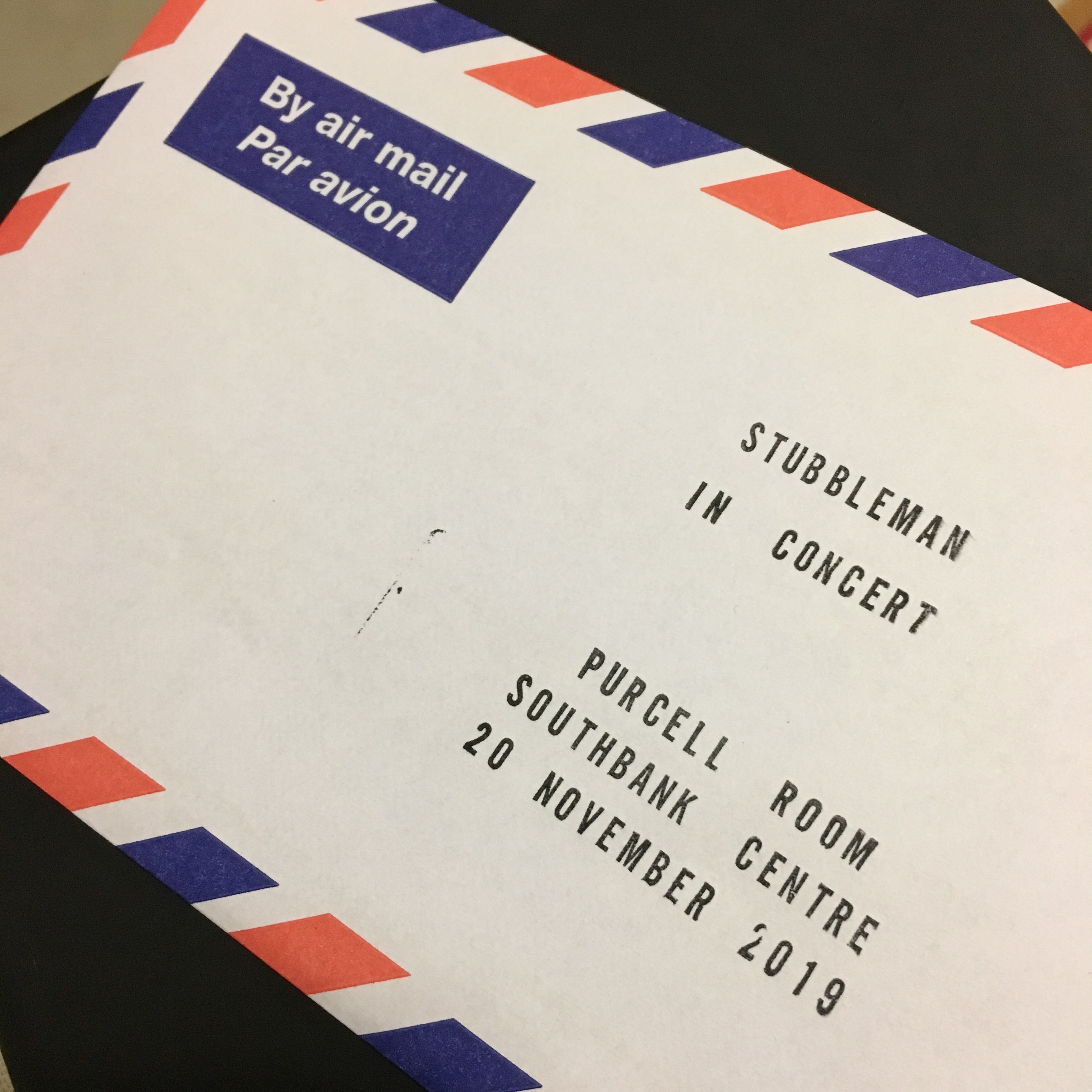
Stubbleman & Simon Fisher Turner – Purcell Room, 20.11.2019 + new SFT remix

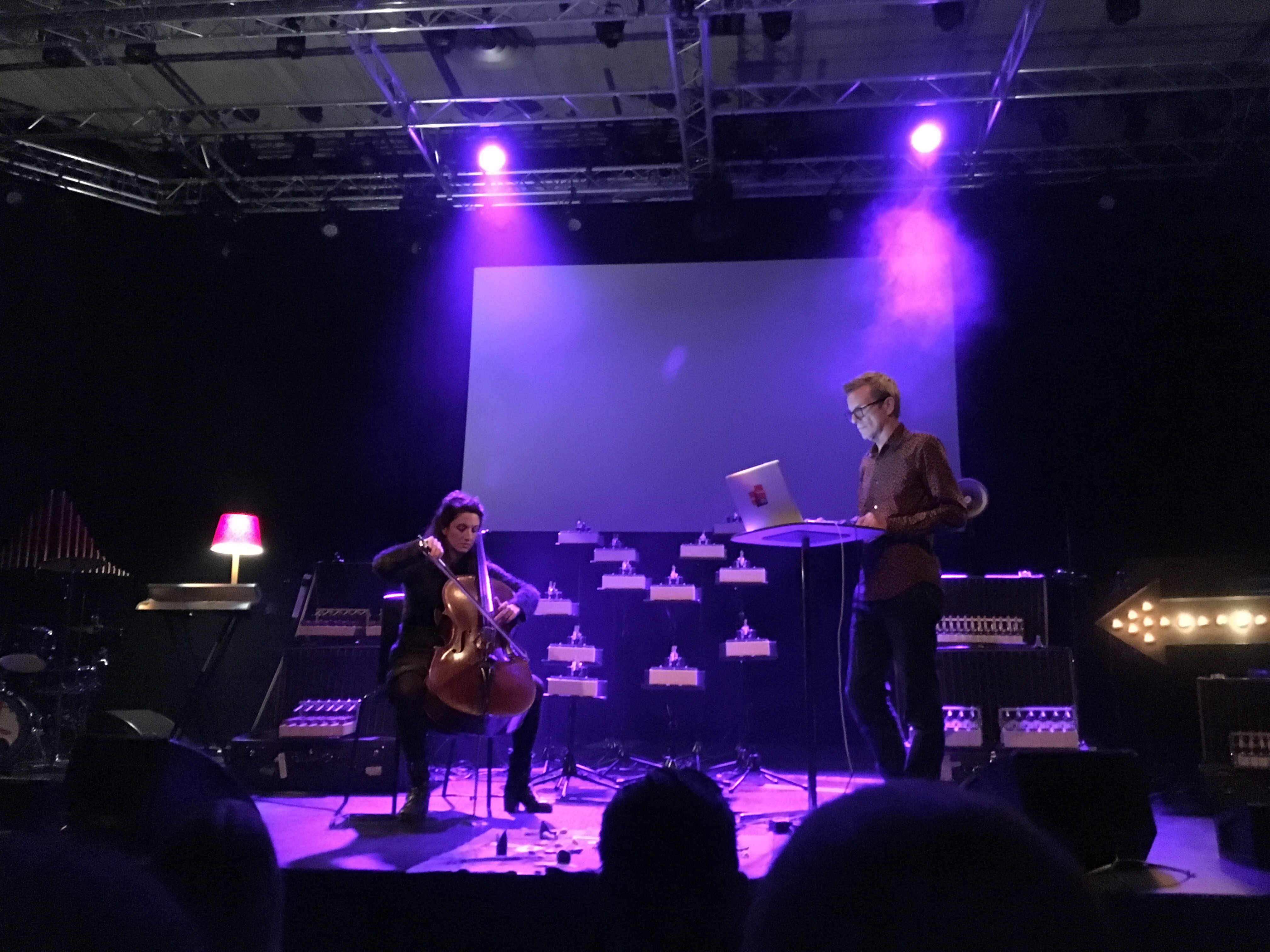
“Was that what you were expecting?” asked a confused lady sat next to me as Simon Fisher Turner and Laura Moody concluded their opening set of electronics and expressive cello playing.

Being well-versed in Fisher Turner’s varied musical output I replied that it was exactly what I was expecting, at least in terms of approach; that said, even I was a little scared out of my wits as loud splinters of noise unexpectedly peppered a suite of sounds encompassing overheard recordings of what could have been people milling about in the bar before the show, the sound of plates being spun around on a tabletop, wonky rhythms created from breathy stutters and all sorts of intriguing, richly textured sonic events.

Alongside this, Laura Moody took a whole-instrument approach to her cello playing, striking the strings with the flat of her bow to create springy, bassy reverberations, tapping the back to develop rhythms, furiously sawing away to develop dissonant, upper-register squeals, or playing the bridge instead of the strings. Occasionally Fisher Turner would play sections of strings, and with that as a cue, Moody would then settle into what one might describe as a more traditional sort of playing, her cello cresting above the recorded strings without ever sounding too mournful or melancholy.

The pieces were taken from Fisher Turner’s forthcoming album with the ceramicist and author Edmund de Waal, with whom he recorded his version of John Cage’s 4’33” for Mute’s STUMM433 boxset. ‘Is this jazz?’ asked the lady next to me, largely unmoved by my explanation of what she’d just observed and my enthusiastic summary of Fisher Turner’s career in everything from pop to soundtracks to sound art.

I could (half) see her point. Fisher Turner and Moody’s set was not jazz, and neither was the artist they were supporting – Pascal Gabriel, in his Stubbleman guise – but they could be forgiven for asking the question. Gabriel’s performance formed part of the EFG London Jazz Festival, and even if you took a most liberal definition of what jazz is, the music he performed – a 55-minute seamless journey through his entire Mountains And Plains album and an extract from a new work inspired by his fastest time cycling Mont Ventoux in Provence – wasn’t jazz. But hey, genres are just labels anyway.

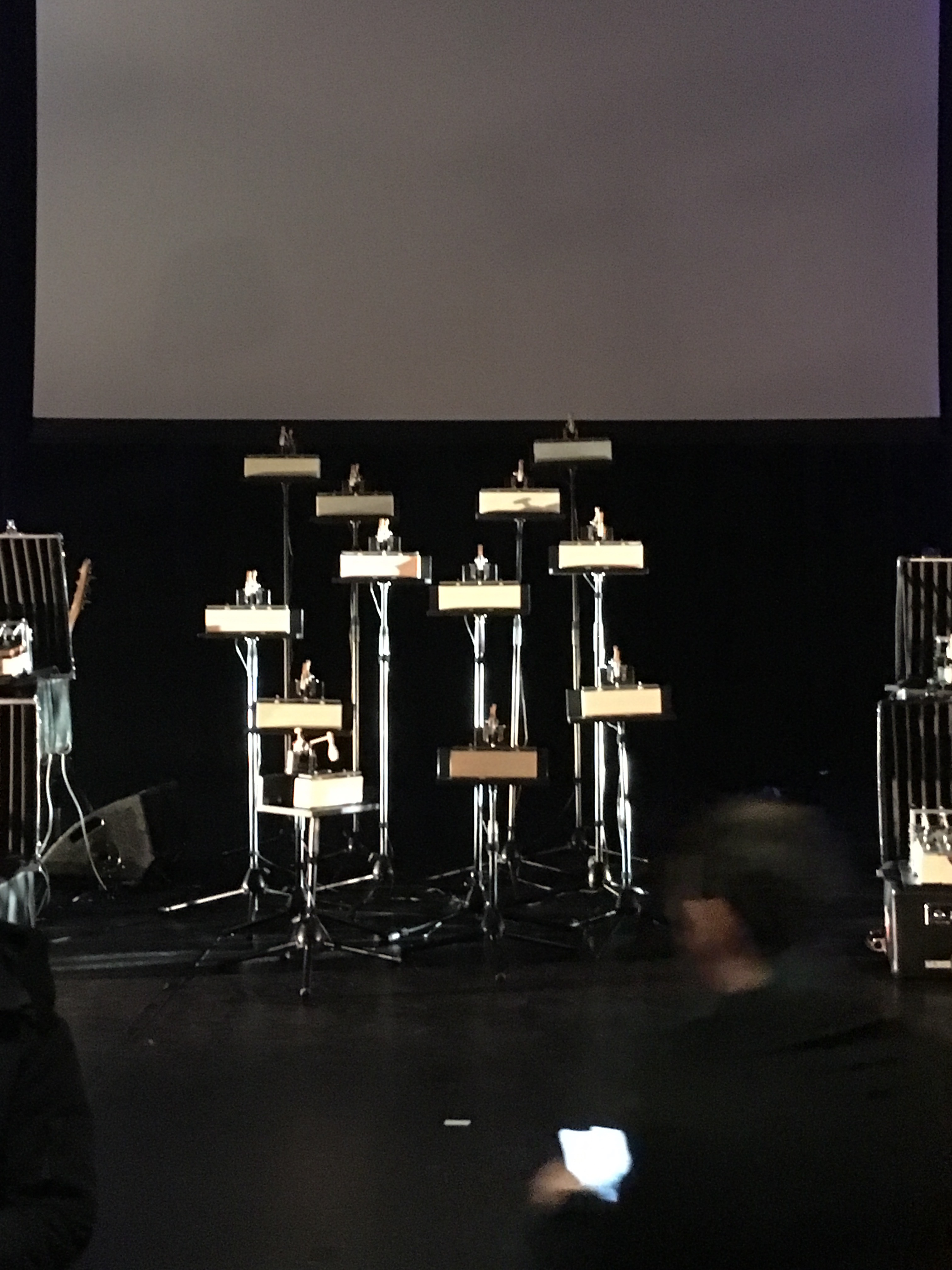
Gabriel faced a challenge with realising the many-layered sounds presented on Mountains And Plains for a live show without resorting to an unadulterated laptop playback non-performance. Instead, he painstakingly crafted a series of electrically-controlled automata housed in old-fashioned travel trunks that could be triggered to perform melodies alongside his and his Rotem Haguel’s playing. Watching a drum kit play itself on a piece like ‘South 61 West 14’ was a strange delight to behold, the kind of stuff of dreams or episodes of Bagpuss. One imagines that Luigi Russolo and his merry band of Futurists would have approved.

Watching the machines, which occupied centre stage with Haguel and Gabriel flanking them, was nothing short of mesmerising, reminiscent of Victorian player-pianos and fairground organs yet positioned within an ultra-modern context. Hearing the machines play the haunting, filigree passages of ‘Piety Wharf’ or ‘Abiquiú’, accompanied by visuals of the environments that Gabriel and his wife Pippa observed on their road trip across America was moving in a plaintive, unexpected way.

Gabriel concluded his performance with a twenty-minute concluding extract from his second Stubbleman release, titled 1:46:43. The suite is named after his best time on Mont Ventoux, and its inputs were the various metrics his bike’s onboard computer recorded throughout the best part of two hours of hard peddling – heart rate, cadence and so on – which Gabriel then turned into electronic sequences.

The extract was given extra poignancy by Gabriel’s explanation that his composition was also informed by the abortive climb of Mont Ventoux by British cyclist Tom Simpson, who died a short distance from the peak during the 1967 Tour de France. The music taken from 1:46:43 could immediately be linked to the stylistic poise of Mountains And Plains while taking on a hypnotic, meditative edge and restless drama that nodded firmly in the direction of Philip Glass and Terry Riley.

Ahead of the show, SFT has remixed ‘Abiquiú’ from Mountains And Plains.

Pascal Gabriel: keys, modular synth, Artiphon, theremin, foot controller

Rotem Haguel: bass, Moog Sub Phatty

Watch the rehearsal video below.

Read my interview with Pascal Gabriel here. Read the review of Mountains And Plains here.

(c) 2019 Documentary Evidence

Andy Bell Is Torsten In Queereteria TV (Clash feature, 2019)

The third instalment of Barney Ashton-Bullock’s Torsten series kicks off at Vauxhall’s Above The Stag theatre on April 10 and finds Erasure’s Andy Bell once again taking on the role of the half-Norwegian, half-English polysexual semi-immortal Torsten.

Amid the maelstrom of press interviews that Bell has undertaken to support Queereteria TV, managed to get some time with Andy and Barney during rehearsals to talk in detail about the latest postcard from the hotspots of the 114-year old Torsten’s memory.

My interview went live on the Clash website earlier today and can be found here. A longer version will appear here on Documentary Evidence during the show’s run.
Queereteria TV runs at Above The Stag from April 10 to April 28. Tickets are available at abovethestag.com. A new album, Andy Bell Is Torsten In Queereteria is released by Strike Force Entertainment on April 12.

(c) 2019 Mat Smith / Documentary Evidence for Clash

Small Doses 7 – Rema-Rema

Small Doses 7 – courtesy of Iv/An

And you thought that getting a copy of Rema-Rema’s Wheel In The Roses EP was like trying to locate rocking horse shit: in a painfully small edition of just 100, issue seven of Iv/An’s obsessively detailed, intensively-researched and beautifully-designed Small Doses is entirely devoted to telling the absolutely definitive story of a band who had already fragmented when their solitary EP was released, an act which simultaneously launched the 4AD label and which also started in motion the ongoing mystique and mythology surrounding the group.

For Iv/An this is, first and foremost, a highly personal endeavour and a work of love as a fan of the group; because of that this issue intertwines his own story of becoming intrigued by Rema-Rema with the story of the band.

Featuring interviews with four of the band’s five members (Mick Allen, Dorothy ‘Max’ Prior, Mark Cox, and Gary Asquith) providing a comprehensive first-hand account of the band’s history, unseen photos, a discography including compilation appearances and cover versions and a ‘family tree’ showing where the members of Rema-Rema came from and where they went onto after their eleven gigs and solitary EP. The fanzine is accompanied by a CD-R of unreleased recordings by the band culled from demos and live rehearsals, all sequenced into a single piece brimming with white heat and blistering energy.

Small Doses 7 – courtesy of Iv/An

More information on the new issue will be made available at Iv/An’s 0.5 Facebook and Bandcamp pages on May 1. I already have a copy. It’s signed by Gary and I’m not selling. Don’t even ask.

The latest issue of the fanzine comes hot on the heels of 4AD’s overdue Fond Reflections by Rema-Rema – a collection of unreleased live tracks, demos and studio material from the same rich archive as the Small Doses CD-R that approximates what should have been the band’s 1980 debut album, assembled by Gary Asquith and Takatsuna Mukai and released earlier this month.

The album’s launch was supported by a live Q&A with Max, Mick, Gary and myself at London’s Rough Trade West, just a few hundred metres from where they recorded their first demos in a Portobello Road basement on a tape recorder borrowed from Hazel O’Connor.

Rema-Rema and Mat Smith at Rough Trade West, March 1 2019 – Q&A for the release of ‘Fond Reflections’. L to R: Mat Smith, Gary Asquith, Max, Mick Allen. Used with kind permission of Trevor Pomphrett.

(c) 2019 Mat Smith / Documentary Evidence

Camp Christmas (Channel 4 broadcast, 24 December 1993)

Title from ‘Camp Christmas’.

Twenty years BSG – Before Snow GlobeErasure‘s Andy Bell and Vince Clarke participated in Camp Christmas, an alternative Christmas show broadcast by Channel 4 on Christmas Eve 1993. The broadcast formed part of the British broadcaster’s New York-themed suite of programmes that evening, though what Camp Christmas‘s connection to that was now seems lost forever. (I only even remember that because the ident for Channel 4’s NY Christmas programming theme was to be found at the start of my VHS recording.)

Camp Christmas was hosted by Andy Bell and Melissa Etheridge and saw the pair shacked up in a log cabin amidst a seasonally snow-filled studio set, joined on their Christmas vacation by Julian Clary’s wisecracking wall-mounted reindeer head, director Derek Jarman (who died from an AIDS-related illness early the following year) and footballer John Fashanu. Christmas video messages were included from Martina Navratilova and Ian McKellen, the New York Gay Men’s Chorus delivered a humorous song from the Wollman Rink in Central Park while Lily Savage played the role of the party’s hapless caterer.

East 17 made an unlikely appearance – unlikely because they were more or less the only participants on screen who weren’t gay – and Quentin Crisp delivered a soliloquy based on an alternative version of Dickens’ A Christmas Carol. In a programme filled with strange moments, Simon Callow (currently performing his own one-man Dickens show at London’s Arts Theatre) delivered a bizarre hybrid of Shakespeare and panto which is probably not the highest point in his career as an esteemed thesp.

Vince worked as the ‘musical director’ for the broadcast, aided by Martyn Ware and Phil Legg – essentially the team that worked on the I Say I Say I Say album that would get released the following year. The songs for Camp Christmas were recorded in the same sessions with Ware and Legg.

Andy sang three songs with Etheridge (‘Walking In A Winter Wonderland’, ‘Sleigh Ride’ and a very special rendition of ‘My Favourite Things’ from The Sound Of Music), a lovely solo rendition of ‘Take Me To The Emerald City’ from The Wizard Of Oz and ‘Have Yourself A Merry Little Christmas’, joined by the assembled studio cast on the final chorus. It’s fair to say that the musical moments are the points where Andy seems at his most comfortable, and Vince’s accompaniment is nothing short of lovely, blending wintery chill with analogue wackiness as only he knows how.

Still from Andy Bell singing ‘Take Me To The Emerald City’.

Music to one side, Camp Christmas manages to work its way from sublimely daft to frankly cringe-worthy. One such audacious moment comes with Pam St. Clements – Pat Butcher from EastEnders – pretending to be a fairy on a Christmas tree, delivering a song I don’t recognise about farting. It’s ludicrous, naturally, but Vince somehow managed to work his magic effortlessly, even on such a ridiculous piece of over-the-top cabaret.

Channel 4 have always had a reputation for adventurous programming, and Camp Christmas was unlike anything else that had been broadcast up to that point. Adventurous as it was for its time, and despite some dodgy moments, Camp Christmas was also pretty funny in the same way as a pantomime can have you rolling about in the aisles. And that’s in spite of some appearances that are every bit as wooden as the shack they’re supposed to be holidaying in.

vhs_campchristmas

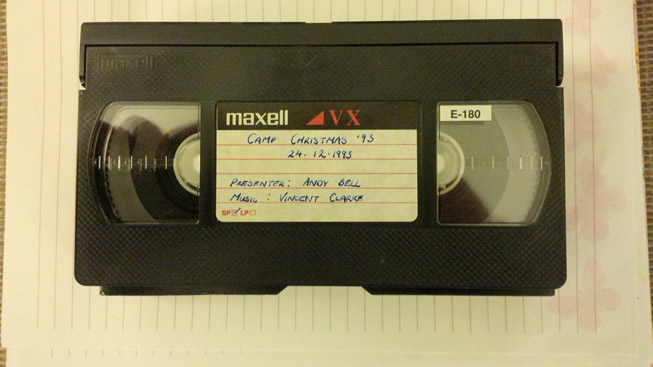
My VHS recording of ‘Camp Christmas’, 24 December 1993, complete with neat teenage fountain pen handwriting.

Thanks to Martyn. Several YouTube rips of the broadcast can be found online, as can bootleg recordings of the Andy Bell songs.

First posted 2013; re-posted for the holidays 2018

(c) 2018 Mat Smith / Documentary Evidence