
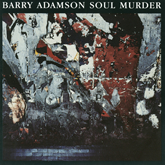
mute records | stumm105 | 1992
Released in 1992, Barry Adamson‘s second Mute Records album proper is also perhaps his darkest, most cinematic to date. Beginning as all stories should with a ‘Preface’, Adamson sets the scene of murder and crime with a sample of a convicted brother detailing his list of crimes and misdemeanours, before Adamson kicks in a short burst of dramatic strings; the track concludes with either a vintage movie sample, or a heavily-aged new one – ‘Sorry to disturb you Mr Adamson.’
The album begins in earnest with a classic Adamson spoken word monologue on ‘Split’, referring to himself as El Deludo, Mr Moss Side Gory and Harry Pendulum, all over a lush jazz backdrop dripping with pianos, brshed cymbals and rousing horns. ‘There’s a light at the end of the tunnel,’ concludes Pendle. ‘When you see it that means that you’re dead.’ ‘The Violation Of Expectation’ is mysterious and beautiful – simple piano clusters over synth chords and a characteristic pallette of juxtaposed sounds. The introduction of a watery, distorted voice humming away to some unrecognisable tune runs a chill through this track that is partially leavened by the isolated sounds of crashing waves that conclude the track. ‘Suspicion’ features some solid Public Enemy-style gritty, industrial hip-hop beats, over which high octave keyboard melodies are layered.
‘A Gentle Man Of Colour’ is a truly disturbing story of prejudice in the vein of Harper Lee’s To Kill A Mockingbird – a black man is wrongly accused of a crime against a white woman, leading a mob of men to torture and ultimately burn him to death. The story is delivered as a news report by Marcia Schofield, while Adamson provides the narrative with a backdrop of incidental sounds. This is followed by ‘Trance Of Hatred’, an outwardly gentle piece for vibes and strings, counterweighted by a sample of what could be an armed gang robbery scene from a movie.
The frantic pace of the six minute ‘Checkpoint Charlie’, with its layers of keyboards and swirling, tense melodies reminds me very much of the opening music by Ennio Morricone for Oliver Stones The Untouchables. ‘Reverie’, in contrast, is a piano and xylophone work of melancholy beauty rendered in waltz time. The addition of some serene synth pads give this a soaring, moving quality, and it is hard not to to be touched by its serenity. ‘Un Petit Miracle’ in contrast is throwaway twee Gallic pop, featuring innumerable Casio presets, whistling and a innocent vocal from Pascale Fuillée-Kendall.
‘007, A Fantasy Bond Theme’, in contrast, is one of Adamson’s most humour-filled pieces. Setting the scene, Adamson drops in a narration by Arthur Nicholls detailing a Jamaican – James Bond – who believes he is Ian Fleming’s spy hero; ‘Bond…is black!‘ he tells us, in a stroke of genius wordplay. Monty Norman’s famous theme is here delivered with a skanking rockers beat and ska vibe – ludicrous and marvellous in the same breath. ‘The Adamson Family’ features vibes and some very sixties organ, the jazzy tones and cinematic strings, while ‘Cool Green World’ – with its MOR keyboards – could have been lifted from the soundtrack to an Eighties romantic comedy; it has a wholesome, family feel – imagine tree-lined wide pavements in some US suburb, immaculate front gardens, the leaves collecting in the gutter as summer turns to autumn – until the final minute and a half, where the key changes subtly, casting a darkening shadow over the track.
‘On The Edge Of Atonement’, a slowed-down pairing of jazz and gentle strings to the same theme as ‘Reverie’, with gospel vocals from Sarah Bower, Deloray Campbell, Peter Francis, Patricia Knight and Caron Richards, has a drifting, romantic tone and a capacity to uplift. ‘Epilogue’ closes with the same angry brother and strings as ‘Preface’, closing off a dark and mysterious addition to Barry Adamson’s catalogue.
First published 2004; re-edited 2014.
(c) 2014 Mat Smith / Documentary Evidence
 Documentary Evidence