Sketching Venus – lvu (Edvard Graham Lewis Venursion)

One of the great pleasures of my Mortality Tables collaborative projects is being able to collaborate with artists who’ve released material through Mute. So far I’ve worked with Vince Clarke, Simon Fisher Turner, Gareth Jones and Maps, and there are several more collaborations in the works.

Yesterday, I released a new / old release which included a completely new version by Edvard Graham Lewis (Wire / He Said / Dome etc).

Full press release details below.

///

In 2000, I made an album under the alias Sketching Venus. Hardly anyone heard it, and that’s how it should probably stay.

While revisiting and archiving old files, I came upon one track from the album, ‘lvu’, which stood out, and which I felt like I needed to do something with. It is unique, in the sense that it is the only song where you’ll hear me singing. It is also unique within the sound pieces that I’ve made over the years, in that every highly processed sound was made with a guitar.

Specifically, it was my ex-girlfriend’s guitar who I’d messily broken up with during the Millennium celebrations. ‘lvu’ was made at the very start of a new relationship, with my future wife. I think of it as a reflection on endings and beginnings.

Around this time, I was listening to a lot of Wire. My lyrics and vocals were a crude attempt to channel the band’s songwriter, bassist and occasional vocalist Edvard Graham Lewis, who has created a new version of ‘lvu’ that includes his own vocals.

The single is rounded out by a hypnotic remix by frequent Mortality Tables collaborator Rupert Lally.

Available at  mortalitytables.bandcamp.com

[1] lvu (Original Version)
[2] lvu (Rupert Lally Remix)
[3] lvu (Edvard Graham Lewis Venursion)

‘lvu’ originally appeared on the mostly unavailable Sketching Venus album svUTLD01abm (NominalMusics, 2000).

released March 28 2025 

[1] Written and produced by Mat Smith (2000) 
[2} Additional production and remix by Rupert Lally (2024) 
[3] Additional production and vocals by Edvard Graham Lewis (2025). Edvard Graham Lewis appears courtesy of Upp Records. 

Mastered by James Edward Armstrong 

Original photography by unknown photographer, Orlando, FL on 5 September 2001 

[1] Design and image processing by alka 
[2 + 3] Design and image processing by Andrew Brenza 
[3] Image re-processing by alka 

A Mortality Tables Product 
MTP38

Words: Mat Smith

(c) 2025 Mortality Tables / Documentary Evidende
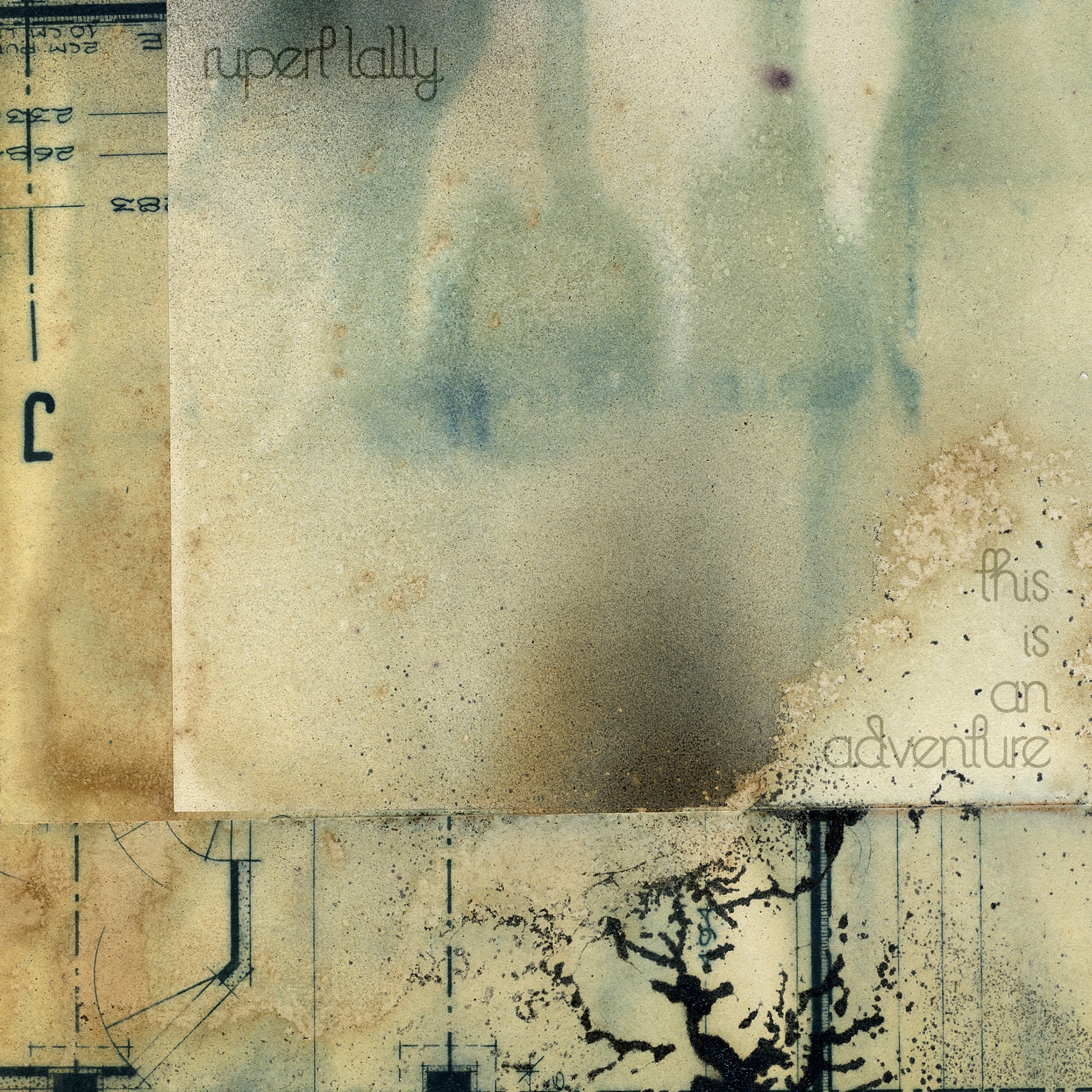
Rupert Lally – This Is An Adventure (album, 2018)

cover

Long-term readers of my blog will know I’ve often championed the work of Switzerland-based electronic musician Rupert Lally, who has a string of solo albums to his name, as well as a number of collaborations with Mute alumnus Espen J. Jörgensen.

I reviewed Lally’s superb new album This Is An Adventure for the Cold War Night Life website. My review can be found here.

(c) 2018 Mat Smith / Documentary Evidence

Rupert Lally / Espen J. Jörgensen – Øde (No Studio album, 2017)


The work of Rupert Lally and Espen J. Jörgensen is a lot like a tabloid-friendly romance. The duo have consciously uncoupled more than once, only to reform again each time. There’s no animosity, no conflict, just a compulsion to continue pushing out albums and to keep collaborating whenever they feel like it, typically followed by mutterings that each will be their last project together.

The result of this on-off-on again approach is a series of interconnected albums where the only connection is a firm willingness to do whatever feels right at that particular time. The pair have traded in ambient soundscapes, touched on pop and even mucked around with guitars. From a distance, being so outwardly inconsistent in terms of style could be decried as an incoherent vanity or therapy project never intended to be heard outside of the duo themselves; the reality is instead a rich seam of new ideas and new approaches, largely arising as a result of never physically working together in the same place as one another.

The 25-track Øde’s precedent lies in Lally’s last two solo albums, Day One and Scenes From A High Rise, both of which made heavy use of modular synthesis in their rich sound design, and both of which found Lally’s music taking on a somewhat uncharacteristically dark hue. Øde pushes that darkness to an extreme, the result being a nervous, edgy, tense affair full of cloying atmospheres and a panic-inducing analogue buzz about the sequences.

It would be tempting to view Øde as being a sonic representation of the parlous state of the world right now. Lots of such albums have begun to emerge as musicians variously attempt to direct their anger and resentment through their music; being mostly instrumental, Øde can’t rely on lyrical gestures to make its point. Instead, the album does a commendable job of encapsulating what it feels like to be living through all of this: the feeling that there’s something in the air, something restless, something not quite right that could develop into something far worse if not kept in check. Not for nothing does the album open with a tone-setting piece of sound design – echoes, muffled feedback, a tired voice – called ‘Getting Darker’.

While a lot of Øde relies on modular synth work, the album’s construction from lots of short pieces allows for a multitude of brief ideas to flourish, ranging from orchestral arrangements to wonky hip-hop, filled out by glitchy static and borrowed atmospheres. The pair have always traded voraciously in the markets of eclecticism, but never quite so liberally as they do here. No idea is allowed to develop into repetition, and yet each idea is developed just enough to avoid feeling like a collection of unfinished sketches. The approach feels highly democratic, as if each idea is afforded equal airtime in the album’s debate with itself.

Whether this represents another final album among final albums remains to be seen. If it is, Lally and Jörgensen may have just delivered their definitive statement; if not, what you are listening to here is surely part one of the soundtrack to the end of the world, as realised by its self-appointed resident composers.

Øde is released via Bandcamp – rupertandespen.com

(c) Mat Smith / Documentary Evidence

Espen J. Jörgensen / Rupert Lally – Paradise Once-inspired artworks

Artist Enrico Maniago has produced some artworks to accompany Paradise Once, the latest chapter in the ongoing distance collaboration with one-time Simon Fisher Turner accomplice Espen J. Jörgensen and Switzerland-based musical polymath and forgotten film buff Rupert Lally. Paradise Once was released on Espen’s No Studio imprint last summer and I reviewed the album for Electronic Sound.

Check out the art in this YouTube video.

Meantime, Lally has released a superb suite of modular synth pieces (Day One; review forthcoming) and found the time to set up a movie blog, which you can reach here.

(c) 2016 Mat Smith / Documentary Evidence

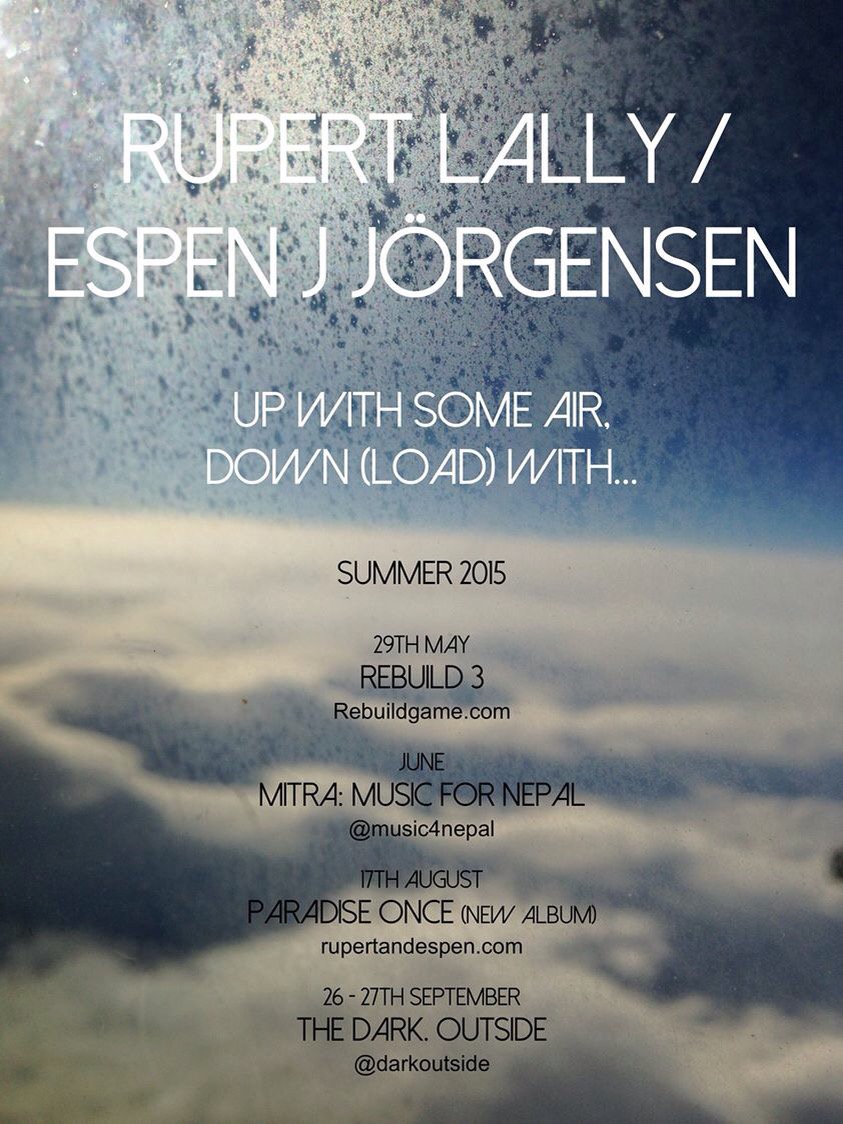
Rupert Lally & Espen J. Jörgensen: Paradise Once and a Busy Summer


Long-time collaborators Rupert Lally and Espen J. Jörgensen are set for a busy summer, with contributions to Stuart McLean’s The Dark Outside event, the worthy Mitra – Music For Nepal compilation, the soundtrack to the Rebuild 3 game and a new album, Paradise Once. Check rupertandespen.com for more details.

(c) 2015 Mat Smith / Documentary Evidence