Back in the day, Alison Goldfrapp could occasionally be found adding her vocals to all sorts of tracks, the most prominent of which tended to be by Orbital and where, for no discernible reason, she went under the name ‘Auntie’. One of my favourite pre-Goldfrapp Alison Goldfrapp collaborations is this track with Massive Attack alumnus Tricky. I can’t fathom a word she’s saying since it has that jazzy wordless style that Orbital liked to deploy as a textural component of their tracks, but which is here presented as a foreground to this sluggish trip-hop piece. Her strange, Shirley Bassey-esque vocal is the perfect foil to a delivery from Tricky that rasps with a stoner’s ramblings. In the background, the samples run from folksy ethereality (something Goldfrapp would investigate years later with Seventh Tree) and a scratchy grunge passage not dissimilar to Butch Vig’s mix of Depeche Mode’s ‘In Your Room’. It might not be patch on other tracks on Maxinquaye, but it all adds to the quiet confidence exuded by Tricky on his first solo record.
Elsewhere on the album, occasional Mute producer and Rhythm King stalwart Mark Saunders adds his production nous to most of the tracks here, including the seminal, much-quoted ‘Brand New You’re Retro’.
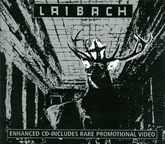
Recorded in London in 1985 with, among others, Mute regular Richard ‘Rico’ Conning, the 2002 reissue of Nova Akropola is an excellently-presented special edition gatefold digipak from Cherry Red Records, and captures Laibach just prior to their Mute releases.
The album begins with ‘Vier Personen’ (‘Four People’), a veritable shot to the head comprising barked, parade ground orders and militaristic drumming, over which an electro-industrial drum machine pattern is repeated, slowly developing as additional banged pipes and other sonic detritus is introduced. A grim and slightly sinister track, this opener adequately sets the tone for the remainder of the album.
‘Nova Akropola’ (‘The New Acropolis’) takes the dark tone of the opener, but deploys strings (keyboards, judging by the repeat points) as the main carrier of its emotion. Horn refrains and a slow, reverberating drum pattern create a filmic atmosphere, with the trademark ‘devil voice’ vocals making their first appearance; the track feels mournful, funereal, conveying plenty of rage and sadness in its minimal sonic palette. Pounding Nitzer Ebb-style drums introduce ‘Krava Gruda – Plodna Zemlja’ (‘Bloody Ground – Fertile Land’), a percussive electronic and machinery-driven vocal track conjuring up memories of Einstürzende Neubauten‘s earliest experiments with air cylinders and heavy construction equipment. Unlike the previous two pieces ‘Krava Gruda…’ has several different themes, rather than a central, developed refrain.
Beginning with some organ discord, ‘Vojna Poema’ (‘War Poem’) quickly develops into an operatic piano song extremely reminiscent of some of Bertolt Brecht and Kurt Weill’s compositions. Baritone vocals are mixed with what sounds like a full orchestra towards the end of this 1920s-styled piece of avant-cabaret. If ‘Vojna Poema’ was a departure from the earlier tracks on this album, ‘Ti, Ki Izzivas (outro)’ quickly returns us there – layers of stark percussion stalk through this short piece, fading out into ‘Die Liebe’ (‘The Love’), perhaps the closest to some of Laibach’s later Mute output: faster-paced and more aggressive, with those sinister vocals casting a dark shadow on the repeated phrase of the title. The track also features a wider array of electronic sounds, with one of the central melodies recalling Monty Norman’s James Bond theme, once again reinforcing the ‘extreme soundtrack’ atmosphere of this album.
‘Drzava’ (‘The State’) sounds like a twisted take on the electro genre, wherein Mantronix-esque drum programming is mixed with horn flourishes and orchestral-style loops (sampled, I presume), and also features some vocal samples that appear to be of political speeches. The track is one of the liveliest on this album; certainly not euphoric, the track is just one or two shades lighter on the colour chart than the black of the previous material. The accompanying promotional video with dancer and some-time Wire collaborator Michael Clark is fantastically bleak, perfectly rendered in monochrome colours. ‘Vade Retro’ is positively terrifying, its rhythm recalling some sort of alternative version of the Terminator soundtrack as conceived by Throbbing Gristle. The ‘vocals’ here are otherworldly, alternately wheezing and ghostly and scratchy and insistent; the ‘melody’, on the other hand, appears to be church bells mangled and heavily-processed to near oblivion. Perhaps the most aggressive and extreme track here, ‘Vade Retro’ is an exciting collage of sounds that pushes Laibach into electroacoustic territory.
‘Panorama’ ushers in on kick drums that appear to have been borrowed from New Order’s seminal ‘Blue Monday’. Extensive use of synths and percussive samples make this one of the more accessible tracks on the album – the rhythm is tight and the sounds are less obviously harsh. At around three minutes, the track pares back to some percussion loops and spoken word English reportage, before quickly reassembling itself. The final track (‘Decree’) once again begins with some sampled marching band drums, over which another electro break is layered. With the exception of some fairly random atmospherics and the odd sample, the track seems to be nothing more than a stop-start percussive experiment or remix of a more complete work. Despite its absence of more concrete ideas, the track is strangely captivating, although you do feel that this represents something of a filler, a space that would have been better filled with a track more in keeping with the extreme sonic soundscapes elsewhere on the album.
Originally posted 2003; edited 2017
Notes: this was a pretty important review for me, as it represented one of the first times I’d been sent a free CD just to be able to review it. I was amazed at the time that Cherry Red responded to my email at all, let alone that they would part company with a batch of catalogue stuff just so that I could write about it for a website – my own – that was just launching and which was so niche it was never going to attract any readers. Whenever I take the notion of receiving music in my inbox every day via various PR firms for granted, I think back to how fortunate I was that Cherry Red sent me this and other CDs, even though this one has now been sold out of my collection.
Issued by Mute in 2003 to house the various formats of the ‘Twist’ and ‘Train’ singles by Goldfrapp. I’m selling both of these. They can be found on eBay here and here.
‘Is it so wrong, to break from your kiss to turn up a pop song?‘ is the ethical question posed by Art Brut‘s Eddie Argos on the third single to be taken from the band’s 2007 album, It’s A Bit Complicated. The song is an emotional, tender song that manages to merge youthful sexual experiences with a passion for records that seems to eclipse the singer’s interest in the former. Hence the question about whether it’s fine to be as focussed on the music coming from a radio as it is on the, ahem, job at hand. Throughout, Argos manages to paint a vivid image of teenage bedroom awkwardness while big, punked-up clanging guitar riffs and soulful harmonies dominate. The more I listen to Argos’s semi-spoken, semi-sung delivery, with all his clever double meanings and casual observations, the more I think of him as a poet rather than an accomplished indie band’s frontman. The answer to the question, by the way, seems to be a very firm ‘no’, judging by the reaction of the girl in the song.
Released as a single track download the year after the album was put out by Mute as part of EMI / Labels, like all of their material from this period it is no longer available on iTunes. Whether that’s anything to do with the band apparently not knowing it was even being put out is anyone’s guess. This is what Argos posted to the band’s website at the time: “It seems Art Brut have accidentally released a single. Yes, the rumours are true. But how could this happen, you may ask? Why were we not informed? Well, my friends, pick up any thread of incompetence and it will usually lead you to a record company. That’s right, it seems EMI have decided to release ‘Pump Up the Volume’ without informing either the band or myself, making any kind of widescale promotion rather difficult.”
Thanks to Z for help with the preparation for this review.
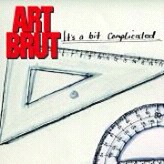
‘Direct Hit’ was the second single to be taken from Art Brut‘s album It’s A Bit Complicated which was released and marketed by Mute as part of the Labels arrangement with their then-parent EMI. Packaged in a sleeve that evokes school maths lessons (designed by the band and Mute’s art director Paul A. Taylor), ‘Direct Hit’ was released as a 7″ and two-track CD; a digital release was probably also put out, but sadly has been removed from iTunes.
‘Direct Hit’ finds the band in feisty mood, spitting out faintly over-the-top AC/DC heavy guitar riffs that have no logical place on an indie record; Beach Boys wordless vocal harmonies blend in with frontman Eddie Argos‘s finest Colin Newman deadpan (‘here comes the really good bit,’ he says at one point, just like something straight off Wire‘s ‘Map Ref. 41N 93W’). There are also some rattling guitar interjections that wouldn’t go amiss on a mid-period Sonic Youth track, shouty chorus vocals, what sounds like a theremin, lots of instructions to get on the dance floor and move, and even some descriptions of social awkwardness. For a three minute song, that makes for a pretty busy little track and its relativel non-conformity gave some encouragement back in 2007 that perhaps the spirit of punk hadn’t been lost for good after all.
Across the CD and 7″ are two B-sides. ‘Dont Blame It On The Trains’ is an ode to staying in the house under a duvet, general laziness and snoozing the whole day away. ‘What am I doing this weekend? Avoiding phonecalls from all my friends,’ runs one of the best couplets on a track that has a musical palette that feels like Blur attempting a cover of The Velvets’ ‘Sister Ray’ in a ‘Parklife’ stylee. The It’s A Bit Complicated album includes a track called ‘Blame It On The Trains’ which is nothing like this. Over on the 7″, the fantastically-titled ‘I Want To Be Double A-Sided’ is an emotional paean to love and insecurity over a rough, garagey groove. Argos’s vocals were apparently recorded on a the tour bus by Mikey Breyer in a car park, all of which gives this the feel of a pencil sketch, and it’s all the more lovely as a result.
By rights, this isn’t actually a ‘Mute‘ record at all – it’s one of those EMI releases that Mute marketed, and so it doesn’t carry a Mute catalogue number. It formed part of EMI’s valuing of Mute as a vehicle for representing music from the indie underground, and it said much – to me – about the future direction of my favourite label at that time. It’s hard to listen to this rather angular slice of spiky guitar pop and find any other reference point within the Mute roster of years gone by with which to compare this, apart from maybe 13th Hour band Foil if you squint hard enough.
The Mute website proudly claimed that this single had one more ‘Nag’ than Cabaret Voltaire, which of course is totally true, but it seems like a pointless point of reference since Art Brut are the complete antithesis of the Cabs’ industrial ethic. But, criticisms aside, ‘Nag Nag Nag Nag’ is a brilliant example of why 2006/7 was a really exciting period for UK music. Art Brut specialised in acerbic, near-spoken word vocals from lead ‘singer’ Eddie Argos, dark guitar melodies and furious drumming. ‘Nag Nag Nag Nag’, whilst in its own way uplifting, is intense and relentlessly negative – ‘a record collection reduced to a mixtape‘ is just about the most dispirited thing I’d heard in a song since Joy Division, while also anchoring this into a distrust of the iTunes era.
B-side ‘I Found This Song In The Road’ continues the theme, finding Argos tapping thoughts into his phone and leaving ‘eighty messages saved and unsent‘; the ultimate act of digital cowardice perhaps, but cathartic nonetheless. Something in the delivery reminds me not just of Foil, but of Wire‘s Colin Newman, but there’s no denying that Art Brut were ploughing their own furrow back then and it was an exciting thing to hear.
central control | postcard-flexi/dl no cat ref | 03/09/2012
Barry Adamson released ‘Brighton Rockers’ on his own Central Control label in September 2012. Released as a single track download and also as a limited-edition flexi-postcard record, all profits and additional donations are donated to the charity CALM, the Campaign Against Living Miserably, which seeks to reduce the suicide rate of men. More information on CALM, its aims and its plans to deal with the biggest killer of men under the age of thirty-five can be found at their website.
The ‘sleeve’ shows an idyllic Brighton blue sky and a pedestrian taking a break on one of the benches dotted along the promenade. The music is a nice heavy slice of solid dub reggae, all thunderous bass, staccato piano and reverb-heavy rhythms and interludes, with some authentic horns and organ lines washing into the mix at times. The inclusion of some soulful, meditative sax and tinkly jazz organ stops this from becoming too dub-derivative, creating a typically noirish Adamson take on the genre, and a hitherto under-explored area of Adamson’s musical interest. The result is something that sounds like an authentic, well-researched take on the dub template, whilst retaining an identifiable distinctly Adamson groove (and, in the title, his trademark wry sense of humour) at the same time.
The summer may sadly be all but over, but this track is just about the best soundtrack I can think of for kicking back and relaxing on Brighton’s pebble beach in the sunshine.
album // I Will Set You Free
central control international | lp+cd/cd/dl cci019 | 30/01/2012
Barry Adamson released the confidently-titled I Will Set You Free, his ninth solo album, on his own Central Control International label at the tail end of January 2012. The release followed an intense three years of shifting directions for Adamson, including writing his first piece of fiction (Maida Hell, included in the London Noir collection, for which he won the Best Short Story prize at Italy’s Piemonte Noir festival), releasing the highly lauded Back To The Cat album, returning to the stage with his first band, Howard Devoto‘s Magazine and releasing his first short film, the disturbing Therapist. During the interview accompanying Therapist, Adamson described feeling like he was treading water in the studio ahead of shifting his attention to the film project, creating music that was more or less Barry Adamson-by-numbers, inadvertently leading to a sense of nervousness about his latest album.
While it would actually be quite nice to hear a cinematic Adamson on record again, it’s evident from I Will Set You Free that recreating the dark mood of his earlier solo self is just not where his head is right now. The album only contains one piece that remotely evokes that forgotten vibe in the clever sound design of ‘The Trigger City Blues’, which includes sampled rainfall and gunshots interspersed with electronic pulses and squirming synth tones. Those poignant, dark alley whispered vocals of yesteryear Adamson usher in bluesy guitar riffs and opening-credit-sequence industrial hip hop beats. ‘The Trigger City Blues’ makes you think of the music to the scene in a heist movie where the bad guys and getting prepped for the big bank job, donning masks and sticking the guns in the unmarked van.
I Will Set You Free was crafted by Adamson (bass, vocals, programming) with Ian Ross (drums), long-standing collaborator Nick Plytas (organ) and Bobby Williams (guitar). Horns come from Sid George (trumpet), Steve Hamilton (tenor sax) and Harry Brown (trombone), a trio capable of turning out pretty much any jazz mood required by their band leader. In the main, I Will Set You Free continues the mood of albums such as Stranger On The Sofa, where Adamson as a front man and vocalist really came to fruition, here striking a balance between the outright acid rock of tracks like ‘Destination’ (released ahead of the album as a free download) with more emotionally sentimental pieces like ‘If You Love Her’. The contrast between the stately croon of the latter with the motorik-meets-white-hot punk of ‘Destination’ provides a neat overview of an album that finds Adamson operating at both extremes, between the loverman and the serpentine voodoo priest perched atop the dangerous, nihilistic bloodymindedness that characterises ‘Destination’.
Further explorations into dark rock come with the opener, ‘Get Your Mind Right’, which finds Adamson pitching in with a vocal somewhere between David Bowie’s archness and the stream-of-consciousness lurching of Shaun Ryder, augmented by typically frazzled organ from Plytas and glam drumming from Ross. In a nice stylistic shift, ‘Stand In’ is a wide-eyed Eighties-referencing towering pop track, replete with a nice elongated synth section that feels like Yazoo covering Kraftwerk; okay, so it feels nearly twenty years too late for a John Hughes movie, but it has a big sound and a catchy chorus that will stick in your head long after the track has finished its emotional motions.
Of the ballads, ‘Turnaround’ is probably the highlight, being an ephemeral, lysergic ballad shimmering with emotional outpourings. Adamson as a crooner is one of the most surprisingly confident aspects to his still comparatively recent development as a singer, finding his honey vocal enveloped with serene acoustic guitar and washes of dreamy synth strings.
Some of I Will Set You Free‘s best moments come in the form of two downright fonky tracks, ‘Black Holes In My Brain’ and ‘The Power Of Suggestion’. The former is delivered in a relaxed, jazzy vibe that for some reason reminds me of George Michael (don’t ask why, but for once it’s not a bad association) and a stretched-out bassline which could have been lifted wholesale from Marvin Gaye’s ‘Inner-City Blues’. ‘Black Holes In My Brain’ feels like a more organic Soul II Soul or another of those eclectic soul-jazz-hip-hop collectives from around the same time, all lumpy beats and soulful breeziness. ‘The Power Of Suggestion’, meanwhile, is sexy and upbeat, imbued with a summery warmth and sublime jazz piano lines. The track shuffles out over thick, chunky beats and and contains a theatrical swing that feels like it would suit a remake of Bugsy Malone.
I Will Set You Free has an embedded self-assuredness that suggests Adamson can turn out a leftfield rock album pretty much in his sleep these days. Whilst irritating reviewers like this one may well pine for those noir days of cinematic classics like Moss Side Story, there’s no denying that the path that Barry Adamson is singularly marking out for himself right now will continue to be littered with obfuscations, contradictions and further questing within his future projects, whatever they may prove to be. The press release talks of Adamson being released from shackles, and that is exactly how this album sounds; free, effortless and typically idiosyncratic.
from the penman press: cat werk imprint | box+cd cw010 | 07/2016
angleterror original digital release: cat werk imprint | dl cw002 | 01/11/2011
From The Penman Press by Paul Kendall is nothing short of beautiful. Housed in a minimalist brown cardboard box with simple lettering, this is a work of art – a statement – even before you’ve prised off the lid.
Inside, you’ll find unique hand printed A5 images, all monochrome and appealingly spartan, each representing a painstaking letterpress experiment by Kendall. It’s like looking at what Bridget Riley might have delivered had she focussed on designs for abstract architecture instead of headache-inducing artistic mindfuckery.
What’s all the more appealing about the starkly minimal prints is how at odds they are with Angleterror, the Paul Kendall album included within the box in a newly sparkling remastered form by AGF (Antye Greie / Antye Greie-Fuchs / Antye Greie-Ripatti). Angleterror was originally released in 2011 as a Bandcamp download, and has never been issued in a physical form. It would be somewhat disingenuous to describe Angleterror as a sprawl, but in its dense layers and skipping tendency to veer with jump-cut precision from one idea to the next – inventively, never restlessly – it is the maximalist antithesis of the artwork; the yin to its yang, even.
From The Penman Press was issued in a run of just 100 copies, most of which should have now been sold given how captivating it is. Check here to see if you can still get one.
Promotional videos for ‘Glass Eye’ and ‘Aspirateur’ can be found below. Below those you’ll find my own, newly remastered, review of Angleterror from 2011.
Paul Kendall will be a familiar name to any Mute fan thanks to his credit as an engineer, producer and mixer on many releases over a thirteen year period that stretched from 1984 to 1997. PK, as he was known, seemed to work with most artists on the label in one capacity or another across Mute’s electronic and non-electronic roster, and those initials on a release always seemed to mark it out as very special indeed.
Kendall as a musician, rather than studio guy, was something that wasn’t really heard in earnest until he started the Parallel Series label as an off-shoot of Mute, releasing four compelling collaborations with Andrei Samsonov, Simon Fisher Turner, Bruce Gilbert / Robert Hampson and also The Faulty Caress (under the alias Piquet), before splitting the sub-label off for one post-Mute release (a collaboration between Kendall and Olivia Louvel, Capture, as The Digital Intervention in 2003). Kendall then headed off to work with ex-Depeche Mode man Alan Wilder‘s long-running Recoil project.
Angleterror was originally released as a digital download in 2011 on the Cat Werk Imprint run by Olivia Louvel. The seven tracks presented here were mostly recorded between 2002 and 2007 when Kendall was living in Paris and find him exploring some pretty harrowing soundscape and contemporary concrète works that are every bit as un-nerving as the picture of the indeterminate creature on the sleeve.
Central to the album are four pieces – ‘Glass Eye’, ‘Betricht’, ‘Wheel’ and ‘Call Of Wild – that feature David Husser’s guitar. Husser completed the Shotgun mix of Recoil’s ‘Prey’ which was released as a download in 2008, and also recorded a version of Depeche’s ‘Enjoy The Silence’ with the band Y Front. For these pieces, Kendall provided Husser with a series of pre-existing soundscapes and drone templates, over which the guitarist improvised; Kendall then treated the contributions as source inputs, re-editing and re-processing the outputs into the forms presented here. What’s interesting about this approach is the fact that Kendall’s final versions exist only because they were responses to Husser’s work, which in turn only arose as a response to Kendall’s original frameworks. It’s presumably the case that the pair could keep referring the responses back to one another indefinitely, creating works that would presumably be a huge distance from the original composed source.
‘Glass Eye’ has an almost Manuel Göttsching sense of melodic repetitiveness; raw electricity bursts pass over bass clusters and almost bluesy chord changes; tense, strangled guitar sounds leap upwards and are sucked back into the noise bed that’s developed. There’s a rough beauty about ‘Glass Eye’ particularly when it coalesces into a kind of mesmerising, beatless motorik rock just after the halfway mark. In complete contrast, ‘Wheel’ starts with pockets of whining sound before veering unexpectedly into a dirty blues with a nagging, simple beat and layers of low-slung axe wrangling punctured by randomised sonic events and abrasive noise interludes. It sounds like nothing else here, and as it fades back into the drone cycles that opened the piece, you can’t help but wonder if that extended blues section wasn’t just a slightly unsettling dream.
A different approach was taken on ‘Starvation’ and ‘Aspirateur’, which Kendall describes as being built from ‘first principles with guitar gestures as their source’. The guitar on ‘Starvation’ was provided by Guy Parker, while the identity of the guitarist on ‘Aspirateur’ isn’t identified, but its scratchy cut and thrust was inspired by sorely missed improv titan Derek Bailey. ‘Starvation’ is a stately waltz-paced piece built up from clattering IDM glitch-beats that develops rapidly into a punishing bass-heavy industrial electronica with lots of distorted bass noises and fast-paced switches between channels. Even though it probably never existed outside a computer there’s a sense of patches being forced into complicity, the segments where mere tracery is left and Guy Parker’s dark, cinematic guitar shines through suggesting the software couldn’t quite cope. The final dark ambient segment is how I expect Trent Reznor might attempt a soundtrack for a new noir version of Blade Runner directed by David Lynch. Sticking with cinematic imagery, ‘Aspirateur’ opens with what feels like a transmission from an abandoned spaceship drifting aimlessly through the galaxy, possibly harbouring some sort of terrifying alien lifeform – certainly the chilling processed breathing sounds and general sense of chaos in the intrusion of various sounds do much to enforce that sonic vision. It’s very dark, in a spine-chilling sense. You know what’s about to happen; it’s more a case of when.
The final track on the album, ‘Route 1 + 2’, was produced using a piece of software called Thonk which appears to have been a program that could process source inputs using complex algorithmic functions, often taking very long periods to deliver its outputs. Kendall believes that the source material for this may also have been a guitar, allowing us to contrast a parameterised software-based improvisor’s response to source material alongside that of David Husser on the four tracks he worked on here, at least in theory – if ‘Route 1+2’ began life with a guitar, there’s little evidence of that apart from a feint hint way off in the distance. The track is a series of scrapes, juddering noises and fractured sounds that skip and squiggle evasively around your ears, a maddening inner-body soundscape laced with a dose of lurking dread.
Kendall has engineered both of Olivia Louvel’s releases on Cat Werk Imprint – 2011’s award-winning Doll Divider and 2012’s o, music for haiku – both of which are highly collectible physical releases. With Angleterror PK proves once again that his inquisitive ear for sonic exploration remains undiminished. An almost-Burroughsian sliced-up video of Kendall talking about the album can be viewed below, complete with sagely spectacles, roll-ups and swanky coffee machines.
Art Brut‘s It’s A Bit Complicated was released and marketed by Mute as part of EMI / Labels. Consisting of Eddie Argos (vocals), Ian Catskilkin (guitar), Freddy Feedback (bass), Mikey Breyer (drums), and Jasper Future (guitar), Art Brut were a band unafraid to take musical cues from disparate parts of the rock music spectrum – metal, punk, ska, emotional power rock, you name it.
Their musical magpie tendencies were fronted by the truly original Argos, whose spoken vocals are both as punk as you can imagine while also having an unerring capacity for amusing couplets, wry observation and the sort of poetic musings that rarely find their way onto records, such as using late-running trains as an excuse for sleeping in; the closing track, ‘Jealous Guy’ – not the John Lennon song, just an opportunity to rob a good song title – finds an angsty, desperate Argos trying to wake up his girlfriend because he’s concerned that they don’t have sex any longer, getting manic and jealous that the same pattern didn’t emerge when she was with her ex. I can’t think of another band and vocalist capable of such dry, detached musing.
Elsewhere, there are preoccupations with pop music on the single ‘Pump Up The Volume’ and ‘Sound Of Summer’. The latter has a relaxed, laidback sound with a chorus that talks of making mixtapes, fetishising the act of pressing play and record, a process that pretty soon no-one will remember; in less optimistic fashion, there’s also negative talk about how all pop songs are about a boy meeting a girl but that the narrator’s life didn’t turn out that way. There’s also a small nod toward false optimism with a belief that taking the tabs out of a cassette will stop it getting recorded over. ‘Sound Of Summer’ links neatly to the single ‘Nag Nag Nag Nag’ which immediately follows, a song which is much less positive about reducing a record collection down to mere mixtapes; meanwhile, the Fratellis-esque ‘I Will Survive’ (another cheekily borrowed title) includes a line about selling a record collection just to pay for a party. Further cynicism comes through on ‘People In Love’ which finds Argos getting down on the whole love thing and its futility. ‘People in love lie around and get fat,’ he says in the song’s opening moments. Musically, ‘People In Love’ has nice Sixties references mixed in with dirty guitar. ‘Late Sunday Evening’ has a tidy Dexy’s ska-punk vibe – complete with brass from The Kick Horns (familiar from their contribution to Mute albums including Erasure‘s The Innocents) with ‘Love Cats’-esque jazziness. It makes for a refreshing, truly euphoric sound.
Two clear highlights emerge in the form of ‘St. Pauli’ and ‘Post Soothing Out’. The former features heavy, prominent bass from Freddy Feedback and Franz Ferdinand-style preposterous guitar riffs mixed in with raw, unbridled energy. ‘Sorry if my accent’s flawed / I learned my German from a 7″ record‘ is one of the best lines ever committed to a song, delivered in response to the chorus about punk music which is sung in faltering German. Like some of Graham Lewis‘s best lyrics, ‘St. Pauli’ jumps from one theme to another, here being a mix of talk about family, talk about love, and then the chorus about punk. ‘The kids don’t like it / What else can we do when the kids don’t like it?‘ ponders Eddie Argos with a shrug, all delivered over snarling effervescence. ‘Post Soothing Out’ possesses some truly fantastic riffs, as well as a few handclaps, and a mood that sits somewhere between joyfulness and breakup-inspired negativity.
It’s A Bit Complicated was produced by the band with Dan Swift, who had previously worked with The Futureheads, Snow Patrol and many others. The album would prove to be their only release for EMI / Labels / Mute, which may or may not have been something to do with EMI releasing the album’s third single, ‘Pump Up The Volume’, without any discussion with the band.




 Documentary Evidence