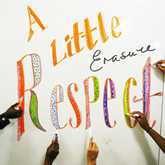
Erasure – A Little Respect (HMI Redux) (Mute Records single, 2010)

Erasure 'A Little Respect (HMI Redux)' download artwork

mute records | i mute451 | 05/12/2010

Erasure re-recorded what might well be their signature song, ‘A Little Respect’, in 2010. Released as a one-track download, the single was issued in support of the Hetrick-Martin Institute, a New York-based non-profit organisation for lesbian, gay, bisexual, transgender or questioning (LBGTQ) youths between the ages of 13 and 24.

The charity’s name is taken in honour of its founders, psychiatrist Dr. Emery Hetrick and NYU professor Dr. Damien Martin who founded the Institution for the Protection of Lesbian and Gay Youth (IPLGY) in 1979. The organisation was renamed following the deaths of its co-founders and states its aim as follows: ‘The Hetrick-Martin Institute believes all young people, regardless of sexual orientation or identity, deserve a safe and supportive environment in which to achieve their full potential.’ (Source: HMI website)

‘A Little Respect’ has always had an anthemic quality, whether in the hands of Erasure themselves or in the likes of Wheatus or the many other acts who have subsequently co-opted the song for themselves (and there are plenty). At its heart is a simple, understated message of defiance and a polite demand for equal treatment. As a spirited call to respect a person just because they don’t fit in, have a different sexual orientation, a different belief system or any number of personal values that might not quite fit with the homogeneity that is the so-called ‘norm’, ‘A Little Respect’ has a universally simple appeal and it lends itself perfectly to HMI’s laudable goals. It’s an organisation that Erasure’s Andy Bell is a major supporter of, hence the re-worked version of the track that he and Vince Clarke put together – aided by the Hetrick-Martin Institute Youth Chorus – with proceeds going to the charity.

Fans of the original Stephen Hague-produced track will no doubt bemoan the springy, updated new arrangement (which ditches Vince’s guitar in favour of a crisper beat and shimmering electronic palette), but Andy Bell could probably sing this backward and it would still sound just as uplifting. The addition of the choir inevitably reminds the listener of the crowd at Rangers who seem to have co-opted the track as an unofficial anthem, but some deep soulful ad libs at the very end brings this right back into the warm nod to Motown that many of the tracks on The Innocents carried.

More information on HMI can be found here. A video for the single was released and can be viewed below.

Thanks to Jorge.

Track listing:

i:
1. A Little Respect (HMI Redux)

(c) 2014 Mat Smith / Documentary Evidence

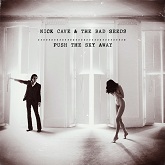
Nick Cave & The Bad Seeds – Push The Sky Away (Bad Seed album, 2013)

Nick Cave & The Bad Seeds 'Push The Sky Away' LP artwork

bad seed ltd | lp/cd/cd+dvd/box/dl bs001 | 18/02/2013

Push The Sky Away is the first Nick Cave material to emerge since he parted company with Mute in the wake of his terminated Grinderman project, and the first Bad Seeds album since 2008’s Dig!!! Lazarus Dig!!!. Now bereft of long-term arranger Mick Harvey, the Dirty Three multi-instrumentalist Warren Ellis steps in and takes the role vacated by Harvey; since 2007 Ellis’ playing has filled the void left by Blixa Bargeld‘s guitar, he was Cave’s foil in Grinderman and the pair have realised several soundtracks together, showcasing a symbiotic relationship that has produced some of the best material in Cave’s back catalogue.

It’s precisely thirty years since the volatile young Nick Cave formed The Bad Seeds in Berlin following the demise of post-punk’s ravaged Birthday Party. Much has changed. Aside from a surprise reappearance of original Bad Seeds bassist Barry Adamson on two tracks here, not one of the original Bad Seeds line-up features in the group that bears the name today, but the core group of musicians that have been with Cave the longest remain in situ – Warren Ellis, Jim Sclavunos (percussion), Thomas Wydler (drums), Martyn P. Casey (bass) and Conway Savage (piano, organ). The fire and brimstone seems to have been exorcised effectively by two raucous Grinderman records and the Dig!!! Lazarus Dig!!! album in the middle, leaving Cave and co focussing more or less completely on the beautiful melancholia of the more serene moments of Abbatoir Blues / The Lyre Of Orpheus.

Your reaction to Push The Sky Away will thus depend on whether what you want from Cave is howling, just on the edge of being out of control blues-informed punk, or the mature ideology that has coincided with the establishment’s embrace of Cave as one of the finest songwriters of the past thirty years. If the former is what you’re looking for, you’ll be disappointed, since Push The Sky Away generally has the slightly maudlin atmosphere that provided the mood on The Lyre Of Orpheus‘ closing track ‘O Children’; all of which is fine, but as anyone who’s listened to the Velvet Underground’s lovely third album for a while will tell you, sometimes you just want to hear ‘Waiting For The Man’. The closest Push The Sky Away gets to anything like the Cave of his earliest Bad Seeds work is on ‘Water’s Edge’ or ‘We Real Cool’, where the growling bass that dominates the low-end reminds listeners of the apocalyptic ‘Tupelo’ from The Firstborn Is Dead. The rest of the album is delicate balladry, with almost psychedelic arrangements (such as the ephemeral title track), quiet musings and bewildered observations on subjects ranging from mermaids to Wikipedia to teenagers cavorting carelessly on the beaches of Hove outside Cave’s window. In the press release, Cave describes Push The Sky Away thusly: ‘I don’t know, this record just seems new, you know, but new in an old school kind of way.’

That sense of the ‘new’ comes through in the remarkable palette of sounds deployed on the album, much of it purportedly derived from loops prepared by Ellis. With Mick Harvey gone and Cave seemingly unwilling to pick up a guitar after Grinderman, the album is largely devoid of any six-string action, with only the stand-out ‘Jubilee Street’ carrying anything close to a guitar line. Ellis shines through as effective lead musician, tracks filled-out with his loops, violin, mandolin and other assorted instruments. The rest of The Bad Seeds literally seem to play second fiddle to the dominance of Ellis, offering up loping basslines, intricate percussion and sprinkles of beautiful piano. Nevertheless, it’s reasonably clear – and not necessarily a bad thing – that Ellis is the primary mood-maker here. The upshot is some of the most advanced music that the Bad Seeds have ever realised, often bordering on a sort of synth music offshoot that no-one has named yet.

Cave’s singing has matured into a distinctive, varied and considered voice over time. The rough edges are all completely gone, leaving a honey-coated rasp that feels a long way from the guttural bleatings of the Cave of the past, hunched over a microphone in apparent pain, spitting words and sibilant sounds forth like a man possessed. The pretty ‘Wide Lovely Eyes’ Cave – with Cave observing the funfare being dismantled and images of departure set to a backdrop of shoes being arranged carefully on a pebble beach – sees the beautiful pairing of Cave and Conway Savage reminding us of some of the most brittle moments of the Bad Seeds catalogue, wherein the tenderness long ago replaced the anger; on this and a number of other songs, Cave reminds me of Ed Harris’s character in The Hours, sat in his window watching the world go by, a resigned, tired air colouring proceedings.

The frontman reprises some of his humourous bluesy story-telling and diverse intonations on the obscure centrepiece, ‘Higgs Boson Blues’, namechecking everything from Hannah Montana / Miley Cyrus, Wikipedia, Robert Johnson, vague mythologies and Switzerland’s Large Hadron Collider; that and ‘Jubilee Street’ are the clear highlights of the album, both being the most fully-formed and musically complete pieces here. The former has a skittish, absorbing jazz-blues dimension; the latter has a rousing, slowly-developing mix of lovely rolling drums, acoustic guitar, percussion, full orchestration and a muted intensity as Cave rises up into the sky toward the end in angelic contrast to the devilish way he flew forth in ‘Mutiny!’ back in the day. ‘Jubilee Street’ (which may or may not be set on the much-altered street in Brighton now devoid of any of its original charm) has a strong and compelling narrative, touching on the darker side of life with a bleak tale of what sounds like a prostitute who gets moved on from Jubilee Street by Russians.

The rest of the album is sonically clever and absorbing, even if Cave sounds like he might be sleepwalking through his songwriting at times. Nevertheless, he’s managed to produce some truly lovely songs as well as a new-found observational capacity in tracks like ‘Water’s Edge’, wherein the opposing forces of London girls looking for a good time and local boys looking for something to do clash; like Quadrophenia for vampires and party girls. There’s also moments where his particular brand of Viz-style smuttiness and wry humour shine through. Overall, it feels like Laura Ashley wallpaper – nice to look at, perfectly inoffensive and fine in the background, but you wouldn’t decorate your whole house with it.

Thanks to Rhian at Big Mouth.

***

I’m reposting this on the occasion of the Push The Sky Away receiving the prestigious Ivor Novello Album Award, an incredible achievement for both Nick Cave and his publisher Mute Song.

Cave has deserved greater recognition for his songwriting for far too long, and I’m delighted that the rest of the music world seems to have caught up with those of us who always knew where his songs would ultimately take him. I just wish that it had been another album that had secured him that recognition; a year on, I still haven’t warmed to this album, and I personally feel that there are far better works than this in the Cave back catalogue.

Track listing:

lp/lp+7″/cd/cd+dvd/dl:
A1. / 1. We No Who U R
A2. / 2. Wide Lovely Eyes
A3. / 3. Water’s Edge
A4. / 4. Jubilee Street
A5. / 5. Mermaids
A6. / 6. We Real Cool
A7. / 7. Finishing Jubilee Street
A8. / 8. Higgs Boson Blues
A9. / 9. Push The Sky Away

7″/dvd:
C. Needle Boy
D. Lightning Bolts

First published 2013; edited 2014.

Erasure – I Say I Say I Say (Mute Records album, 1994)

Erasure 'I Say I Say I Say' LP artwork

mute records | lp/cd/lcd/c stumm115 | 16/05/1994

Erasure‘s 1994 album found Andy Bell and Vince Clarke getting warm and tender. Compared to the previous album, Chorus, which had a grit to its analogue construction, the oddly named I Say I Say I Say – whose electronic backdrops were again created entirely using retro synths – has a serene, enveloping tone. Andy’s lyrics too veer toward the affectionate and romantic. Rightly or wrongly, I like to think of this as Erasure’s album of love songs, eschewing some of the more wordly-wise themes of the previous albums.

Curiously, this is also the Erasure album I have listened to the least. I put this down to the limited edition CD that I bought – a beautifully-designed 12″ box with a pop-up fairytale castle with the CD itself intended to look like a shimmering lake at the foot of the castle, everything swathed in shades of blue from a gibbous moon. Great idea, but it meant that this got stuck in a box with my vinyl for safekeeping, rather than being accessibly on the shelf with my other CDs. ‘Fairytale’ is not a bad description for this album, as producer Martyn Ware (ex-Human League and Heaven 17 and future project partner of Vince as The Illustrious Company) wraps a dream-like, sommnambulent atmosphere around many of the songs, particularly those featuring St. Patrick’s Cathedral choir (‘So The Story Goes’ and ‘Miracle’). I Say I Say I Say yielded three singles – the gorgeous ‘Always’, the chart success of which Erasure would not match until 2005, ‘Run To The Sun’ and ‘I Love Saturday’ – but sadly marked the start of a long period of poor singles success for the duo.

‘Take Me Back’ has a beautiful, extended introduction, which unfolds into a multitude of cascading melodies, Andy delivering a strident, impassioned vocal, wishing to return to the safety of his childhood. There is a brief section where the layers are sloughed off, leaving an intricate drum pattern built of springy, metallic synth sounds and what can only be described as a distorted attempt to replicate vinyl scratching using a synth. ‘Man In The Moon’ runs in waltz time and includes some almost classical keyboard work (albeit an elastic synth rather than piano or harpsichord) and a melody played on a flute-esque synth, while Andy delivers a cosy, romantic lyric. The track concludes with Andy singing solo over what sounds suspiciously like the tinkly opening bars of the Velvet Underground’s ‘Sunday Morning’, and overall this track has a quirkily similar, enveloping sound. ‘So The Story Goes’ is another waltz, and the first to feature the choir. Andy’s vocal is full and theatrical, while Vince offers a deep bassline similar to Chorus‘ ‘Turns The Love To Anger’ and flutters of synth arpeggios. Andy delivers a solo monologue at the end of the song, while the choir achieve an atmospheric discord that is as much mysterious as it is chilling.

‘All Through The Years’ has a country twang to it, and plenty of sterling synth work from Vince. Its autumnal imagery and warm tones mark this out as one of the best songs on the album, Andy bathing the track with mystery and misery with the addition of some beautiful backing vocals. ‘Blues Away’ is also one of the outstanding tracks here, a mellow soulful tune with sparse synths and a vocal from Andy delivered in a difficult falsetto while his own backing vocals cover all the mid- and low-range harmonies – he single-handedly (single-voicedly?) covers the full range without any signs of difficulty, and rightly so Vince takes a back seat on this song, although there is another great midsection that finds shards of electronics pealing off in random directions over a detuned beat.

‘Miracle’ is simultaneously inspiring and moving, a beatifully simple electropop track blessed by a harmony-filled chorus where Andy is ably aided by the St. Patrick’s choir. ‘We’ll be going home / Where the passion finds the perfect love‘ runs the chorus, sung with a melody similar to The Cranberries’ ‘Dreams’. Closing track, ‘Because You’re So Sweet’ is a sugary sweet ballad with some very meditative synthwork from Vince and an innocence and naivety that is both brave as it is beguiling.

***

I’m reposting this review since its now twenty years since I Say I Say I Say was released. It’s nearly ten years since I wrote this review, and my opening comments about not having listened to this that much compared to other Erasure albums still holds.

The album turning twenty years old inevitably encourages comments of the ‘where does time go?’ variety; for me it signifies that it’s twenty years since I went to look around the university campus that would become my home from 1995 to 1998. My family and I drove from Southend-on-Sea, where we were staying in a guest house, to Colchester to visit the university, and I insisted on playing the cassette of this album that had come out that week.

Some years after I wrote this review I alighted upon an old VHS video cassette which included a short interview with Andy Bell and Vince Clarke on some Saturday morning kids’ TV show; Andy attempted to explain the title of the album using a joke. It fell flat on its face, wasn’t funny and didn’t help explain the daftness of this title. It’s always struck me as odd – this is a comparatively serious LP, but its title suggests a lightheartedness that just isn’t there in the music.

Track listing:

lp/cd/lcd/c:
A1. / 1. Take Me Back
A2. / 2. I Love Saturday
A3. / 3. Man In The Moon
A4. / 4. So The Story Goes
A5. / 5. Run To The Sun
B1. / 6. Always
B2. / 7. All Through The Years
B3. / 8. Blues Away
B4. / 9. Miracle
B5. / 10. Because You’re So Sweet

First published 2005; edited 2014

(c) 2014 Mat Smith / Documentary Evidence

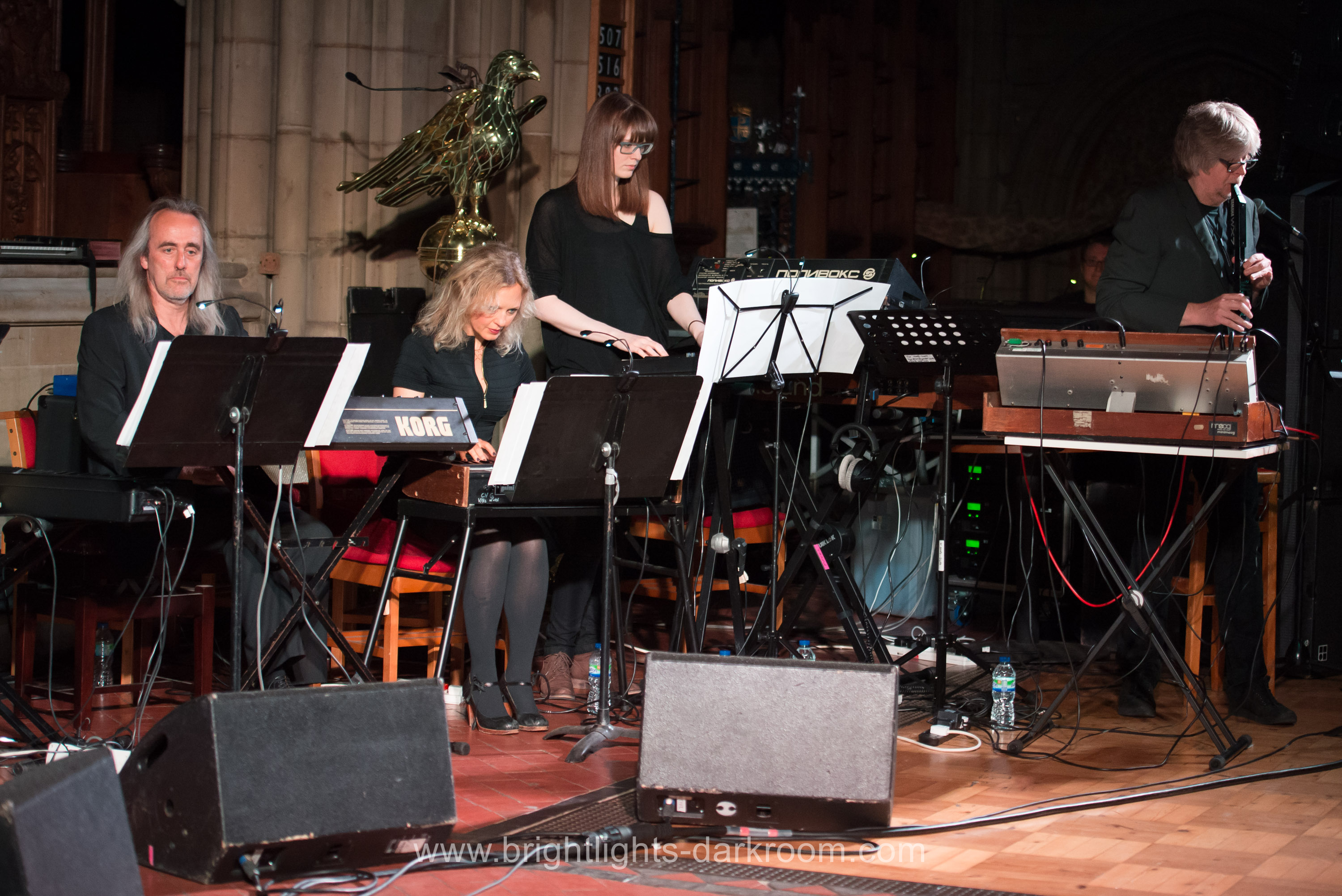
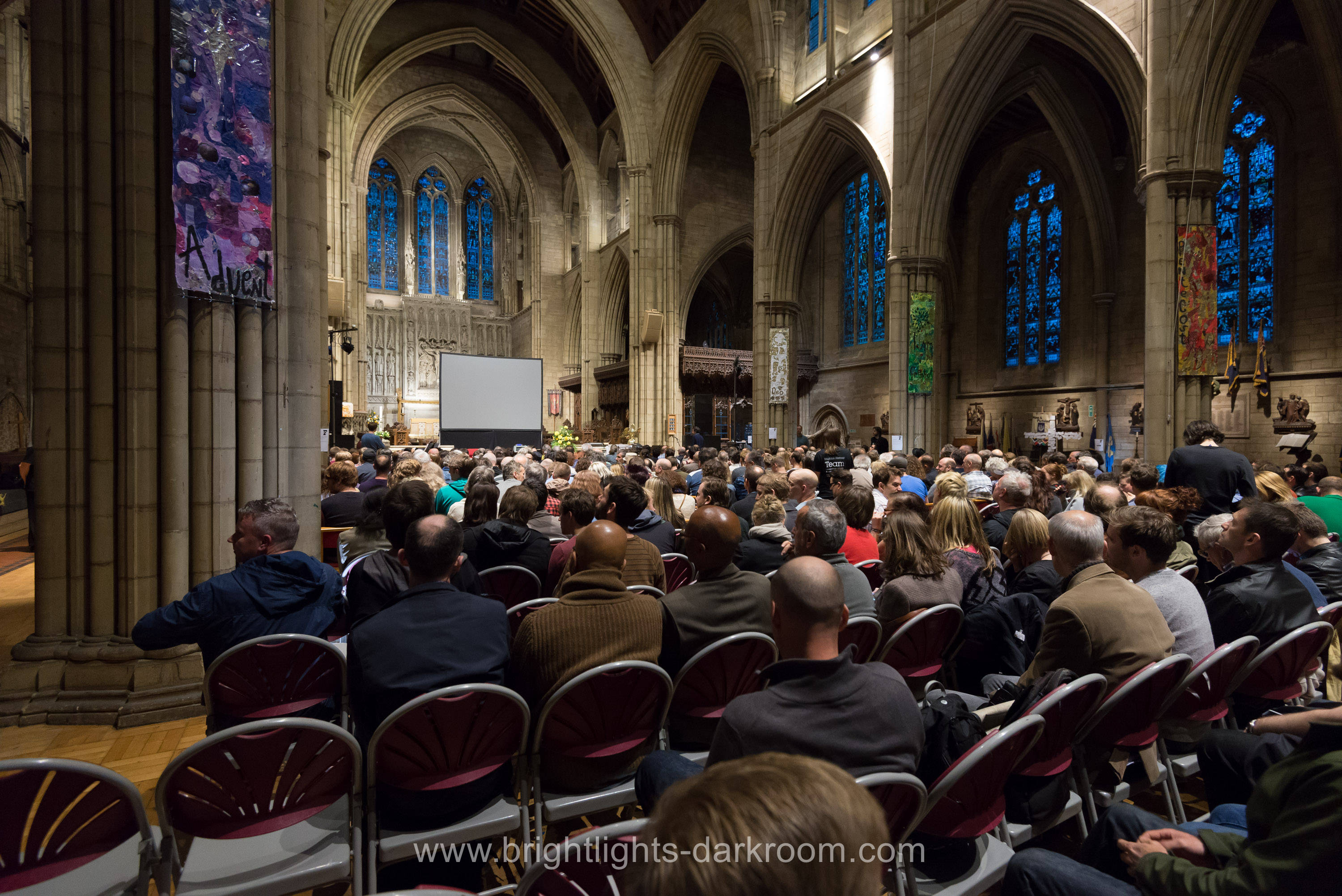
Will Gregory Moog Ensemble, All Saints Church, Hove 15/05/2014

Image

DSC_1960 DSC_1954 Will Gregory Moog Ensemble, All Saints Church, Hove 15/05/2014 - (c) Andy Sturmey Will Gregory Moog Ensemble, All Saints Church, Hove 15/05/2014 - (c) Andy Sturmey

Will Gregory Moog Ensemble performing at All Saints Church, Hove 15/05/2014.

Photos used with kind permission of Andy Sturmey (Brightlights-Darkroom Photography).

Click individual images to enlarge.

(c) 2014 Andy Sturmey / Brightlights-Darkroom Photography

2K – ***k The Millennium (Blast First single, 1997)

2K '***k The Millennium' 12" artwork

blast first / mute records | 12″/cd bffp146t / bffp146cdk | 29/09/1997

‘What Time Is Love?’, ‘3AM Eternal’, ‘Last Train To Trancentral’ – all songs synonymous in my memory with my first love affair with music generally and dance music specifically. The late eighties, and the ensuing dance-tinged early nineties were a great time for an electronically-minded boy to be getting into music, and The KLF played a major role in piquing my curiosity. Later, at university I managed to track down original 12″ versions of the re-released ‘What Time Is Love?’ and ‘3AM’ and, in my first and only attempt at DJing, managed to beat-mix the two tracks perfectly using the campus radio station’s decks and cross-fader. Good times.

On the back of the three classic singles above, I bought The White Room, and was hugely disappointed; the straightahead dance tracks were nowhere to be seen, and the whole album hung together disjointedly. The anarchistic / artistic events that followed, the dead sheep and thrash-metal with crutches and rifles version of ‘3AM’ at the Brit Awards, the Tami Wynette version of ‘Justified And Ancient’, the whole Justified Ancients of Mu-Mu faux-cult thing generally; all of this left me thinking The KLF a little silly, and it altered my affections toward the triumverate of singles above.

Nevertheless, by 1997, my addiction for buying all things Mute and a renewed interest in the ‘mythology’ I suppose you’d call of it of The KLF, I was really excited by the prospect of this single. Adopting the moniker 2K, Jimmy Cauty and Bill Drummond reunited specifically for one single on Blast First, following the inclusion of ‘What Time Is Love?’ on the Jeremy Deller-compiled Acid Brass album.

With the combining together of the music I loved as a teenager and my favorite record label, I was pretty excited about this single. I remember vividly the day I bought this. I also bought the second volume of Nick Cave‘s King Ink lyrics collection, and it was during a period where futures were being decided and graduate placements were being applied for. There was a rising level of noise around the coming new millennium and the unifying celebrations that would be had that year, the Millennium Bug was being lauded as the end of modern civilisation, and this single aimed to tap into that excitement. And just like most of those supposedly exciting things, none of which lived up to their hype, neither does the 2K single.

The central ‘point’, if indeed there is one, of ‘***k The Millennium’ is the line ‘F**k the millennium / We want it now‘, which is meaningless and also fundamentally impossible to achieve. The duo also take the opportunity – chortle, chortle – to open the track with a shouted ‘1997 – what the f**k’s going on?‘, referencing the album from a decade before with which the ‘controversy’ that often circled Cauty / Drummond (and which now seems childish) began.

At almost 14 minutes, ‘***k The Millenium’ is an in-joke taken too far, combining pointless sloganeering and the same form of pompous spoken word passages that ruined the rocked-up version of ‘America : What Time Is Love?’. The only redeeming feature of this song is the usage of a section of acid-house burbling from the original, rare as hen’s teeth, ‘What Time Is Love?’; but when placed alongside shouted nonsense, horns and repeated expletives one has to ask: what’s the point? Far better to track down that original classic than indulge this disappointing nail in the Koffin.

Alongside a single edit, and a radio-friendly swearing-free version thereof, there’s an alternative version of the Williams Fairey Brass Band‘s take on ‘What Time Is Love?’. With so much rear-view mirror action going on, one is left with the inescapable notion that this was a parting shot from a duo who were looking back fondly on their achievements from yesterday, themselves wondering where the ideas went and what the point of this single actually was. (The 12″ includes a Pan Sonic remix of the Acid Brass track which is probably worth owning; I still don’t know whether I’ve got it or not.)

Track listing:

12″:
A. 2K – ***k The Millennium
B1. Acid Brass – What Time Is Love? (Version K)
B2. Acid Brass – What Time Is Love? (Version P – Royal Oak Mix by Pan Sonic)

cd:
1. ***k The Millennium
2. Acid Brass – What Time Is Love? (Version K)
3. ***k The Millennium (Radio Edit)
4. ***k The Millennium (Censored Radio Edit)

First published 2008; edited 2014

(c) 2014 Mat Smith / Documentary Evidence

The Psyclops Trees – All Back To Spikes (Flying Saucer Records single, 2014)

The Psyclops Trees 'All Back To Spikes' 7" artwork

flying saucer records | 7″ flys5001 | 30/05/2014

Lee Curtis is a producer and DJ who has released records as Lee Curtis Connection on the venerable Ninja Tune and who also formed one half of Flavournaughts with Dave Priseman. His latest project is Psyclops Trees, prefacing a much-anticipated track for Gary Asquith‘s Le Coq Musique imprint called ‘I’ll Surrender’ which will see Curtis collaborating with the erstwhile Renegade Soundwave / Rema-Rema frontman as Renegade Connection.

All Back To Spikes’ is like a time machine back to the halcyon big-beat / trip-hop days of 1994 – Athletico compilations, The Chemical Brothers back when they still lived on Planet Dust, Mo’Wax before megastardom etc. Curtis himself describes these tracks as ‘funky psychedelic breaks’ which is completely apt – on ‘All Back To Spikes’ the (block rocking) beats are rich, hypnotic and chunky, while deep textures that shimmer, twist and loop suggest movement through multiple dimensions.

The single is backed with ‘Beak Street’, which earns the distinction of being this author’s summer anthem. On this particular street the beats are slower, the vibe funkier; the melodic hooks sits somewhere between Stevie Wonder circa ‘Sir Duke’, the theme tune to Grange Hill and the Pierre Henry piece that Fatboy Slim ripped off shamelessly. ‘Beak Street’ casually pulls off this mood with a cheeky swagger, making this a perfect soundtrack to sipping cocktails by the pool.

Check out videos for the two tracks below. The single can be purchased from Rough Trade here or Flying Saucer’s own website here.

Track listing:

7″:
A. All Back To Spikes
B. Beak Street

(c) 2014 Mat Smith / Documentary Evidence

Link

David Baker (Komputer) – Dirty Contacts 2 DJ Date

Dave Baker from Komputer / Fortran 5 / I Start Counting DJs at London electronic music night Dirty Contacts 2 at The Boogaloo in Highgate, London on 1 May.

Details can be found through this link, which also includes an extract from my Mute Short Circuit review from 2011.

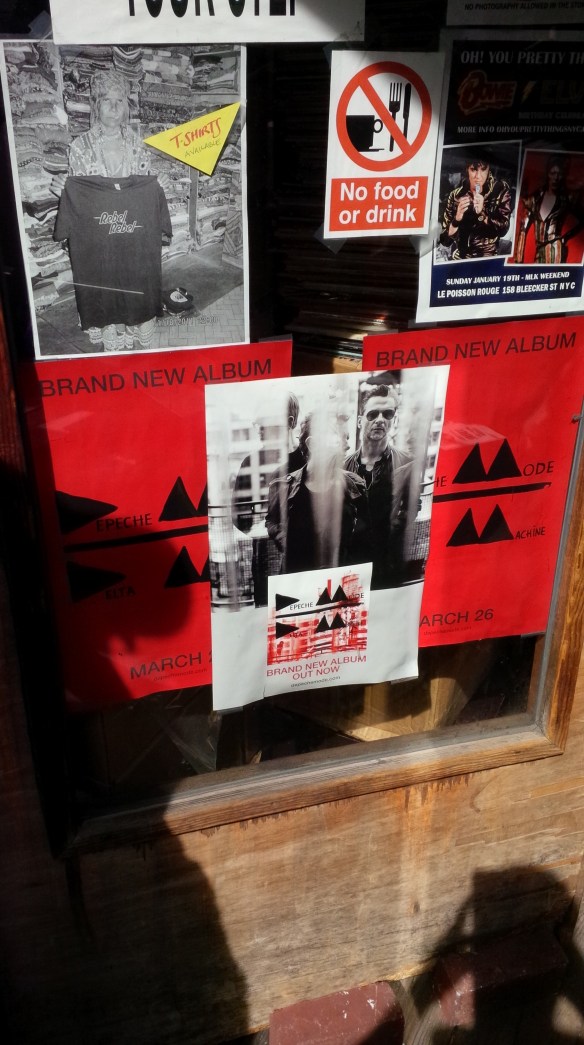
At Rebel Rebel, Bleecker Street, Greenwich Village, NY

Image

At Rebel Rebel, Bleecker Street, Greenwich Village, NY

(c) 2014 Mat Smith / Documentary Evidence

At Rough Trade NYC, Williamsburg

Image

At Rough Trade NYC, Williamsburg

(c) 2014 Mat Smith / Documentary Evidence

Rema-Rema – International Scale / Short Stories (Inflammable Material / Le Coq Musique single, 2014)

Rema-Rema 'International Scale / Short Stories' 7" artwork

inflammable material / le coq musique | 7″ burn017 | 04/2014

‘Can you imagine what these beautiful songs would sound like if we’d done them in a 24-track recording situation?’ ponders Gary Asquith by email when I let him know that the copy of Defiant Pose Eight with its accompanying Rema-Rema 7″ he sent me has arrived. ‘It’s so sad that the most beautiful creations that I’ve ever made are just demo quality-lo-fi. They’re the pinnacle of my musical thinking.’

Rema-Rema’s recorded output, until the release of this 7″, was confined to the Wheel In The Roses 12″ that effectively properly launched the 4AD label; apart from a couple of live tracks on a very underground cassette and an alternative version of one track on a Japanese 4AD compilation, that was it. And yet, as future Wolfgang Press member and Rema-Rema founder Mick Allen recounts in the interview with him and Gary Asquith in the Defiant Pose fanzine, this post-punk unit seemed to have developed a cult following that even these two members are surprised about. Allen recalls Nick Cave talking to him about his time in the band whilst his Bad Seeds were on tour with Allen’s Wolfgang Press, and Steve Albini‘s Big Black covered one of their tracks. I can vouch for their status: when I posted a review of Wheel In The Roses last year, including some insightful information from Asquith, I received emails from people enquiring about whether the band had any other recordings that might see the light of day.

Which brings us on to the exciting prospect of two hitherto unheard Rema-Rema tracks, rescued from cassette demos and pressed onto heavyweight vinyl to accompany the Defiant Pose feature and interviews. ‘International Scale’ is a breathtaking moment of sparse robotic motorik rock underpinned by squealing synths from Mark Cox, a taught, sinewy guitar riff from Marco Pirroni and a Mick Allen bassline that dominates with ground-out, low-slung angsty prominence. Asquith prowls above the mix, his vocal somewhere between punky snarl and wide-eyed wonder, offering repeated phrases and complex wisdom. Like all the best post-punk this feels like a head-on collision of ideas: the edginess of punk and the regimented rhythms of German electronic pop (thanks to a skeletal beat from Max) and a leaning into artsy esoterics. It’s not hard to see why Asquith considers his Rema-Rema period his best – ‘International Scale’ suggests a raw confidence and effortless cache of ideas that could have served this band very well had circumstances been different. It’s a travesty of grand proportions that we’ll never get to hear a finalised version of ‘International Scale’ but this is more than adequate aural evidence of what makes Rema-Rema so compelling a proposition.

‘Short Stories’ clocks in at just under two minutes and has a much rawer, embryonic sound to it, Asquith sounding not dissimilar to Wreckless Eric with an emotional, almost anguished vocal. Slow, gravelly and murky, ‘Short Stories’ feels like a single evolution away from the pure punk of The Beastly Cads / Models and Manic bands from which Rema-Rema were formed. No surprise, perhaps – in the accompanying interview we learn that Allen and Asquith brought fragments from unused songs from their former bands to the studios as the genesis for the Rema-Rema material.

Asquith turns more sanguine as our brief email exchange concludes. Hey, we have these moments and we get respect – because you can’t be in a band with Marco Pirroni and Michael Allen playing guitar and bass that isn’t worth a listen. Because those two people exude class. That’s the moment I live for, and when I die I will say “please God, can we cut a deal and you play me some Rema -Rema?”‘

Buy this; it’s important.

Get it at Defiant Pose

Track listing:

7″:
A. International Scale
B. Short Stories

Thanks to Gary

(c) 2014 Mat Smith / Documentary Evidence