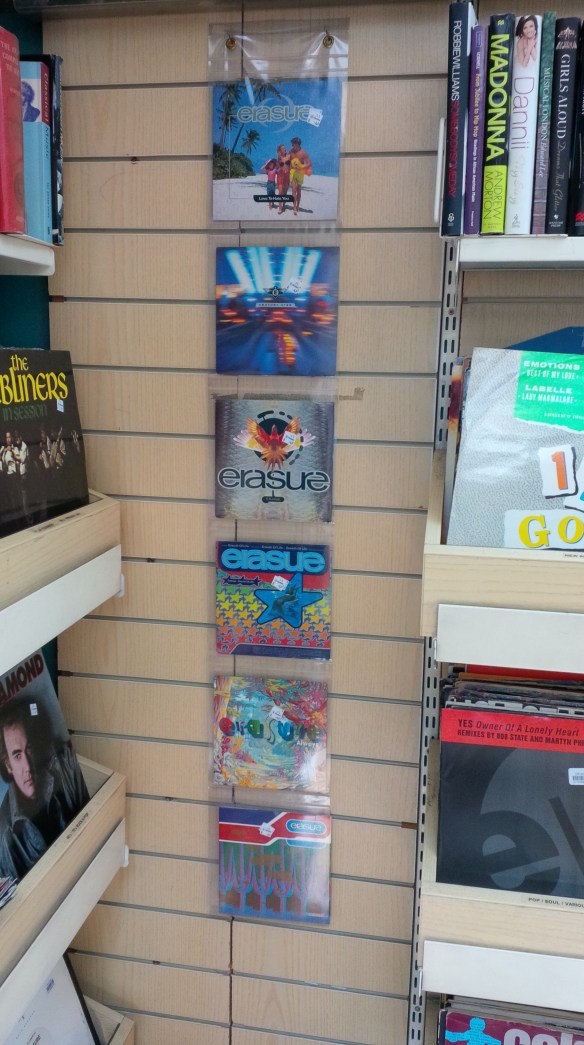
Clearly someone offloaded their Erasure collection… (not me).
(c) 2014 Mat Smith / Documentary Evidence

Clearly someone offloaded their Erasure collection… (not me).
(c) 2014 Mat Smith / Documentary Evidence

Harry MacElhone’s ABC Of Mixing Cocktails is widely acknowledged as the go-to book for authentic mixology. Harry MacElhone was the owner of Harry’s New York Bar in Paris – a firm favourite with the Hemingway crowd – and either personally created or offered some of the earliest cocktails, many of which have become enduring classics.
The Bloody Mary is such a drink. Although at least three people have laid claim to inventing the drink, the story that’s most credible is that the Bloody Mary as we know it today was created by Fernand ‘Pete’ Petiot, a bartender at Harry’s New York Bar in Paris in 1921. A man named George Jessell is one of the bartenders who claimed to have mixed vodka with tomato juice for the first time, but it’s Petiot that first mixed it with lemon juice, Tabasco sauce and salt (tomato juice in the Twenties was sold without salt having been added, unlike today) to give us the basis of the drink that’s become a staple hangover cure today. (There are some decent arguments for why the antioxidants in the ingredients make this the best hair of the dog out there, but sadly received scientific wisdom would argue that nothing’s better than water to overcome the night before’s shenanigans.)
Petiot claims he first prepared the drink for two Chicagoans who had visited Harry’s Bar, and the name stemmed from them wistfully recalling a bar back home called The Bucket Of Blood and a specific waitress called Mary who worked there. Others have claimed it was named after Queen Mary. We’ll never know for sure, but we can be assured that the addition of spice – principally to please the American palate – was every bit as inspired a move as mixing tomato juice and vodka in the first place.
Although variations of Bloody Marys are now ten a penny, Petiot’s original recipe which is included in MacElhone’s ABC Of Mixing Cocktails is firm on one divisive ingredient: ‘above all no celery salt’. Thus he would turn in his grave at the Blood On The Snow – named after a track from Snow Globe – which not only includes the offending inclusion but also horseradish sauce.

Unfaithful to a proper Petiot Mary it might be, but this is a drink that deals well with extra spices, and so adding that alongside Tabasco and worcestershire sauce still makes for a great drink, even if drinking lumpy horseradish sauce takes a bit of getting used to. I’m with Petiot and MacElhone on this one though – you can keep your celery salt. And if you find the idea of drinking vodka with brunch the next day a little hard to justify (poor, poor you), ditch that and prepare it as a virgin version – you won’t notice its omission through the spice.
(c) 2014 Mat Smith / Documentary Evidence

So, following up my post last week about the Blue Savannah cocktail from the Snow Globe boxset booklet of recipes, I decided that the next one on the list would be the A Little Raspberry-spect. Clearly, this is somewhat clumsily named after what I recently described as Vince Clarke and Andy Bell‘s signature song, ‘A Little Respect’, and just like that single, this one has hit written all over it.
This is a mix of gin, lemon juice and muddled raspberries, the tartness of which is offset by sugar syrup (I used agave syrup, which has a lower GI, whatever that means, and where the taste is a bit less in your face). The recipe in the Snow Globe book specifically calls for Beefeater gin, but I wasn’t going to go and buy some just for this, and instead used the dregs of some Tanqueray that have been skulking in the back of the drinks cabinet since Christmas. (The second time around we used vodka and that worked just as well.)
This drink is refreshing, sweet / sour, brilliantly seasonal and provides a neat use for raspberries that have gone a bit squidgy and which would otherwise be destined for a smoothie if you can be bothered, or the bin if you can’t. It also looks pretty darned chic as well, and might well replace the relative heaviness of Pimm’s round our way when summer really gets going.
(c) 2014 Mat Smith / Documentary Evidence

To celebrate the announcement of the new Erasure album yesterday, I thought it was probably high time to take a proper look inside the box of their last album, 2013’s Snow Globe. Specifically, I thought I’d raise a glass to The Violet Flame by mixing one of the Erasure song-themed drinks included in the novelty cocktail booklet that came inside the Snow Globe box.
Alongside my love of all things Mute, another of my interests is making cocktails. I don’t say that as code for enjoying getting drunk – far from it; I’m not good at that at all – but rather I genuinely enjoy the process of taking ingredients, following recipes and mixing interesting drinks.
I selected the Blue Savannah, named in honour of the third single taken from Wild!, for two reasonably sensible reasons; first because I happened to have all of the ingredients in the house already, and second because Mrs S tends to prefer longer, juice-based cocktails.
The Blue Savannah is a vodka-based drink mixed with blue curacao, orange and pineapple juices which is then strained into a highball glass over ice. Anyone with a rudimentary grasp of colours will know that mixing blue with orange will produce a greeny, almost turquoise hue, and so it is with the Blue Savannah, as can be seen in the photo. Pineapple juice, when shaken and strained, produces a velvet foam (as does egg white), hence the ‘head’ that’s visible on the drink.
Curacao is a liqueur made with a bitter, orange-esque fruit called lahara. When mixed with sweet juices as it is in this drink, curacao has the effect of cutting through sweeter flavours and toning down fruit sugars. Plus, in the case of blue curacao, it naturally adds a distinctive colour to proceedings. Not being a fan of really sweet cocktails, I really liked the addition of some bitterness. Mrs S was less convinced, saying that something in the drink was bothering her throat.
I will ultimately work my way through the other cocktails in the book over the next few months. I’ll even tackle the Love To Hate You, a challenging drink that includes Marmite alongside fruit flavours.
Cheers.
(c) 2014 Mat Smith / Documentary Evidence
Erasure release their new album, The Violet Flame, on 22 September through Mute.
Listen to an extract from a new track from the Richard X-produced album via YouTube.
The album will be released as a CD, 2CD, download and obligatory, financial destitution-ensuring boxset and will be accompanied by a global tour.
More info at erasureinfo.com
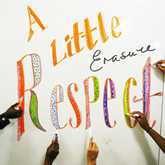
mute records | i mute451 | 05/12/2010
Erasure re-recorded what might well be their signature song, ‘A Little Respect’, in 2010. Released as a one-track download, the single was issued in support of the Hetrick-Martin Institute, a New York-based non-profit organisation for lesbian, gay, bisexual, transgender or questioning (LBGTQ) youths between the ages of 13 and 24.
The charity’s name is taken in honour of its founders, psychiatrist Dr. Emery Hetrick and NYU professor Dr. Damien Martin who founded the Institution for the Protection of Lesbian and Gay Youth (IPLGY) in 1979. The organisation was renamed following the deaths of its co-founders and states its aim as follows: ‘The Hetrick-Martin Institute believes all young people, regardless of sexual orientation or identity, deserve a safe and supportive environment in which to achieve their full potential.’ (Source: HMI website)
‘A Little Respect’ has always had an anthemic quality, whether in the hands of Erasure themselves or in the likes of Wheatus or the many other acts who have subsequently co-opted the song for themselves (and there are plenty). At its heart is a simple, understated message of defiance and a polite demand for equal treatment. As a spirited call to respect a person just because they don’t fit in, have a different sexual orientation, a different belief system or any number of personal values that might not quite fit with the homogeneity that is the so-called ‘norm’, ‘A Little Respect’ has a universally simple appeal and it lends itself perfectly to HMI’s laudable goals. It’s an organisation that Erasure’s Andy Bell is a major supporter of, hence the re-worked version of the track that he and Vince Clarke put together – aided by the Hetrick-Martin Institute Youth Chorus – with proceeds going to the charity.
Fans of the original Stephen Hague-produced track will no doubt bemoan the springy, updated new arrangement (which ditches Vince’s guitar in favour of a crisper beat and shimmering electronic palette), but Andy Bell could probably sing this backward and it would still sound just as uplifting. The addition of the choir inevitably reminds the listener of the crowd at Rangers who seem to have co-opted the track as an unofficial anthem, but some deep soulful ad libs at the very end brings this right back into the warm nod to Motown that many of the tracks on The Innocents carried.
More information on HMI can be found here. A video for the single was released and can be viewed below.
Thanks to Jorge.
Track listing:
i:
1. A Little Respect (HMI Redux)
(c) 2014 Mat Smith / Documentary Evidence

mute records | lp/cd/lcd/c stumm115 | 16/05/1994
Erasure‘s 1994 album found Andy Bell and Vince Clarke getting warm and tender. Compared to the previous album, Chorus, which had a grit to its analogue construction, the oddly named I Say I Say I Say – whose electronic backdrops were again created entirely using retro synths – has a serene, enveloping tone. Andy’s lyrics too veer toward the affectionate and romantic. Rightly or wrongly, I like to think of this as Erasure’s album of love songs, eschewing some of the more wordly-wise themes of the previous albums.
Curiously, this is also the Erasure album I have listened to the least. I put this down to the limited edition CD that I bought – a beautifully-designed 12″ box with a pop-up fairytale castle with the CD itself intended to look like a shimmering lake at the foot of the castle, everything swathed in shades of blue from a gibbous moon. Great idea, but it meant that this got stuck in a box with my vinyl for safekeeping, rather than being accessibly on the shelf with my other CDs. ‘Fairytale’ is not a bad description for this album, as producer Martyn Ware (ex-Human League and Heaven 17 and future project partner of Vince as The Illustrious Company) wraps a dream-like, sommnambulent atmosphere around many of the songs, particularly those featuring St. Patrick’s Cathedral choir (‘So The Story Goes’ and ‘Miracle’). I Say I Say I Say yielded three singles – the gorgeous ‘Always’, the chart success of which Erasure would not match until 2005, ‘Run To The Sun’ and ‘I Love Saturday’ – but sadly marked the start of a long period of poor singles success for the duo.
‘Take Me Back’ has a beautiful, extended introduction, which unfolds into a multitude of cascading melodies, Andy delivering a strident, impassioned vocal, wishing to return to the safety of his childhood. There is a brief section where the layers are sloughed off, leaving an intricate drum pattern built of springy, metallic synth sounds and what can only be described as a distorted attempt to replicate vinyl scratching using a synth. ‘Man In The Moon’ runs in waltz time and includes some almost classical keyboard work (albeit an elastic synth rather than piano or harpsichord) and a melody played on a flute-esque synth, while Andy delivers a cosy, romantic lyric. The track concludes with Andy singing solo over what sounds suspiciously like the tinkly opening bars of the Velvet Underground’s ‘Sunday Morning’, and overall this track has a quirkily similar, enveloping sound. ‘So The Story Goes’ is another waltz, and the first to feature the choir. Andy’s vocal is full and theatrical, while Vince offers a deep bassline similar to Chorus‘ ‘Turns The Love To Anger’ and flutters of synth arpeggios. Andy delivers a solo monologue at the end of the song, while the choir achieve an atmospheric discord that is as much mysterious as it is chilling.
‘All Through The Years’ has a country twang to it, and plenty of sterling synth work from Vince. Its autumnal imagery and warm tones mark this out as one of the best songs on the album, Andy bathing the track with mystery and misery with the addition of some beautiful backing vocals. ‘Blues Away’ is also one of the outstanding tracks here, a mellow soulful tune with sparse synths and a vocal from Andy delivered in a difficult falsetto while his own backing vocals cover all the mid- and low-range harmonies – he single-handedly (single-voicedly?) covers the full range without any signs of difficulty, and rightly so Vince takes a back seat on this song, although there is another great midsection that finds shards of electronics pealing off in random directions over a detuned beat.
‘Miracle’ is simultaneously inspiring and moving, a beatifully simple electropop track blessed by a harmony-filled chorus where Andy is ably aided by the St. Patrick’s choir. ‘We’ll be going home / Where the passion finds the perfect love‘ runs the chorus, sung with a melody similar to The Cranberries’ ‘Dreams’. Closing track, ‘Because You’re So Sweet’ is a sugary sweet ballad with some very meditative synthwork from Vince and an innocence and naivety that is both brave as it is beguiling.
***
I’m reposting this review since its now twenty years since I Say I Say I Say was released. It’s nearly ten years since I wrote this review, and my opening comments about not having listened to this that much compared to other Erasure albums still holds.
The album turning twenty years old inevitably encourages comments of the ‘where does time go?’ variety; for me it signifies that it’s twenty years since I went to look around the university campus that would become my home from 1995 to 1998. My family and I drove from Southend-on-Sea, where we were staying in a guest house, to Colchester to visit the university, and I insisted on playing the cassette of this album that had come out that week.
Some years after I wrote this review I alighted upon an old VHS video cassette which included a short interview with Andy Bell and Vince Clarke on some Saturday morning kids’ TV show; Andy attempted to explain the title of the album using a joke. It fell flat on its face, wasn’t funny and didn’t help explain the daftness of this title. It’s always struck me as odd – this is a comparatively serious LP, but its title suggests a lightheartedness that just isn’t there in the music.
Track listing:
lp/cd/lcd/c:
A1. / 1. Take Me Back
A2. / 2. I Love Saturday
A3. / 3. Man In The Moon
A4. / 4. So The Story Goes
A5. / 5. Run To The Sun
B1. / 6. Always
B2. / 7. All Through The Years
B3. / 8. Blues Away
B4. / 9. Miracle
B5. / 10. Because You’re So Sweet
First published 2005; edited 2014
(c) 2014 Mat Smith / Documentary Evidence

(c) 2014 Mat Smith / Documentary Evidence

mute records | 7″/12″/cd/c mute125 | 17/06/1991
‘Chorus’ was Erasure‘s first single since ‘Star’, the final single from the Wild! project. The difference between those two songs couldn’t be more stark, since ‘Chorus’ heralded a period of completely analogue focus for Vince Clarke, returning in many senses to the sounds and synths he had first used ten over years previously during his brief period with Depeche Mode. The intro to ‘Chorus’ is every bit as thrilling as the opening section of ‘Sometimes’, except here it’s a sound like an synth air-raid siren that kicks off the song, followed by some sonar sounds and an impassioned cry from Andy Bell before thudding, crisp metallic beats and a hypnotic, modulating bass melody and counterpoint bass pads drive the whole thing forward with a malevolent urgency. Andy Bell sings a cautionary tale that has post-nuclear overtones, appeasing the Body Shop doom-mongers of the day with a chorus that describes the sun dying, birds disappearing and fishes going to sleep; analogue intricacy in abundance, and a very deep message of impending environmental disaster (a la ‘Drama!’). ‘Chorus’ charted well and topped the indie charts. To me this still sounds perfect, unique and timeless and it will always have a place in my heart (to read more about this song’s influence on me, and the reason it is responsible for the idea of this site, click here).
The 7″ and cassette single feature the blissful pop of ‘Over The Rainbow’ (not the song from The Wizard Of Oz), which starts with a muffled German speaking clock, and whose line in the chorus ‘The boys are back in town / They’ll never let you down‘ always makes me smile, as Erasure have indeed never let me down. Andy sings about listening to ABBA – a clue to the later ABBA-esque EP? – and paints a beautiful picture of summering in Oslo. It has one of the best Vince Clarke synth riffs too, and all in all is one of my personal favourite Erasure b-sides. ‘Snappy’ is mostly an instrumental, featuring a nagging bassline, robotic sounds, a scary voice intoning ‘welcome to the world’, Nineties dancefloor-friendly beats and snatches of an Andy Bell vocal that has almost Indian spiritual overtones. Like a lot of dance music at the time, it moves around from idea to idea, but that bassline remains a constant force. (The US Maxi-CD labels this a 12″ remix, which it may be; I dimly remember having a shorter version of ‘Snappy’ as a bootleg, but I can’t find it now.)
Remixes come from Youth and Justin Robertson. Youth turns in two mixes, both having a leaning toward an early version of trance music, namely the entrancing vibe that emerged from the crossing-over of ambient and house which producer and Killing Joke bassist Youth was involved in via The Orb, Blue Pearl and others. His Transdental Trance mix (either the faded or unfaded versions which are on the CD and 12″) is a shifting, barely-there mix which takes recognisable sections from the Erasure original but gives the version a layered, dark, noxious ambient edge. The Pure Trance mix does the same but adds urgent breaks and beats and a sense of mysterious euphoria. Even Andy’s chorus shifts into view at one point.
Justin Robertson is a Manchester DJ / producer / remixer who has been spinning tunes since the early, hazy Balearic days of UK club music. His Spice Is Risen mix of ‘Snappy’ is a world away from his later trip-hop work as Lionrock, blending that track’s spiritual dimension with a more pronounced percussive beat and a dose of dancefloor kudos, making this a Leftfield / Spooky-esque slice of early progressive house.
The US vinyl and CD maxi-single releases retitled the song ‘Chorus (Fishes In The Sea)’ and included an additional mix by Youth (the Aggressive Trance Mix, which is a longer and harder extended take on the Pure Trance mix, and includes Andy’s full vocal).
Track listing:
7″/c:
A. Chorus
B. Over The Rainbow
12″:
A1. Chorus (Pure Trance Mix)
A2. Chorus
B1. Snappy (The Spice Has Risen Mix)
B2. Chorus (Transdental Trance Mix (Fade))
cd:
1. Chorus
2. Chorus (Transdental Trance Mix)
3. Snappy
4. Over The Rainbow
First published 2013; edited 2014.
(c) 2003 -2014 Mat Smith / Documentary Evidence
 Documentary Evidence