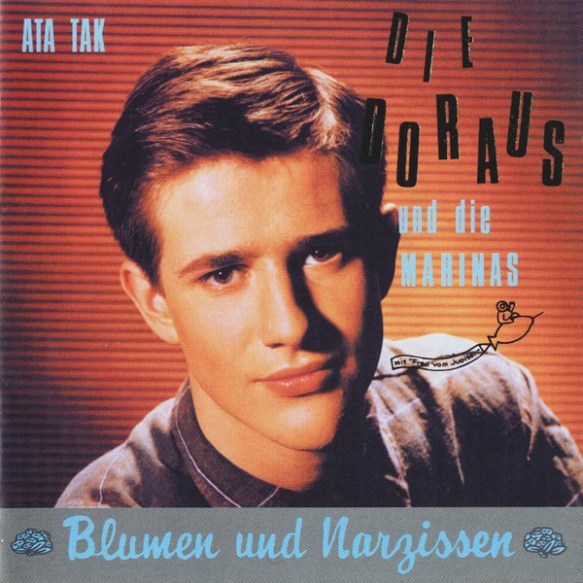
Die Doraus Und Die Marinas ‘Fred Vom Jupiter’ single artwork.
Sometime in 2009, Steve Lamacq interviewed Mute‘s Daniel Miller on 6Music. I missed it and forgot to listen again via the website, but Mrs Smith happened to listen. She told me that Lamacq had discussed his favourite early Mute release, and so I asked her what it was. She couldn’t remember who it was by, what it was called, only that it had kids singing on it and – and I thought this was genius to have remembered this – it had a catalogue number of MUTE19.
And so I rushed upstairs, grabbed the CD-sized Mute catalogue in which I mark the releases I own, and scoured for a record with this number. I was disappointed to find that it was ‘Fred Vom Jupiter’ by Die Doraus Und Die Marinas, a record I’d tried many times to track down up to that point but which never, ever seemed to come up on eBay, and I’d given up. That day, however, it was on eBay amazingly, and for a paltry fiver filled in a major gap in my collection.
Worth it? Absolutely.
Die Doraus was Andreas Doraus and a bunch of session musicians, while Die Marinas were a revolving group of kids who, on this track were Dagmar Petersen, Claudia Flohr, Michelle Milewski, Christine Süßmilch and Isabelle Spelly. A friend of Palais Schaumberg member and future Mute artist Holger Hiller, Dorau was barely eighteen when he recorded the sessions for Blumen Und Narzissen in 1981 in Düsseldorf for Kurt ‘Pyrolator’ Dahlke from Der Plan’s Ata Tak imprint. The album was produced with Dahlke and Ata Tak co-founder Frank Fenstermacher. The album’s packaging presented Dorau as a clean, good-looking pop heart-throb, potentially surprising anyone buying the LP given its amalgam of angular post-punk and adventurous synthwork.
Die Doraus Und Die Marinas ‘Blumen Und Narzissen’ LP artwork.
The lead track from the album was ‘Fred Vom Jupiter’, written by Dorau and Olaf Maureschat. The track would became a massive hit amid West Germany’s homegrown post-punk Neue Deutsche Welle movement. The single was originally released by Ata Tak in 1981, while Mute licensed it for release in the UK the following year. In hindsight, that move looks relatively opportunistic to catch some of the momentum of the single’s success in Germany for UK listeners, as Mute didn’t option either the album or any of Dorau’s copious other output with Die Marinas or as a solo artist.
‘Fred Vom Jupiter’ is, at face value, a novelty electronic pop track, perhaps in the style of Miller’s own Silicon Teens project – the sleeve certainly supports this. However, that would ignore the harsher synths and noises evident behind the innocent German accents of Die Marinas’ ramshackle choir. If you do ignore these, what you do have is a blissfully original slice of early electronic pop which fully deserves its cult status as a collector’s item. It’s incredibly catchy like all good pop should be, although my knowledge of German is so weak now that all I can understand is the title which is sung and repeated at the end of the chorus; but its infectiously hummable if nothing else. The sleeve helpfully explains what the song is about: ‘From Jupiter comes Fred, the marvelous Kosmonaut. All the girls feel enthusiastic about him and want to keep him here forever.’
The darker sounds are explored more wholeheartedly in the pulsing, electro-industrial instrumental on the flip, ‘Even Home Is Not Nice Anymore’ which was co-written with Fenstermacher. The sleeve explains that ‘Fred has come home to his planet after his “excursion” to earth. But there he feels very lonely and realises…’ – realises what, we are not told. Whereas ‘Fred Vom Jupiter’ is a cute pop track with a bit of edge, the B-side is claustrophobic and edgy and anything but twee. Its beats speed up as the track progresses over its short duration, rising like pulsing jackhammers inside your head, a huge throbbing bass synth anchoring the entire track into a sense of panicked urgency.
The tracks that make up Carter Tutti Void‘s Transverse collaboration were recorded live at Mute‘s Short Circuit festival at London’s Roundhouse on May 13th 2011, and according to the sleeve (more on that in a moment) the trio of Chris Carter, Cosey Fanni Tutti and Nik Void prepared the pieces together in the studio and then played them live on the day. No-one else had apparently heard the four tracks that made up their performance, but the prospect of witnessing a collaboration between one half of Throbbing Gristle teaming up with Factory Floor‘s Void had people being turned away at the door. Transverse, according to the Mute spiel, is one of a number of concert recordings from Short Circuit being prepared for release.
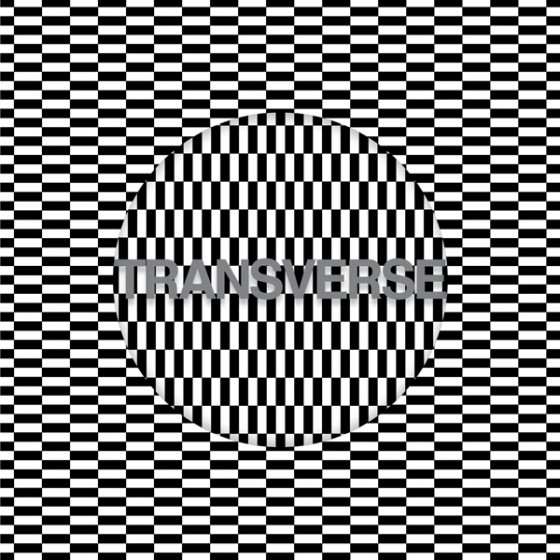
The first thing that grabs you about Transverse is the sleeve, a simple Bridget Riley-esque repeated monochrome pattern which appears to move as you tilt your head, and which really hurts your eyes if you stare at it too long. Simple is not a word you could use to describe the music contained on Transverse, however. Aiming for the complex end of the sonic spectrum, Transverse consists of four tracks of thudding, heavy, hypnotic ambience loaded with edgy sounds, dark tones and industrial style noise infiltration.
The central point of reference in each case is a deep, pulsing beat, not dissimilar from some of Orb’s most dub-esque soundscapes, that beat providing a consistent backdrop for the more challenging drones, squalls, yelps and clattering percussion that litter these tracks. At times barely-controlled bowed guitar feedback from Void drifts into view; at others Cosey Fanni Tutti moans wordlessly as though experiencing some sort of dark religious euphoria; at others snatches of words swing into view; at others, thick bass drones dominate; at others it feels like each track might just be a tweak of a dial away from complete overload and ear-shredding noise collapse.
Overall, the effect is exactly what you’d expect from this trio. Factory Floor have been heralded as taking Throbbing Gristle’s legacy and bringing that band’s name to a whole new audience, while Chris and Cosey have been toying with industrial clamour for decades. The four long pieces included here are detailed, intricate and confrontational all at the same time, particularly suited to those who need more angst and unpredictability in their deep listening soundscapes. Unlike most work of this nature, the fractured sounds and feedback bursts suggest that this should be listened to really loud, allowing the bass passages to have a similar, punishing effect on your body as that monochrome sleeve has on your eyes.
The LP + CD edition of Transverse includes an alternate version of the CD release, the four tracks being augmented by an additional track in the shape of ‘V4 Studio (Slap 1)’, a studio version of the final track played as part of the trio’s Short Circuit set. The studio version feels more playful than the version played live, reducing the prominence of the bass and eliminating a lot of the reverb and resonance inevitably presented on the Roundhouse performance version. Pre-ordering the album from Carter Tutti Void’s own Sandbag web store also meant you could get hold of an exclusive recording, ‘cruX’ which was delivered as a download on the day of release.
Last year’s experience of assembling a simple list of what I considered to be my favourite albums of the year didn’t appeal this time around, so I’ve broken down my 2018 into four categories – concerts, interviews, events and albums. As ever, these are all chosen from personal (and often highly personal) vantage points; it doesn’t mean that other things aren’t better – it’s just that these things appeal to me more.
Concerts
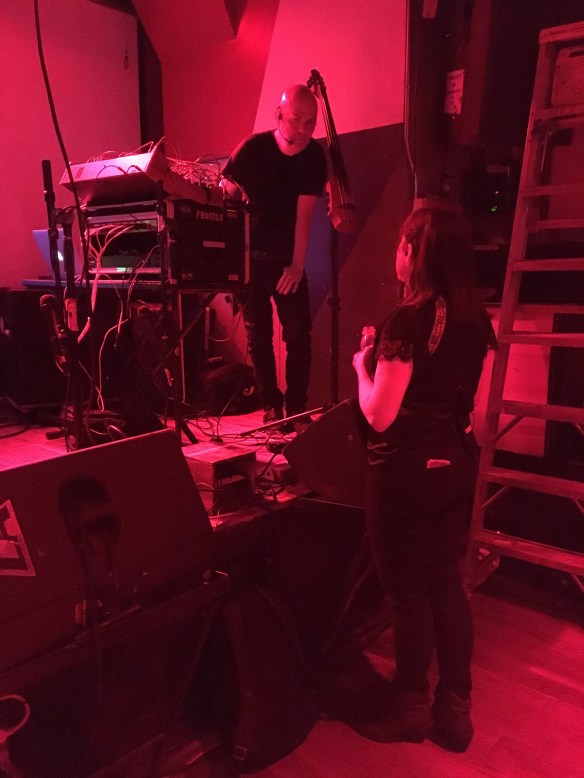
Reed & Caroline, Pianos, NYC, May 2018
Last year I wrote gushingly – and, to some, perhaps offensively – about Reputation by Taylor Swift, and this year we saw Ms Swift twice, once at Wembley and once at the Raymond James stadium in Tampa, FL. Mrs S. cried throughout both concerts (I got emotional too, okay?) and, after Wembley, our impressionable eldest / almost-teenage daughter immediately asserted, via the medium of her WhatsApp status, that Taylor represented someone whose values meant a huge amount to her. I don’t even know how to use emojis, let alone add a WhatsApp status, but I will say this (again) – Taylor Swift writes fucking great songs, is an incredibly important role model for young females, and is a sensational live performer. Feeling the concrete vibrate under your seat high up in an American football stadium as thousands of people register their enthusiasm is pretty hard to beat. Weirdly, I was asked some questions about my unashamed love of Taylor Swift (among other things) for The Electricity Club, which you can enjoy here.
I go to fewer and fewer concerts these days, but GoGo Penguin’s strobe-heavy show at the Royal Albert Hall was incredible, as was Barry Adamson’s confessional / big band performance at the Union Chapel, as was Daniel Blumberg at our local gallery in Milton Keynes, as was Nadine Khouri at Rough Trade East. Having a rare dad-and-daughter night out with our eldest daughter to watch Erasure in Aylesbury was a treat, as was her watching me interview Andy Bell for Clash by the bins at the back of the venue during a fire alarm immediately beforehand; it gives new meaning to the fabled ‘bring your daughters to work’ day. Watching Reed & Caroline’s cosy show at Pianos on New York’s Lower East Side in May was another memorable event in so, so, so many ways. More on Reed & Caroline further down the page.
Interviews
Daniel Blumberg by Angela Beltran
As a writer, you always strive to get an opportunity to tell those stories which deserve to be told but which somehow get overlooked. This year I was fortunate to be able to write some really important stories for Electronic Sound, from the weird circumstances of Ciccone Youth’s ‘Into The Groove(y)’, to the still-unreleased synth-heavy ‘Rubberband’ sessions convened by Miles Davis in the 1980s, to Space’s ‘Magic Fly’, to the DIY recordings of Thomas Leer and Robert Rental.
The piece that I’m most proud of, though, was an interview with Daniel Blumberg for Clash. Blumberg’s Minus was one of the albums that caught my attention the most this year, situated as it is on the crossroads between improvisation and Townes Van Zandt-style balladry. Interviewing Blumberg about his creative impulses in his kitchen / non-kitchen for two hours, watching him drawing in front of me, and having the opportunity to piece together his disparate interests while tearing up every question I’d prepared was a profound experience, and one I will never, ever forget. A few moths later I rewatched an interview with David Bowie on the Dick Cavett show around the time of Young Americans, and some of Daniel’s mannerisms reminded me of that, convincing me yet further that I’ve been privileged to have spent time with an absolute artistic genius. The Blumberg piece for Clash is here.
Events
Andy McCluskey – Sugar Tax Interview CDr
April, 2018, an Irish bar in deepest Greenwich Village: not unlike the three witches at the start of Macbeth, Reed Hays, Vince Clarke and I are scheming intently, over, variously, pints of New York tapwater, Diet Coke and Stella. We are talking about how we might promote the new Reed & Caroline album, Hello Science, which would eventually be released in July of this year.
Other than profound enthusiasm, I can’t say I really brought anything new to the table (other than maybe a round of drinks) but it was a massive privilege to have worked with Vince’s VeryRecords on that record nonetheless. After lots of conversation among us and with Caroline Schutz about the song’s hymn-like qualities, at some point I managed to get permission to share ‘Before’ from the album with the music teacher of my my eldest daughter’s school, culminating in a mesmerising performance by the choir at a very special evening event in June which you can see below.
Another professional privilege was being asked by Mute to host a live Q&A with Barry Adamson at London’s Rough Trade East in early November to support his Memento Mori career-spanning compilation. This is the second such event I’ve hosted for Mute, and I can’t express how much of an honour it is to be offered the chance to support the label I’ve been a fan of for so long in this way, other than to say, humbly, and rather feebly, that I feel incredibly lucky. The Q&A, which I cheekily described as “Memento Mori Jackanory” (to the amusement of myself and one other person), was also a form of redress for an earlier Adamson interview I’d conducted just as he left Mute, representing one of the first Q&As I’d ever done, which I still cringe at today.
This year I interviewed OMD’s Andy McCluskey for the second time. The conversation, focussed exclusively on the album Sugar Tax, will never get written up, and the recording will never be heard beyond three people – myself, my mother and my father. The catalyst was my father’s January diagnosis with Alzheimer’s, and the significance of Sugar Tax was that it was an album he and I would often listen to in the car on Saturdays while he drove around our home town working his own second job. I cherish those memories so much, and am so grateful to Andy for consenting so readily to sharing his own, highly personal recollections of that LP so directly with my family and I.
Alzheimer’s has made 2018 a tough year for our family, but music has often been the salve to the suffering we have all felt since his diagnosis.
Albums
The album I spent most time with in 2018 was O.Y. In Hi-Fi by Optiganally Yours, a duo of Optigan aficionado Pea Hicks and vocalist / multi-instrumentalist Rob Crow. By way of quick summary, the Optigan was a Mattel home organ / pre-sampler keyboard that utilised discs of pre-recorded loops that you could use to make your own songs. I’d have known nothing of this this duo were it not for the enthusiastic recommendations of Reed Hays, who used an Orchestron – a kind of grown-up, professional version of Mattel’s 70s keyboard project – on the aforementioned Hello Science LP.
For O.Y. In Hi-Fi, Hicks dusted down the original master tapes of the sessions that produced the various LP-sized discs of Optigan loops (hence the ‘hi-fi’ reference in the title), meaning – deep breath – that this album samples original material that would end up being used as lo-fi recordings on an early keyboard that sort of used sampling technology as its basis. Honestly, this album contains some of the best songs I’ve heard this year. Well worth investigating, as is a tinker with Hicks’ GarageBand-bashing iOptigan iOS app, just like I made Vince Clarke and Reed Hays do as we regrouped over drinks at that same Irish pub later in the year.
As I’ve said before, so much of album reviewing is, for me, inextricably linked to where I am at that precise point in time, whether mentally or geographically. Reviewing Erasure’s neo-classical collaboration with Echo Collective while sat in a hotel window overlooking Central Park in a reflective and lonely state of mind takes some beating, while listening to First Aid Kit’s Ruins while ‘enjoying’ a freezing cold work trip to Canada also can’t help but leave a mark on you (possibly frostbite).
Daniel Blumberg’s Minus is synonymous, for me, with taking apart and rebuilding our youngest daughter’s wardrobe as we relocated her bedroom in our house, while the fantastic debut Ex-Display Model LP just reminds me of an evening wandering the West End after work, watching while everyone seemed to be having a good time in bars and pubs while I seemed resolutely outside of pretty much everything.
Milton Keynes Gallery, 11 October 2018: after meticulously setting up in front of the audience, and removing his shoes, violinist Billy Steiger is nowhere to be seen. He has disappeared into an antechamber to the left of where I’m sitting, coaxing sounds from a metal music stand that he moved there earlier. It is a curious effect, these naturally reverberating, occasionally uncomfortable metallic, unamplified resonances emerging from a place that isn’t where your eyes are naturally trained.
After a while, though these sounds are far from predictable, you find yourself adjusting to the noise, leaving you just with your thoughts. After his set concludes, he takes up position on the opposite side of the performance space from Daniel Blumberg and his headless black Steinberger guitar, the intense form of double bass player Tom Wheatley between them. The trio run through songs from Blumberg’s Minus opus and songs that are inextricably of the same source as Minus but unfamiliar, including one track – ‘Off And On’ – that they play twice, both versions as different from one another as they are similar. As is Blumberg’s preference, the audience is not given the opportunity to applaud between songs, and the only interaction discernible with those here to watch him comes when Blumberg lets his brass slide fall to the floor in response to someone at the back’s wine glass falling on its side, not once, but twice (it would turn out to be his out to be his girlfriend’s, something she embarrassedly admits after the show).
Afterwards, I find myself outside with Daniel. In the course of that conversation, he enthusiastically flits from one thing to another – the tour, the next album he’s already working on, the weird topography of Milton Keynes and the fact that he’s off to his nan’s care home the following day to sing traditional Hebrew songs
To the uninitiated, this is pure logorrhoea, a chaotic slew of seemingly randomly-assembled thoughts and subjects; I was fortunate enough to spend the best part of two hours interviewing Blumberg earlier in the year and you just kind of adjust to it after a while; it shows a mind always racing, always thinking, always processing, always crashing ideas together, constantly creating, never still.
‘Off And On’ and another track, ‘Digital’, that the band play turn out to be taken from Liv, recorded by Blumberg, Steiger and Wheatley at London’s Sarm West in 2014 with additional contributions from Seymour Wright (sax) and Kohhei Matsuda (mono synth). Minus was an important album, showing an artist operating at the furthest orbit from where he had been before with bands like Yuck; but, as important and complete it was, it showed Blumberg after his metamorphosis. Liv is an important album as it shows how Blumberg got there, and shows the impact on his affecting songwriting from his time immersing himself into the Café Oto scene with skilled players like those on this album. It illustrates the profound effect that that immersion had on his approach to songwriting: the noise-followed-by-calm methodology is there, but it is perhaps less absolute in its switches from one device to another; it is more interwoven, blurrier even.
Liv opens with ‘Liv’, containing layer upon layer of synth loops, distortion, and impenetrable clusters of compelling, intense noise that suddenly breaks into the enquiry “Who are you that I lived with?” in Blumberg’s distinctive, questing tone. The noise returns, ebbs away and Blumberg’s enquiry becomes “Who are you in my kitchen?” I’m reminded of my own time sat in his kitchen, and I briefly recall how uncomfortable and out of my depth I felt as we started that interview. The track then becomes beatific wordless harmonies, pitched over an antsy, restless bed of sonic shards.
The version of ‘Digital’ included here is more elemental; quieter and more reflective. You can discern a sort of hollow, inquisitive blues poking its way through, the model for the tender songs that would pepper Minus; synth noises whirr and ping around the guitar, as does fluttering violin. It is romantic yet uncertain. “How do I greet her when I’ve been thinking about the other one?” asks Blumberg, his words loaded with pathos. It’s rueful, fragile, uncertain, restless, and speaks to a rift, a crisis, viewed from an otherworldly, out-of-body type of vantage point. ‘Digital’ ends with Steiger’s violin sawing over bird-like sounds, either from Matsuda’s synths or Wright’s sax.
‘Off And On’ begins with hypnotic bass evolutions, tentative synth melodies becoming a stop / start blend of silence and fullness. It’s wonderfully pretty when all enmeshed together, only to become disrupted and expansive. Here you will find hope filtered through strangely uncertain ruminations. Steiger’s violin is here, at times, straight, unadorned, expressive without being taken into angular splinters. Wheatley‘s approach to the double bass is an entirely physical one, being less an instrument and more a box of toys for him to manipulate, pull, scrape, pluck and push its strings to the limits of their tension, and if you close your eyes you can imagine him doing all of that when the players are working their way through this troubled piece.
‘Caught’ is a a long, ‘Madder’-esque centrepiece, Blumberg’s guitar nodding less to inchoate freeform shapes but toward a kind of floating, droning post-rock suite of riffs bobbing up and down over fuzzy distortion and prowling bass. The effect is like drifting along on an uncertain, turbulent sea. It is unswerving in its progress, if a little frayed at the edges, staying there until a tentative vocal appears out of the fog around five minutes in. As ever, these words undeniably mean something to Blumberg, but to the observer, they are impenetrable, suggestive but never definitive; you can interpret the sentiment, but the true impression is elusive, like a fragment of a diary entry of an unknown writer. “Why is this happening?” might be a message of despair or a quizzical, offhand enquiry of some piece of equipment not behaving quite as it should. Around the halfway mark, as the music lurches into a comfortable dirge, Blumberg’s vocal veers toward folksy sung harmonies, a pretty counterpoint to the music elsewhere. Everything stops, falls away, sounding like the end of days in its absence, while the lyrics suggest some sort of harrowing interstitial space in which Blumberg finds himself. Toward the end, the piece lunges back toward a desperate, impenetrable wall of sound in which Wright’s sax bleats and whistles over everything else, briefly.
The album concludes with ‘Life Support’, an accomplished moment of lovely, early Velvets balladry. Here, Blumberg’s folk singer poise and Matsuda’s held tones and splintered half-melodies are underpinned by Steiger’s adaptable playing. Truly transcendent, ‘Life Support’ is a wonder to behold, a towering conclusion to a set showcasing a songwriter undergoing a major transformation and the minus-ing of his craft to where he finds himself today.
Liv is only available through Rough Trade. Thanks to Paul, Zoe, Joff and DB.
Pairing two esteemed sound artists together, Care found Klara Lewis working in collaboration with Simon Fisher Turner across four long, painstakingly-created atmospheric pieces for Editions Mego.
These are pieces built from discrete sonic movements, never quite following any sort of predictable path or settling into formulaic ambient / soundscape familiarity. Opening piece ‘8’ is a case in point – 15 minutes in length and consisting of noisy interruptions interlaced with quieter found sound – conversation, birds, whispering near-silence – each gyration from one passage to another catches you off guard, typically just as you think the track has settled into itself. Electronics are processed into grainy distortion and rhythmic gestures are compressed into harsher shapes, often for the briefest of moments before being harshly cut into silence at seemingly randomised points.
It’s a conceit that Lewis and Turner use across Care without ever once feeling like they’ve settled into some sort of cosy familiarity, either with one another as collaborators, or with the material they’re working with. Far from it – these four pieces are alive with a continual tension and drama, never quite betraying where they might evolve to next, or for how long, or which section might suddenly re-emerge.
Each piece here is subtly different – ‘Drone’, despite its name, isn’t some sort of elaborate, dense dronescape but a piece filled with haunting textures and minimalist piano passages, along with an interruption from what sounds like a mediaeval folk ritual; ‘Tank’ utilises glitchy electronics that seem like they’re writhing out of control, fleeting voices and a processed jazz epilogue that feels skewed toward the point of Lynchian nausea.
The final track, ‘Mend’ starts out with genteel synth chords before becoming elaborately distorted over its full length, though it’s imperceptible at what point the piece lurches from nice to nasty. I was listening to this while descending through the clouds on the way into New York’s JFK. Its evolution from serene drift to noisy texture seemed the perfect soundtrack to the change in vista from uncluttered blue sky to the chaotic sprawl of Queens and Manhattan beyond.
“With each year that passes there are fewer and fewer of us who have a direct connection to those who lived through the two world wars.” Those were the words of our town mayor at this year’s Remembrance service in Woburn Sands, before he solemnly read out the names of those from here who had lost their lives, leaving an indelible mark on this small community with whole generations of family members eliminated.
Over the years their short lives and contributions are reduced to an etching on a war memorial that few of us even notice other than at the annual Remembrance service. Upon the occasion of the hundredth anniversary of the end of the Great War, the sacrifice of over a million British service personnel is – rightly – prominently back in focus, serving as a salutary reminder of war’s devastating consequences.
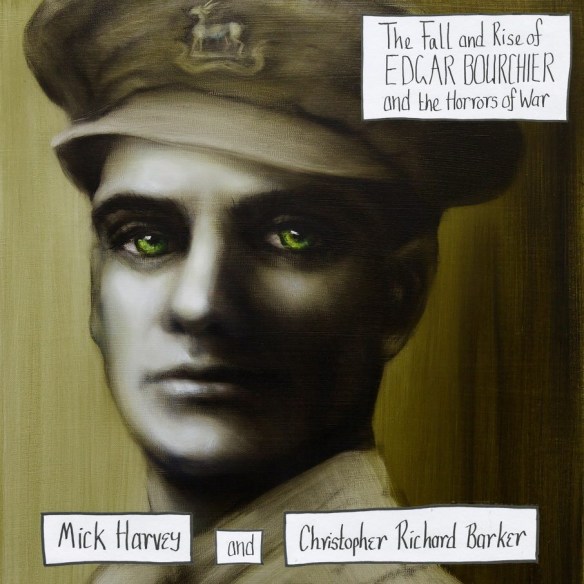
Edgar Bourchier didn’t serve his country in the First World War, at least not outside the imagination of author Christopher Richard Barker anyway. The poet and soldier Bourchier is a fictional character that Barker first created for his 2012 novella The Melancholy Haunting Of Nicholas Parkes, fabricating his Warwickshire birth and Passchendaele death and a vivid backstory of how his poetry took on an entire life of its own following his demise. That include a never-realised Weimar cabaret show, the re-discovery of his words during the turbulent Parisian revolution of the Sixties to ‘new’ realisations his (Barker’s) poetry with Mick Harvey.The Fall And Rise Of Edgar Bourchier And The Horrors Of War is thus a conceptual tribute to the endeavours of an Unknown Soldier that never actually existed, but whom speaks for a whole generation of conscripted boys.
Harvey’s experience as a producer, vocalist and a multi-instrumentalist lends these songs the requisite sensitivity, drama and horror to evoke the realities of life in the trenches, all seen from the first-hand vantage point of a contemporary observer. Veering from wistful, mournful folk on tracks like ‘Listen In The Twilight Breeze’ to distorted, feisty rock on ‘The Last Bastard Son Of War’, this is an album inevitably loaded with dramatic, thought-provoking moments. Harvey leads an ensemble cast including his long-time collaborator JP Shilo, vocalists Jade Imagine, Alain Johannes and Simon Breed across fifteen stirring tracks written collaboratively with Barker. Through these songs we hear the hatred of the footsoldiers toward their stiff upper-lipped superiors and their natural reluctance at finding themselves defending their country in spite of the hollow promises of glory and prosperity.
‘Softly Spoken Bill’ observes a callow young soldier thrust into the role of unwilling cannon fodder, losing the plot as he legs it toward the enemy and ultimately getting sent back to Blighty suffering from an early, undiagnosed, wilfully ignored form of PTSD. That effect on these young men can be heard again on ‘The Expressionist Tell #1’ and ‘#2’, describing the numbing, hollowed-out impact that barrages of mustard gas and incessant mortar fire would have on even the most resolute of individuals, reducing them to ghostly human shields in the name of a greater peace.
To call this harrowing would be a pointless understatement, even as Bourchier’s narrative moves from a sort of forced jingoism to the terrifying, cloying sound art of ‘The Messenger’, in which we hear of the falsehoods of life on the frontline that were forbidden from being reported back home.
As time passes and collective memories fade, we need such honest, unflinching descriptions of the manmade hell-on-earth of war to lead us not into the temptations of conflict as our only means of resolving differences. At a time when ugly, incendiary rhetoric between nations is at an all-time high, as peacetime defence spending is increasing, and as Cold War treaties and agreements are unilaterally scrapped, we need the likes of Bourchier’s posthumous words more than ever – irrespective of their false providence – lest we forget.
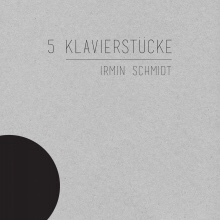
5 Klavierstücke is Can co-founder Irmin Schmidt’s first album since 2015’s career-spanning Electro Violet, and finds the composer – ably assisted by Gareth Jones – playing not just one, but two pianos on five spontaneous compositions.
Well, I say spontaneous; one of Schmidt’s pianos, a Pleyel, was prepared following the teachings of his onetime mentor John Cage, whose various prepared piano compositions over a roughly 25 year period are perhaps the best exemplars of adding nuts, bolts and all sorts of contraptions to piano wires to disrupt their typical sound. It is a painstaking approach that few have the energy and artistic vision to undertake, since one needs to almost surrender one’s compositional ideas to the piano before striking a single note; unprepared, a composer may, in their head, create an expectation of what a song might sound like – when prepared, the composer cannot make those assumptions, for the piano will never behave precisely the same each time unless the precise preparations are followed each and every time. It is one manifestation of Cage’s lifelong obsession with chance interventions into the composition process.
Alongside the prepared piano, Schmidt also used a Steinway, his instrument not that much older than the octogenarian composer himself, and the five tracks alternate between both instruments, the Steinway or the prepared Pleyel. Aside from natural studio ambience, no further gimmicky or sonic trickery was employed, even though at times it’s hard to convince your ears that could possibly be the case.
Though I’m generally not a fan of the track-by-track album dissection approach these days, the five pieces here seem to justify individual analysis on this occasion. These are songs that contain a quiet drama, a composer’s natural instinct for melody and the white space in which the notes can float, uninterrupted, unadorned or adorned depending on which piano is being used. They may be formed from complex treatments, but the results are surprisingly sparse, bringing to mind Chopin’s observation that “simplicity is the final achievement. After one has played a vast quantity of notes, and more notes, it is simplicity that emerges as the crowning reward of art.”
I.
Delicate, filigree playing gives way to noisier, percussive sections from the prepared piano. At times, the repeated prepared bass note sounds like a very meditative jazz rhythm section that’s been asked to wait it out in the background, or notes that sound like the extended echoes of a gong.
II.
Rain-like sounds and insistent rumbling infiltrate the natural resonance of the sporadic unprepared piano notes. After a while, the piece opens out into a section that sounds like a clanking Hang pattern, one that is intensely melodic but unrecognisable from a piano.
III.
Percussive, low-register sketches are coupled with high-register sounds not unlike a cymbal. Loud shards of sound arrive without expectation, almost as if someone is driven to emphatically striking the side of the piano.
IV.
Beginning with churning, bass-heavy arpeggios reminiscent of some of Throbbing Gristle or Dome’s most regimented work, the addition of sprinkles of unaltered piano ends up making this sound like some sort of heavily-shrouded exotica or a spontaneous jazz cop theme. ‘IV’ accelerates toward the end into a thunderous, panic-inducing conclusion that leaves nothing but cavernous reverb in its wake.
V.
This is vaguely reminiscent of Jacques Louissier’s interpretations of Satie’s Gymnopedies and Gnossiennes or a Sunday afternoon Bill Evans session, all gentle, delicate melody and harmonics. That’s the case until the very end, when a clangorous discordancy comes to the fore to bring this outstanding, understated album to a conclusion.
Jon Spencer‘s fantastic debut solo album is perhaps exactly what you’d expect from this purveyor of raucous goodtime rock ‘n’ roll, even if you’ve only taken the most cursory of listens to the Blues Explosion, Boss Hog or Pussy Galore.
I reviewed Spencer Sings The Hits! for Clash – click here to read my comments. Bellbottoms are optional.
(c) 2018 Mat Smith / Documentary Evidence for Clash
To celebrate Mute‘s 40th anti-versary, electronic musician, 0.5 label owner and Small Doses publisher Iv/An has issued a unique tribute to the formative years of Daniel Miller‘s label.
Iv/An has previously released a carefully-hidden cover of The Normal‘s ‘Warm Leatherette’ – spliced with Donna Summer’s ‘I Feel Love’ – on a CDr that came with an issue of Small Doses that coincided with the 35th anniversary of Miller’s debut single. For its 40th, he has issued a highly limited handmade object in a private edition of just twenty copies, containing a CDr with a new version of ‘Warm Leatherette’ interspersed with sections recognisable from Depeche Mode‘s ‘I Sometimes Wish I Was Dead’ and Nitzer Ebb‘s ‘Join In The Chant’.
The CD also includes a new track ‘FG/FT’ based on Fad Gadget‘s ‘Ricky’s Hand’, ‘New Jerusalem’ by Frank Tovey and another early Ebb track, ‘Violent Playground’; taking the concept of documentary evidence to an obsessive level that I could only ever dream of, the lyrics on ‘FG/FT’ are derived from Biba Kopf’s liner notes to The Fad Gadget Singles, a snippet of Fad’s own ‘Insecticide’ and an old Mute LibTech article about Fad / Frank. The final track on the EP is a cover of Yazoo‘s ‘Bad Connection’ containing sections of ‘Back To Nature’, ‘Salt Lake City Sunday’ and ‘Lady Shave’ by Fad Gadget, and Yazoo’s own ‘Goodbye 70s’. The effect is like listening to an Eric Radcliffe and John Fryer DJ set at a Blackwing Mute staff party, with exclusive invites to just a handful of twenty fortunate souls.
The cardboard sleeve quotes J.G. Ballard’s seminal and controversial 1973 novel Crash, one of the primary influences on Miller’s lyrics for ‘Warm Leatherette’, along with still life photocopied images of Ballard and two of the novel’s narrator’s main muses, both of whom died in car accidents – James Dean and Grace Kelly.
The new version of ‘Warm Leatherette’ is available at 0.5’s Bandcamp page as a free download and can be streamed below. Iv/An has also created a video for the track, which you can also find below.
Upon the release of his career-surveying Memento Mori compilation, I will have the enormous pleasure of talking to Barry Adamson at a very special Rough Trade East event on 7th November from 7pm.
Barry Adamson talks to Mat Smith about his 40 years in music, taking in his formative beginnings with Magazine, his time as a member of Nick Cave and the Bad Seeds, film soundtracks and his solo career, as a musician and composer.
This will be followed by a short set of songs from his new 40 year anthology ‘Memento Mori’.
After the performance there will be a signing where Barry will be available to sign his new album and items from throughout his career.
Tickets can be obtained through Rough Trade’s website here.