Mute 4.0: Silicon Teens – Music For Parties (Mute album, 1980)

siliconteens_musicforparties2

As part of Mute‘s fortieth ‘anti-versary’, the label is making available very special limited edition vinyl versions of selected releases from their four decades of releasing and curating incredible music. To celebrate this element of Mute 4.0, we’re re-posting reviews of those special albums from the depths of the Documentary Evidence archives. Full details on the releases can be found here.

After launching Mute Records with his single ‘TVOD / Warm Leatherette’ as The Normal, few would have expected Daniel Miller‘s next musical move to be an album of (mostly) covers of old rock ‘n’ roll songs. But, then again, if you believed the liner notes Music For Parties by Silicon Teens wasn’t by Daniel Miller at all. Rather, the album was made by Paul (percussion), Diane (synthesizer), Jacki (synthesizer) and Daryl (vocals) and produced by Larry Least (a pseudonym Miller would use again as a producer for Missing Scientists and Alex Fergusson). Eric Hine and Eric Radcliffe provided engineering duties for the LP, half of which was recorded at Radcliffe’s Blackwing studio in London, the location for many early Mute recording sessions.

Not having been aware of Daniel Miller, Mute or anything much when this was released (I was four years old), I’m not sure if anyone was suckered in by the ruse at the time – by the time I fell in love with Mute in 1991, the secret (if it ever was one) was already out; Biba Kopf’s Documentary Evidence pamphlet made it completely clear that Silicon Teens was the work of one man and one man alone: Daniel Miller. Apparently, at the time, actors playing the fake quartet would be deployed for interviews. A promotional photo for the group, taken by Simone Grant, included two people whose names are now lost to the mists of time standing in for Diane and Jackie, with Miller and Fad Gadget’s Frank Tovey taking the roles of Daryl and Paul, all four sporting some very Velvet Underground shades.
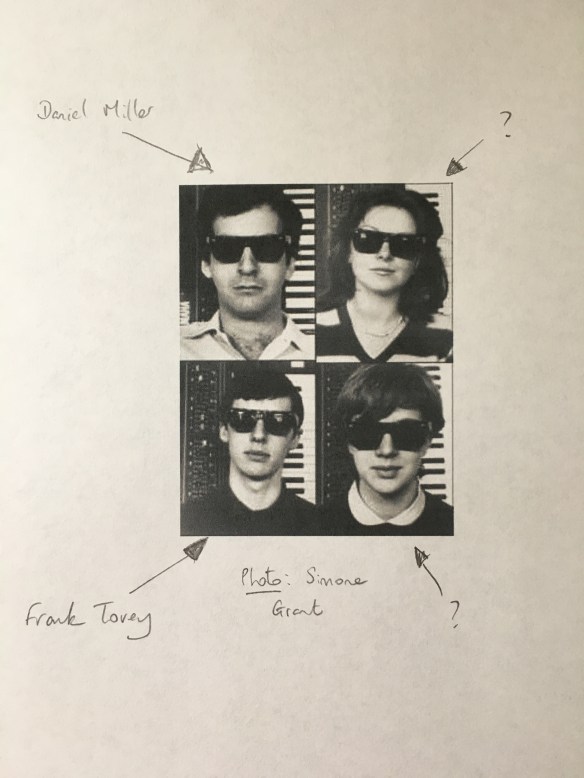
2018-10-07 13.55.43

Anyone familiar with ‘Daryl’s particular brand of singing (nasal, a definite punk-informed delivery) would detect that this was a Miller project from the first lines of opener ‘Memphis Tennessee’; anyone familiar with his electronics work before and after would spot his unique synth work in the chirpy sounds and harsh dissonant interruptions. Anyone who didn’t, but was listening closely to the lyrics of one of the four Miller compositions here, ‘TV Playtime’, may have finally got the connection with the line ‘TV OD, video breakdown‘ delivered in a wobbly voice during one section of that track, while behind the watery voice malfunctioning synths not dissimilar to those deployed on Fad Gadget’s ‘Ricky’s Hand’ flutter and bleep.

To my shame, I only bought this in 2011, though I had bought the album’s three main 7″ singles years before that. I picked up a CD copy of the album from Rough Trade East and happened upon it in the ‘punk’ section; I scoffed at first, until I remembered that when I’d played the version of ‘Memphis Tennessee’ to my dad – an avowed Chuck Berry fan – he screwed his face up in disgust, as if the generally polite sounds of Miller’s version were somehow abrasive on the ears or that making an electronic facsimile copy of a rock ‘n’ roll track was like sacrificing a holy cow; it’s how I’d seen footage of people in punk documentaries reacting to the Sex Pistols, so perhaps Music For Parties was punk after all. Certainly, in ‘TV Playtime’ there is a dimension which evokes the uncompromising sound of Suicide and in turn the pre-Dare sound of Human League at their most uncompromising.

One of my favourite tracks here is Miller’s take on The Kinks’ ‘You Really Got Me’, where the proto-punk / garage rock central riff is replaced with a buzzing synth delivered over a simple motorik beat. If this had been released as a single it could potentially have been chart-bothering, compared with the slightly more bouncy ‘Just Like Eddie’ which apparently did reasonably well as a single. ‘Do Wah Diddy’ and ‘Do You Love Me’ again are brilliant; these were two tracks that I absolutely detested as a child when they cropped up on radio. The latter is frankly among the most manically joyous songs I own, even if it doesn’t start out that way. The album version of ‘Let’s Dance’ sounds like Depeche Mode‘s ‘Photographic’ in its Some Bizarre Album incarnation; like Soft Cell did with their 12″ version of ‘Tainted Love’ mixed with ‘Where Did Our Love Go?’, you almost long for someone to hitch the Teens and Mode tracks together. Irrespective, it’s very danceable, with some quite tasty big fat synth notes as well. The Ramones also covered ‘Let’s Dance’ for their début; when rendered on Ramones as amphetamine-fuelled speed-punk it made complete sense alongside their own ‘Beat On The Brat’, ‘Sheena Is A Punk Rocker’ and ‘Now I Wanna Sniff Some Glue’; here too, as a piece of high-energy synthpop, it likewise makes complete sense and the link to The Ramones’ version comes in as Miller snarls the ‘1, 2, 3, 4‘ intro.

Aside from the abrasive ‘TV Playtime’, Miller also contributes three other compositions to Music For Parties. ‘Chip ‘n Roll’ is an insanely upbeat synth pop gem, lots of handclaps and hissing hi-hats, as well as a gloriously twee main riff. It’s like Martin Gore‘s ‘Big Muff’ only way more poppy. ‘State Of Shock (Part Two)’ begs the question as to whether the Mute archives will ever turn up, or indeed if there ever was, a part one; this is a clanking, vaguely dark instrumental track with a stuttering rhythm and some squelchy sounds muttering away in the background. I’m not entirely what party you’d play this at; probably some dark, moody place where you’d be as likely to hear Kraftwerk nestled up alongside Throbbing Gristle and Cabaret Voltaire. Miller’s ‘Sun Flight’, originally a B-side to the ‘Just Like Eddie’ 7” and included here as a bonus track, is again reasonably dark and mysterious, the distorted chorus intonation of ‘Come to the sun‘ and some snatched radio conversation sounding like a course of action filled will danger, even if the main keyboard riff is singularly both captivating and entirely of its time.

Would an album like this ever get released today? Hardly likely. Music For Parties taps into a sense of kitsch excitement surrounding the relatively (then) untapped potential of the synth in a pop context. Prior to this, and other albums released at around the same time, the synth was mostly deployed by po-faced Progsters with lavish budgets to spend on huge modular synth behemoths. Music For Parties‘ most punk achievement was to take these songs from yesteryear, remodel them as cheeky pop tunes and inject some tradition-baiting lightheartedness.

For Mute 4.0, Music For Parties is being reissued as a vinyl LP.

First posted 2011; edited 2018. With thanks to Simone Grant.

MUTE4.0_V3

(c) 2018 Mat Smith / Documentary Evidence

Mute 4.0: VCMG – Ssss (Mute Artists album, 2012)

vcmg_ssss2

As part of Mute‘s fortieth ‘anti-versary’, the label is making available very special limited edition vinyl versions of selected releases from their four decades of releasing and curating incredible music. To celebrate this element of Mute 4.0, we’re re-posting reviews of those special albums from the depths of the Documentary Evidence archives. Full details on the releases can be found here.

Ssss is the minimal techno album collaboration devised by Depeche Mode‘s Martin L. Gore with original Depeche songwriter Vince Clarke, arriving over thirty years since the pair last worked together.

Vince was, at that time, one of the founding members of Depeche Mode who, in 1981, released Speak & Spell, one of that defining year’s great synthpop albums. Clarke’s departure from the band left Gore in charge of songwriting duties, a role that would allow him to move the band into far darker territory toward the dark electro-rock they are purveyors of today, while Vince has produced – with Alison Moyet as Yazoo and Andy Bell as Erasure – some of the best pop music of the last thirty years.

The idea of Clarke and Gore working together again seemed remote until Vince started mentioning their collaboration on Twitter. That project stemmed from Clarke listening to a lot of minimal techno – which itself seems remote until you consider the remixes of other artists Vince has submitted recently – and asking Gore if he’d like to work with him on a project in that style; he wanted it to be something casual, with no deadlines and no major expectations. Gore himself is a fan of the genre, as anyone who has heard his DJ mixes or heard the tracks he selects to be played just before Depeche Mode take the stage at one of their huge arena shows (always a strange thing to hear barely-there techno over the speakers at somewhere like the O2). Vince went out to his Twitter fanbase and asked what they should call the project and whilst I don’t know if the moniker VCMG was a tweeter’s suggestion, it nevertheless fits the project perfectly (personally, I liked my suggestion of calling themselves Speak & Spell in reference to the last time they worked together, but I’m not bitter).

Ssss was produced by Gore and Clarke and mixed by California’s Timothy Wilkes who goes under the moniker Überzone / Q. Wilkes’s involvement – and Stefan ‘Pole’ Betke’s mastering – adds a certain credibility to what could be seen as two long-in-the-tooth veterans dabbling in a genre that neither have a particular pedigree in.

Opener ‘Lowly’ starts with some chords that feel like they were borrowed from ‘Enjoy The Silence’ or ‘Never Let Me Down Again’ before a dark energy takes over, all buzzing, clamouring synths, solid beats and crunchy percussion. Some nice synth pads heighten the bleak, almost symphonic mood while some very Kraftwerkian pulses and squalls pop up in the background. ‘Lowly’ feels like one of the few tracks on Ssss where Gore slips into the pensive negativity that often creeps into his songwriting. ‘Windup Robot’ starts as one of the strongest tracks here, a shiny, sleek bass-heavy monster although it would have benefited from a touch of 303-style madness somewhere along the way.

‘Bendy Bass’, as its name suggests, has a bendy bass sound, crisp beats and some spinning, elastic synth sounds. The droning synths and wonky, hollow lead riff may be a bit overbearing for this to work on the dancefloor, but it’s engaging enough. The second half introduces a partial riff which reminds me of one of the 12″ remixes of Erasure’s ‘Chains Of Love’. ‘Recycle’ has a slowed-down, subtle sensuality to it, a throbbing bass sound and some neat synths that sound like Kraftwerk’s vision of what pure of electricity might sound like. The vaguely orchestral stabs and the dramatic section at the centre are a bit unnecessary, but ‘Recycle’ is nevertheless one of Ssss‘s best moments. Closing track ‘Flux’ features some nice, emotional riffs that wouldn’t go amiss on some of Depeche Mode’s more poignant moments, offset by percolating synths and hissing percussion.

As a purely ‘listening’ album, Ssss is not a disappointment; whether it would work in a Richie Hawtin club set is debatable, but as a collaboration between two electronic music stalwarts it is interesting and engaging stuff, and there’s no denying the quality of the synth design at work here. At times you do long for a more song-based collaboration, a chance to hear how Clarke would have wrapped his synths around Gore’s mournful lyrics, a Depeche Mode that never was, but that was clearly never the premise here (particularly as Gore is hardly the most prolific lyricist in the world). Nevertheless, there is a distinct sense of two musicians challenging each other by operating outside of their comfort zone, with very fine results indeed.

For Mute 4.0, Ssss is being reissued as an orange double LP edition.

First posted 2012; edited 2018.

MUTE4.0_V3

(c) 2018 Mat Smith / Documentary Evidence
Mute 4.0: Josh T. Pearson – Last Of The Country Gentlemen (Mute Artists album, 2011)

joshtpearson_lastofthecountrygentlemen2

As part of Mute‘s fortieth ‘anti-versary’, the label is making available very special limited edition vinyl versions of selected releases from their four decades of releasing and curating incredible music. To celebrate this element of Mute 4.0, we’re re-posting reviews of those special albums from the depths of the Documentary Evidence archives. Full details on the releases can be found here.

Last Of The Country Gentlemen, Josh T. Pearson‘s much-anticipated début album, garnered all manner of positive reviews in the run up to its release. In a climate where everyone seemed to be focussed on the retro punk stylings of The Vaccines, it was pleasing to see that an album consisting mostly of heart-wrenching confessionals delivered by a singer over simple accompaniment (mostly guitar, some strings) could get so much positive praise. The album was preceded by a piano version of the track ‘Country Dumb’, the album version resplendent with guitars and violin instead of piano, a towering yet fragile ballad that stirs something deep within.

On a personal level, Last Of The Country Gentlemen‘s gentle, emotional grace is deeply affecting. I listened to this over a weekend where we had sold or given away some clothes, toys and other ephemera belonging to our two girls, in itself a moving experience, and Pearson’s songs of transition seemed to heighten the fragile mood I was in over the weekend.

Pearson’s voice is a beautiful thing to listen to. Occasionally whispered, occasionally rising with clarion quality, the consistent aspect is that he makes every single syllable, every word and every line count; everything that comes from his mouth is freighted with depth and sentiment. Though his Texan twang is a million miles away from Antony Heggarty’s vocal gymnastics, the two singers share the same talent for soaking their most basic utterances in something indefinable which can leave you feeling affirmed, tearful and empty after listening to their music; you will need to invest almost everything you have into listening to these songs, and you will feel utterly spent at the conclusion. One song is hard enough; eight songs is nigh on torturous.

Last Of The Country Gentlemen was, according to The Times review, written during a period of heartbreak, and there is a definite theme of separation running through the eight songs here (three of which are well over ten minutes in length). However, with the exception of the bitter (yet controlled) statement of intent ‘Woman, When I’ve Raised Hell’, soaked in strings arranged by Dirty Three and Bad Seeds / Grinderman violinist Warren Ellis that amplify the mood palpably, the theme does not appear to be one of regret at his loss; more, there is a resigned air of Pearson almost forcing a separation, for the benefit of his lover. The twelve minute ‘Sweeheart I Ain’t Your Christ’ is a case in point – throughout this song, Pearson is effectively advising his lover that she’d be better off without him. That sense of setting someone free, for their benefit, especially if they don’t realise it, is just about the hardest damn thing to do, a selflessness that is gut-wrenchingly moving.

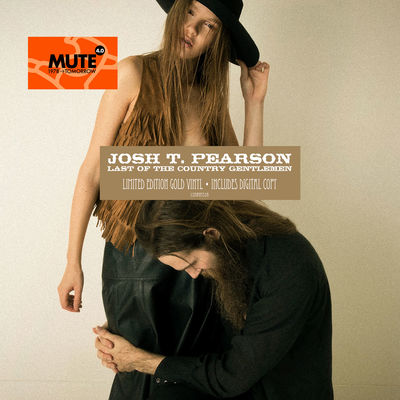
That theme is somewhat at odds with the sleeve, which appears to show Pearson trying to prevent his lover – whose face is blank, emotionless, detached – from leaving. He is grasping her legs, eyes closed, as if he would rather be dragged across the gravel rather than let her go, but it fits with the heartbreak and torment evident in the songs here. The track ‘Honeymoon’s Great! Wish You Were Her’, is a song about marrying someone but still being in love with someone else; this is the closest Pearson gets to being frustrated with his lot (albeit, it seems, of his own doing), and there is a section where the strings come up in great big swells that make you sympathetic toward his conflict, not angry at his infidelity. ‘Sorry With A Song’ is Pearson’s apology, of sorts.

Something about these songs encourage you to believe that Pearson is telling you his story here; like a début novel, the roman a clef tends to be written mostly from personal experience and emotions, containing thinly-disguised autobiographical aspirations more than pure fiction. These songs seem so honest, so genuine, that you want to believe that this is Pearson’s own story being articulated across these eight songs in spite of the desperation, frustration and sorrow contained here. We would be faintly disappointed if this songwriting was found to be fictional.

Last Of The Country Gentlemen was recorded in Berlin, and mixed in London by Gareth Jones (although a couple of tracks were mixed by David ‘Saxon’ Greenep). There is a sense of hands-off production on these tracks, a sense of respect for the songs themselves and the outpourings contained within them. Presenting the songs ‘just so’ is a brave, yet powerful thing to do; the album thus has a stark innocence that leaves me well and truly floored whenever I listen to it.

Special edition: Rough Trade Christmas Bonus

Mute released Last Of The Country Gentlemen again in November 2011 with a second disc of Josh T. Pearson performing a selection of Christmas songs, the occasion being Rough Trade Shops placing his album at the top of their 2011 album chart. The expanded version was only available from Rough Trade. To celebrate the release of Pearson’s Rough Trade Christmas Bonus, Rough Trade East printed up a special rubber curtain containing the picture from the Christmas EP’s sleeve to cover their front entrance.

The thing with Christmas carols is that they can often have an air of sadness about them; few have an obvious joyousness, though all have an inherent beauty. As such, Josh T. Pearson is well-suited to delivering the five songs he intimately performs here. Last Of The Country Gentlemen had few naturally uplifting moments, though – as evidenced by the live LP (again, only released through Rough Trade Shops) The King Is Dead – Pearson himself is actually pretty light-hearted and self-deprecating. Here we find him struggling while trying to pluck the notes to a lovely rendition of ‘Silent Night’, unaware that his musings are being recorded, cocking up the introduction to ‘Angels We Have Heard On High’ and delivering a faultless accapella rendition of ‘Away In A Manger’, which masterfully rescues the carol from thousands of painful school nativities. Likewise, his bluesy rendition of ‘O Little Town Of Bethlehem’ moves the song away from the tuneless butchering of this carol by assembled toddlers and into masterful, graceful territory. In defiance of his image as a humourless misanthrope, he even adds a wee coda of ‘Jingle Bells’ at the very end.

‘O Holy Night’ is testament to how Pearson can take a song that’s not his own and add his own distinctive style to create something utterly original. Here his reading sits somewhere between the melancholy grandeur of Last Of The Country Gentlemen and the more introspective aspects of the Rufus Wainwright back catalogue. In a burst of seasonal goodwill, an alternative version of of ‘O Holy Night’ was made available for free from Pearson’s own website.

For Mute 4.0, Last Of The Country Gentlemen is being reissued as a gold double LP edition.

First posted 2011; re-edited 2015; re-posted 2018

MUTE4.0_V3

(c) 2018 Mat Smith / Documentary Evidence

Mute 4.0: Apparat – The Devil’s Walk (Mute Artists album, 2011)

apparat_thedevilswalk2

As part of Mute‘s fortieth ‘anti-versary’, the label is making available very special limited edition vinyl versions of selected releases from their four decades of releasing and curating incredible music. To celebrate this element of Mute 4.0, we’re re-posting reviews of those special albums from the depths of the Documentary Evidence archives. Full details on the releases can be found here.

The Devil’s Walk, Sascha Ring‘s first Apparat album for Mute Artists is perhaps one of the most absorbing and moving pieces of music I’ve ever had the privilege of listening to. I write this like I’m surprised somehow, but I shouldn’t have been. I bought all three singles before the album was released (‘Ash / Black Veil’, ‘Black Water’ and ‘Song Of Los’) and with each one found myself deeply affected by the way those songs played subtly with my emotions. Thus expectations were raised fairly high from the beginning for The Devil’s Walk, though with that came the fear that the mood of those three tracks couldn’t be sustained across a whole LP. That fear was unfounded; it can.

That said, I’ve not finding it especially straightforward to write about The Devil’s Walk, since the exact word that I’m looking for to describe this album fails me. What I do know is that there is a sense of unifying sadness, making the album less about individual tracks and more about the overall sound. Uplifting moments are frequent, but fleeting and unexpected. Tracks will be progressing along a introspective, reflective path and then, out of nowhere, a subtle chord change will allow the light to seep in ever so slightly and just briefly, lifting the mood somehow; yet that inward-looking feeling is still there, underneath, meaning that those bursts of comparative euphoria, when listened to more closely, are never actually that uplifting after all.

iTunes and Mute Bank‘s website classifies The Devil’s Walk as an ‘electronic’ album, which to me creates a totally incorrect perspective on this album. Sure, it has electronic elements and I dare say a lot of this LP came about after tinkering with recorded sounds and vocals in some software package on a shiny Macbook, but in terms of instrumentation that tag doesn’t come close to describing this album. There are guitars – looped, acoustic passages; electric guitar patterns; what sounds like Stars Of The Lid / Labradford drones and distortion overtones; possible plucked ukulele riffs – reeds, harmonium sounds, strings and percussion that sounds like Photek dismantling an alarm clock or Matt Herbert recording breaks made entirely from the contents of his kitchen drawer. And everything comes with layer upon layer of slowly-evolving sound.

Sometimes those layers produce something like the opener ‘Sweet Unrest’, wherein the final layer to be added is some dreamy choral vocals, giving this an icy spirituality. Sometimes it’s the dark reverb of ‘Goodbye’, where that Labradford connection manifests itself with some clanging Spaghetti Western guitar sounds in the vein of that band’s E Luxo So, only with a constant bass drum rhythm that is felt more than heard. Those subtle chord changes and hypnotic vocals (from Anja Franziska Plascha) give this an exquisite poignancy and a heart-wrenching quality. Sometimes those layers produce the strained, almost Massive Attack stasis of ‘Candil De La Calle’ where shimmering vocals play alongside a multi-channel percussion restlessness of amazing intricacy.

‘The Soft Voices’ blends layers of piano, possibly a dulcimer and a murmuring guitar sound in a way that I read about Brian Wilson perfecting on Pet Sounds, whereupon he took Phil Spector’s methodology of layering sounds to a new level, leaving the listener questing to know what this strange instrument they were hearing actually was, when it was in fact many instruments layered atop one another. Perhaps the knackered short wave radio sound in the background is Sascha Ring’s homage to ‘Good Vibrations’; strings arrive unexpectedly; drums that wouldn’t have sounded out of place on Tubular Bells kick in; a sense of euphoria is reached, only to dissipate suddenly, leaving a wobbly bass noise and a fractured vocal from Ring. ‘Escape’ is delicate balladry, an emotive vocal and lots of constantly-shifting, constantly-evolving loops; it’s the type of song that requires concentration to identify the fact that it is indeed constantly developing, while the addition of strings and ethereal harmonies gives this a filmic quality.

Referencing Tubular Bells above, perhaps ‘A Bang In The Void’ is some sort of cross-generational electronica-weaned response to Mike Oldfield’s proggy opus, via Terry Riley’s In C. It takes a while to scale up via goodness-knows how many layers of pretty melodic sounds – I can’t work out what the instrument is or isn’t – and reaches a midpoint whereupon a broken trumpet pattern kicks in. I’m also reminded of Erasure‘s ’91 Steps’, as it shares some of the muted drama of that B-side.

Closer ‘Your House Is My World’ feels like it’s been lifted straight from a soundtrack to an indie flick that hasn’t been made yet, or maybe Grizzly Bear’s soundtrack to Dedication; very Yann Tiersen; very subtle; very processed; very dramatic; I have run out of superlatives. I am frankly exhausted from over-thinking about what that one word, that one crucial word is that describes this album.

The album was released in a gorgeous limited edition book CD format which includes lots of Gothic imagery, including a child-scaring etching on the front cover straight from an M.R. James ghost story. It also contains all the lyrics, and a read of those reveals the word I was looking for all along in this review – ephemeral. The atmosphere on The Devil’s Walk is one of ephemerality. Phew, I’m glad we resolved that. The limited CD format also includes the bonus track ‘The World Around You’ which is how Tears For Fears would have sounded if they’d been fed a diet of glitchy drone electronica.

For Mute 4.0, The Devil’s Walk is being reissued as a violet LP edition.

MUTE4.0_V3

First posted 2011; edited 2018.

(c) 2018 Mat Smith / Documentary Evidence

Bruce Gilbert – Monad (Touch single, 2011)

brucegilbert_monad

I was really looking forward to this release, I have to say. There is something about deeply experimental music being released on a 7” single that for some reason really appeals. I think it’s because the 7″ is so ordinarily suited to the ‘pop’ track that to hear anything other than pop music on a 7″ is quite exciting. Touch‘s Sevens series has included short releases by the likes of ex-Cabaret Voltaire sound recordist Chris Watson and Pan Sonic‘s sorely missed Mika Vainio. Bruce Gilbert‘s association with the label goes back many years, with albums like The Haring getting released on Touch (it was subsequently re-released by WMO). More recently the ex-Wire guitarist – as part of the group Souls On Board – took the B-side of a live split album with Savage Pencil, released on Touch sub-label Ash International. Monad is housed in a sleeve designed by Jon Wozencroft (as are most Touch releases) and lists out the instruments and tools Gilbert used boldly on the front (Korg Monotron Analogue Ribbon synth, Zoom RFX-200, Korg Kaos Pad 2, Apple GarageBand); there’s also a diagram by Gilbert himself on the back.

I looked up the definition of the word ‘monad’ and its meanings vary from being a small, single-celled organism, to – according to Leibniz’s metaphysics no less – an indestructible entity that is the ultimate fabric of the universe. This confusing word has little bearing on the two tracks included on the single, unless they refer to the songs as being solid and reasonably impenetrable soundscapes or their short duration (at 45rpm both are around two-and-a-half minutes long apiece).

‘Ingress’ is a dense drone whose layers are not immediately obvious unless you really concentrate; if you listen deeply you will pick out the various shifts in sound across the piece’s length, the changes in tone and the rich tug of the bass drone. The best way to describe ‘Ingress’ would be as an approximation of what loading tapes into a ZX Spectrum used to sound like, only this is more measured, more deliberate and more ostensibly ‘composed’ than that noise.

Over on the B-side, ‘Re-Exit’ is less constant, consisting of a throbbing, echoing bass loop offset by buzzing noises and a phasing, quiet drone out in the background. The bass loop provides a rhythm of sorts, but in essence its more of a thick pulse. It’s a style that Gilbert has deployed a number of times, both in his solo work and also with Graham Lewis as Dome. In it’s own, pretty sinister way, it’s beautiful.

First posted 2011; edited 2018.

(c) 2018 Mat Smith / Documentary Evidence

Nick Cave & The Bad Seeds – The Boatman’s Call (Mute album, 1997)

nctbs_boatmans

I was tempted to write this review with just one word. That word is ‘beautiful’. Written by Nick Cave at exactly the same time as Murder Ballads, these songs were written with simplicity in mind, and as such the majority of these superior compositions feature a stripped back Bad Seeds, and a heavy dose of piano. The contrast with Murder Ballads could not be greater, taking a deeply intimate, romantic and often spiritual tone. No one dies here, one may be relieved to know.

But maybe a little part of Nick Cave died in order to make a collection of songs; that part of him would be the preacher, the aggressor, the dervish spirit howling and caterwauling over a maelstrom of sensational music. It genuinely isn’t a criticism – I happen to think that this is among Cave’s finest work. Everything about The Boatman’s Call is black and white – the Johnny Cash-esque Anton Cobijn photo of a particularly harrowed Nick Cave on the front cover, through the predominance of the piano keys across the LP, through to the downright clarity of Cave’s songwriting. What’s most clear about The Boatman’s Call is the often obvious theme of these songs, for this is Nick Cave’s most directly personal collection of songs, from the post-PJ Harvey reflectiveness of the quirky folk leanings of ‘West Country Girl’ and ‘Black Hair’, through to his ruminations on his failed marriage on ‘People Just Ain’t No Good’ or ‘Where Do We Go Now But Nowhere’.

However, aside from a fair amount of openness from our tortured songsmith, The Boatman’s Call also features two generally beautiful love songs – ‘Lime Tree Arbour’ and ‘Brompton Oratory’. Like much of the album, these have a musical accompaniment from The Bad Seeds that is directly informed by subtle jazz but the latter also features a perfectly twee Casio rhythm that sounds like it survived from Cave’s original demo. The latter describes a trip made by Cave to Kensington’s famous, and imposing, landmark, and finds Cave wishing he were one of the stone apostles therein, just so that he wouldn’t have to deal with his muse’s intense beauty. It perfectly captures the intensity of romance’s first flourishes, that feeling of not being able to cope anymore. ‘Lime Tree Arbour’ is just mystical and beautiful, its waterside setting making me think of Murder Ballads‘ ‘Where The Wild Roses Grow’, with all the same romantic longings, just none of the death; an alternative ending, perhaps?

The album features the full Bad Seeds line-up (Mick Harvey, Blixa Bargeld, Thomas Wydler, the late Conway Savage, Martyn P. Casey, Jim Sclavunos and Warren Ellis), albeit in controlled doses, and benefits from an unusually restrained production job from Flood, who also produced the oft-slated U2 album Pop the same year. The style of production is subtle and delicate, and Cave’s vocal is dominant in the mix, casting a personal, intimate shadow over proceedings. It feels like a one-to-one connection between the narrator and sympathetic listener. Warren Ellis’ violin is also an important element here, receiving greater space in the mix than it had been given previously, bestowing the gypsy folk of ‘West Country Girl’ with a rabidly maudlin edge. His work on ‘Idiot Prayer’, perhaps the track closest to a classic Bad Seeds ballad sees his violin overtaking Blix’s fuzzy guitar as lead instrument, a sign of the sea change that was to come.

I have my own, highly personal reasons, for counting this among my favourite albums of all time. Suffice it to say, many years on, it’s the more miserable tracks here – like ‘Far From Me’ – that I find myself reflecting on when I think of that period in my life. ‘Can’t you find somebody else / That you can ring and tell?’, Cave sings on that penultimate, delicately poignant song. Wise words that I wish my younger self had heeded.

First published 2004; edited 2018.

(c) 2018 Mat Smith / Documentary Evidence

Nick Cave & The Bad Seeds – Distant Sky (Live In Copenhagen) (Bad Seed EP, 2018)

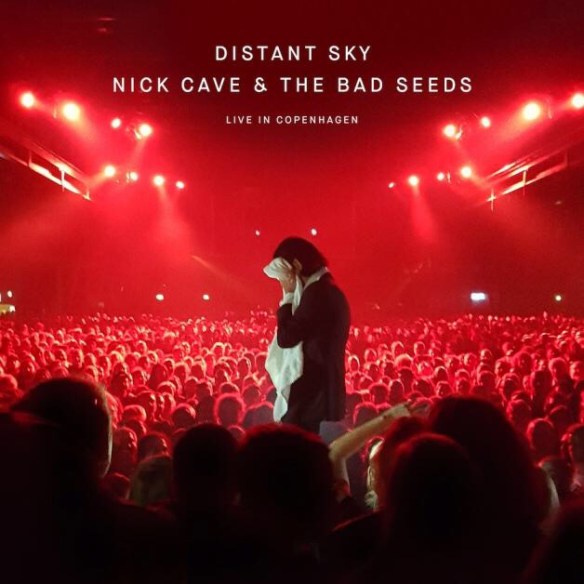
It’s been a while since I wrote about Nick Cave & The Bad Seeds – I think the last thing I put online was a not especially positive review of Push The Sky Away, and Skeleton Tree consequently just passed me by. I feel that I’ve rectified that with this review of the new Distant Sky (Live In Copenhagen) EP that was released last Friday.

You can read my review for the Clash website here.

I also reviewed the new Marianne Faithful album for the latest print issue of Clash, which features a wonderful new composition – ‘The Gypsy Fairie Queen’ – co-written with Cave; Marianne’s new LP was co-produced by Bad Seed stalwart Warren Ellis.

(c) 2018 Mat Smith / Documentary Evidence for Clash
Daniel Blumberg (Clash interview, 2018)

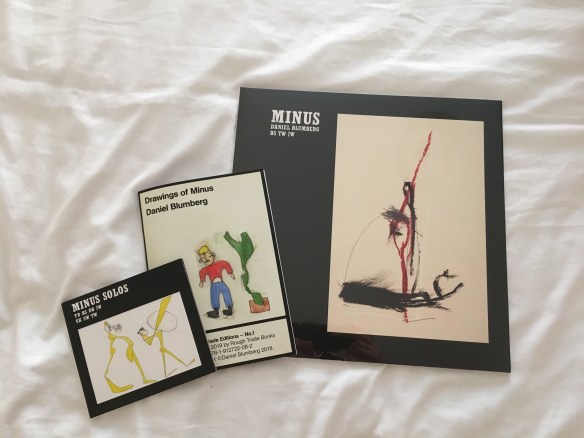
I have concluded that Daniel Blumberg is probably one of the most important signings to join the Mute roster in its entire forty years of releasing records. His debut solo album, Minus, written after immersing himself in London’s improvised music scene, towers above just about everything else around it, capturing a visionary songwriter and musician tearing up his own rule book for the sake of furthering his art.

To coincide with the release of ‘Family’, an unreleased song from Minus sessions, Clash have today published an interview that I did with Daniel Blumberg in July, wherein he explains the genesis of the album and the impulses that drive him.

In my humble opinion, it tells a story that needed to be told, and provides an insight into the mind of a prodigious talent; I am enormously proud of this feature.

Read the interview here.

Watch the video for ‘Family’ here.

(c) 2018 Mat Smith / Documentary Evidence for Clash
Complex Industrialist: Douglas J. McCarthy (interview, 2012)

I interviewed Nitzer Ebb’s Douglas McCarthy in 2012. At that time, Doug was prepping his first solo LP, at that time intended to be called Life Is Sucking The Life Out Of Me, but which eventually emerged as Kill Your Friends on Pylon later that year. My interview was originally accompanied by a promotional photo that Doug had supplied, but which the photographer insisted I removed. I’ve no idea now if this photo is the one she asked me to remove – if it is, I will happily remove (again).

One of the two most important electronic acts to emerge from Essex in the Eighties, Nitzer Ebb surprised a lot of fans by reforming in the 2000s, not just for shows as is the current money-spinning way for the record industry machine to milk a band’s back catalogue, but also to record new material. The trio of Bon Harris, Douglas McCarthy and Jason Payne that had recorded 1994’s supposed swansong, Big Hit, almost ten years earlier, came back together to record Industrial Complex (also abbreviated to ICP), an album which managed to complete the circle that Nitzer Ebb had started but never quite finished, returning them to the punishing electronic body music of their earliest Power Of Voice and Mute releases. With Nitzer Ebb now on downtime after a couple of intense years of touring, including a powerful slot at Mute’s Short Circuit festival at The Roundhouse in London last year, Douglas McCarthy has recorded his first solo album, Life Is Sucking The Life Out Of Me. The album is due for release in April 2012.

‘Last year proved to be a bit frustrating for me with a few projects and tours being stymied by situations, events or people beyond my control,’ explains McCarthy by email from Los Angeles on the origins of Life Is Sucking The Life Out Of Me, ‘so I decided to take matters into my own hands. As it has turned out it was a fortuitous judgement call as, about six months after I started writing, we decided that we would take a year out from Nitzer Ebb. I also wanted to make music that was much more club based than Nitzer Ebb have ever done.’

McCarthy first moved to LA in the early Nineties, then spent some time moving round the country before heading back to England toward the end of the decade. ‘I initially came back to LA in 2005 to work with Bon on the reunion tour and then as the tour progressed and we started to work on new tracks it seemed sensible to relocate from London and work on the album that eventually was released as Industrial Complex.’ Life Is Sucking The Life Out Of Me, however, was begun back in the UK. ‘My father was in the last stages of a very grim terminal illness,’ says McCarthy, ‘and so my wife and I spent a lot of time in the UK. Going out to various nights and parties like my dear friend Richard Clouston’s Cosey Club really reminded me of a lot of things from years gone by and played a big part in the approach to the album. After my dad died, my wife and I came back to LA where the rest of the album was written and recorded in a relatively short space of time. We worked in an amazingly relaxed way, which is a direct response to being out here I think. I actually achieved much more taking that approach.’

While details of McCarthy’s solo record are starting to emerge, ears are still ringing from the breathtaking, urgent fast-paced beats and classic syncopated basslines of 2009’s Industrial Complex, the release of which was promoted by two hard years of touring and almost 150 live shows. ‘It came about after I had recorded an album as Fixmer/McCarthy with Terence Fixmer,’ says McCarthy of Industrial Complex‘s origins. ‘We toured extensively and would always drop in one or two classic Nitzer Ebb tracks. Inevitably it lead those cunning promoters to start asking if Nitzer Ebb could actually do shows again. I emailed Bon and as we were both going to be in the Midwest we agreed to meet up in Chicago for a chat. All went well and we agreed to play a smattering of festivals in Europe. Then, so as not to just be sitting on our arses between events, we added club shows in between. As it turned out we play something like 75 shows in Europe, Japan, Australia, New Zealand, North America and South America. I had already moved from London to LA to rehearse and prepare for the tour so when we had breaks from touring, that was our home. We decided to fill the time with trying out some new ideas and, remarkably given our long break from the studio, it was fun, so we carried on in our own sweet time until we thought we had an album.’

‘In a lot of ways it was very similar to making Big Hit,’ continues McCarthy. ‘We would often start with a blank piece of paper, just evolving ideas in the simplest form as the mood took us – a bass part, a keyboard part, a percussion part, a guitar part, whatever was easiest to start an idea rolling. After that we would work on it for usually no more than a day, put it to bed and start the whole process again on something new. We carried on like that until we had over thirty tracks and then thought we better stop and pick the ones that would be a good collection for ICP. That’s the main difference, with Big Hit we really wrung the living hell out of the tracks before moving on to the next.’

The brittle Big Hit was preceded by Ebbhead, the 1991 album produced by Alan Wilder, recently of Recoil fame, with whom the trio of McCarthy, Harris and Payne performed on stage at The Roundhouse last year. In 1991 Wilder was the musical backbone of Depeche Mode, the other important electronic band to emerge from Essex in case you were wondering. ‘We toured with the Mode for the second time on the Violator album tour in North America in 1990, which was a life changing experience for all and sundry. On the tour we discussed working with Alan upon our return to the studio. The plan was for him to co-produce with Flood, which worked out perfectly. We approached Ebbhead this way because we saw how well these two could work together on Violator and wanted a more ‘musical’ approach to the songs, which is really at the core of someone like Alan as he is classically trained. The combination of that with Flood and Bon’s fantastic knob-twiddling, and my desire to ‘sing’ more, were all part of the evolution of that album.’ Ebbhead showcased a new, tortured emotional depth for Nitzer Ebb, even if it was obscured by the lurid dayglo colours of the album’s bright yellow sleeve.

‘We started as school friends who enjoyed skateboarding, music and drinking cider,’ recalls McCarthy of the halcyon youthful days from which Nitzer Ebb would eventually emerge. ‘Musically, we took our influences from a fairly eclectic array of artists and styles – Forties jazz, Fifties rock ‘n’ roll, glam, disco, punk and the post-punk scene that was emerging as we were starting to go out. Bands like The Banshees, Bauhaus, Killing Joke, Theatre of Hate, The Birthday Party, Neubauten and Malaria! were all playing live shows that we would go to. We were also listening to Cabaret Voltaire, DAF, Fad Gadget, The Human League, Abwärts, Virgin Prunes, Soft Cell and The Normal among many more.’

Nitzer Ebb signed to Mute in time for the release of their first album, 1987’s insistent That Total Age, which was produced by Daniel Miller. ‘We were very aware of Mute and Daniel Miller of course; growing up in Essex with Depeche down the road in Basildon meant it was a no-brainer. Once we had signed Dan took me and Bon over to Hansa Tonstudio in Berlin to remix ‘Let Your Body Learn’ with Gareth Jones. It was our first trip to Berlin and at the airport we ran into Diamanda Galás, who was in the process of moving there so we all took pieces of her luggage as she had a mountain of stuff and had a very amusing flight getting told off by the flight attendants. It was like being Daniel’s naughty nephews on a weekend cultural break.’ Of their former label head, McCarthy has nothing but high praise. ‘Daniel has always been full of fantastic ideas, some more fantastic than others, but he never shows any diminished excitement about a project even, as it often does, when it gets tough.’

As the interview began to wind up, it seemed appropriate to ask McCarthy about the pronunciation of Nitzer Ebb, a debate which has seen fans take two sides, those who call the band Night-zer Ebb and those who prefer Nitt-zer Ebb. McCarthy is ambiguous as ever. ‘To be honest it started off as Night-zer but after decades of Nitt-zer I slip between the two.’

Originally posted; re-posted 2018.

(c) 2012 MJA Smith / Documentary Evidence

Cold War Night Life presents Non-Stop Electronic Cabaret (The Islington, London 29.09.2018)

If you’re remotely interested in electronic music you must have been asleep under a rock to have missed the Soft Cell activities that have been happening this year – a huge box set, a singles collection and a tour.

Ahead of Marc Almond and Dave Ball’s final London date, Simon Helm’s Cold War Night Life website have curated a very special event in Islington under the wonderful title Non-Stop Electronic Cabaret on September 29, 2018.

The event brings together all-too-easily overlooked Canadian synth duo Rational Youth (whose debut album begat Helm’s site its name), fellow Canadian moody electronic act Psyche and Sweden’s Page – to the best of my knowledge the only synth group to openly claim to be directly influenced by Daniel Miller’s cheeky short-lived fake group Silicon Teens.

Discerning electronic music fans can get tickets via Billetto.

Venue: The Islington, Tolpuddle Street, N1 (Angel Tube)
Date: Saturday, 29 September 2018
Times: doors at 7:00 pm, first band on stage at 7:30 pm, ends at 11:00 pm
Tickets: £15 plus agency fee through Billetto
Ages: 18+

(c) 2018 Mat Smith / Documentary Evidence