Complex Industrialist: Douglas J. McCarthy (interview, 2012)

I interviewed Nitzer Ebb’s Douglas McCarthy in 2012. At that time, Doug was prepping his first solo LP, at that time intended to be called Life Is Sucking The Life Out Of Me, but which eventually emerged as Kill Your Friends on Pylon later that year. My interview was originally accompanied by a promotional photo that Doug had supplied, but which the photographer insisted I removed. I’ve no idea now if this photo is the one she asked me to remove – if it is, I will happily remove (again).

One of the two most important electronic acts to emerge from Essex in the Eighties, Nitzer Ebb surprised a lot of fans by reforming in the 2000s, not just for shows as is the current money-spinning way for the record industry machine to milk a band’s back catalogue, but also to record new material. The trio of Bon Harris, Douglas McCarthy and Jason Payne that had recorded 1994’s supposed swansong, Big Hit, almost ten years earlier, came back together to record Industrial Complex (also abbreviated to ICP), an album which managed to complete the circle that Nitzer Ebb had started but never quite finished, returning them to the punishing electronic body music of their earliest Power Of Voice and Mute releases. With Nitzer Ebb now on downtime after a couple of intense years of touring, including a powerful slot at Mute’s Short Circuit festival at The Roundhouse in London last year, Douglas McCarthy has recorded his first solo album, Life Is Sucking The Life Out Of Me. The album is due for release in April 2012.

‘Last year proved to be a bit frustrating for me with a few projects and tours being stymied by situations, events or people beyond my control,’ explains McCarthy by email from Los Angeles on the origins of Life Is Sucking The Life Out Of Me, ‘so I decided to take matters into my own hands. As it has turned out it was a fortuitous judgement call as, about six months after I started writing, we decided that we would take a year out from Nitzer Ebb. I also wanted to make music that was much more club based than Nitzer Ebb have ever done.’

McCarthy first moved to LA in the early Nineties, then spent some time moving round the country before heading back to England toward the end of the decade. ‘I initially came back to LA in 2005 to work with Bon on the reunion tour and then as the tour progressed and we started to work on new tracks it seemed sensible to relocate from London and work on the album that eventually was released as Industrial Complex.’ Life Is Sucking The Life Out Of Me, however, was begun back in the UK. ‘My father was in the last stages of a very grim terminal illness,’ says McCarthy, ‘and so my wife and I spent a lot of time in the UK. Going out to various nights and parties like my dear friend Richard Clouston’s Cosey Club really reminded me of a lot of things from years gone by and played a big part in the approach to the album. After my dad died, my wife and I came back to LA where the rest of the album was written and recorded in a relatively short space of time. We worked in an amazingly relaxed way, which is a direct response to being out here I think. I actually achieved much more taking that approach.’

While details of McCarthy’s solo record are starting to emerge, ears are still ringing from the breathtaking, urgent fast-paced beats and classic syncopated basslines of 2009’s Industrial Complex, the release of which was promoted by two hard years of touring and almost 150 live shows. ‘It came about after I had recorded an album as Fixmer/McCarthy with Terence Fixmer,’ says McCarthy of Industrial Complex‘s origins. ‘We toured extensively and would always drop in one or two classic Nitzer Ebb tracks. Inevitably it lead those cunning promoters to start asking if Nitzer Ebb could actually do shows again. I emailed Bon and as we were both going to be in the Midwest we agreed to meet up in Chicago for a chat. All went well and we agreed to play a smattering of festivals in Europe. Then, so as not to just be sitting on our arses between events, we added club shows in between. As it turned out we play something like 75 shows in Europe, Japan, Australia, New Zealand, North America and South America. I had already moved from London to LA to rehearse and prepare for the tour so when we had breaks from touring, that was our home. We decided to fill the time with trying out some new ideas and, remarkably given our long break from the studio, it was fun, so we carried on in our own sweet time until we thought we had an album.’

‘In a lot of ways it was very similar to making Big Hit,’ continues McCarthy. ‘We would often start with a blank piece of paper, just evolving ideas in the simplest form as the mood took us – a bass part, a keyboard part, a percussion part, a guitar part, whatever was easiest to start an idea rolling. After that we would work on it for usually no more than a day, put it to bed and start the whole process again on something new. We carried on like that until we had over thirty tracks and then thought we better stop and pick the ones that would be a good collection for ICP. That’s the main difference, with Big Hit we really wrung the living hell out of the tracks before moving on to the next.’

The brittle Big Hit was preceded by Ebbhead, the 1991 album produced by Alan Wilder, recently of Recoil fame, with whom the trio of McCarthy, Harris and Payne performed on stage at The Roundhouse last year. In 1991 Wilder was the musical backbone of Depeche Mode, the other important electronic band to emerge from Essex in case you were wondering. ‘We toured with the Mode for the second time on the Violator album tour in North America in 1990, which was a life changing experience for all and sundry. On the tour we discussed working with Alan upon our return to the studio. The plan was for him to co-produce with Flood, which worked out perfectly. We approached Ebbhead this way because we saw how well these two could work together on Violator and wanted a more ‘musical’ approach to the songs, which is really at the core of someone like Alan as he is classically trained. The combination of that with Flood and Bon’s fantastic knob-twiddling, and my desire to ‘sing’ more, were all part of the evolution of that album.’ Ebbhead showcased a new, tortured emotional depth for Nitzer Ebb, even if it was obscured by the lurid dayglo colours of the album’s bright yellow sleeve.

‘We started as school friends who enjoyed skateboarding, music and drinking cider,’ recalls McCarthy of the halcyon youthful days from which Nitzer Ebb would eventually emerge. ‘Musically, we took our influences from a fairly eclectic array of artists and styles – Forties jazz, Fifties rock ‘n’ roll, glam, disco, punk and the post-punk scene that was emerging as we were starting to go out. Bands like The Banshees, Bauhaus, Killing Joke, Theatre of Hate, The Birthday Party, Neubauten and Malaria! were all playing live shows that we would go to. We were also listening to Cabaret Voltaire, DAF, Fad Gadget, The Human League, Abwärts, Virgin Prunes, Soft Cell and The Normal among many more.’

Nitzer Ebb signed to Mute in time for the release of their first album, 1987’s insistent That Total Age, which was produced by Daniel Miller. ‘We were very aware of Mute and Daniel Miller of course; growing up in Essex with Depeche down the road in Basildon meant it was a no-brainer. Once we had signed Dan took me and Bon over to Hansa Tonstudio in Berlin to remix ‘Let Your Body Learn’ with Gareth Jones. It was our first trip to Berlin and at the airport we ran into Diamanda Galás, who was in the process of moving there so we all took pieces of her luggage as she had a mountain of stuff and had a very amusing flight getting told off by the flight attendants. It was like being Daniel’s naughty nephews on a weekend cultural break.’ Of their former label head, McCarthy has nothing but high praise. ‘Daniel has always been full of fantastic ideas, some more fantastic than others, but he never shows any diminished excitement about a project even, as it often does, when it gets tough.’

As the interview began to wind up, it seemed appropriate to ask McCarthy about the pronunciation of Nitzer Ebb, a debate which has seen fans take two sides, those who call the band Night-zer Ebb and those who prefer Nitt-zer Ebb. McCarthy is ambiguous as ever. ‘To be honest it started off as Night-zer but after decades of Nitt-zer I slip between the two.’

Originally posted; re-posted 2018.

(c) 2012 MJA Smith / Documentary Evidence

Cold War Night Life presents Non-Stop Electronic Cabaret (The Islington, London 29.09.2018)

If you’re remotely interested in electronic music you must have been asleep under a rock to have missed the Soft Cell activities that have been happening this year – a huge box set, a singles collection and a tour.

Ahead of Marc Almond and Dave Ball’s final London date, Simon Helm’s Cold War Night Life website have curated a very special event in Islington under the wonderful title Non-Stop Electronic Cabaret on September 29, 2018.

The event brings together all-too-easily overlooked Canadian synth duo Rational Youth (whose debut album begat Helm’s site its name), fellow Canadian moody electronic act Psyche and Sweden’s Page – to the best of my knowledge the only synth group to openly claim to be directly influenced by Daniel Miller’s cheeky short-lived fake group Silicon Teens.

Discerning electronic music fans can get tickets via Billetto.

Venue: The Islington, Tolpuddle Street, N1 (Angel Tube)
Date: Saturday, 29 September 2018
Times: doors at 7:00 pm, first band on stage at 7:30 pm, ends at 11:00 pm
Tickets: £15 plus agency fee through Billetto
Ages: 18+

(c) 2018 Mat Smith / Documentary Evidence

Nitzer Ebb – 1982-2010: The Box Set (Pylon Records, 2018)

Nitzer Ebb is a band whose music dominated my teenage years. My happiest moments may have been soundtracked by Erasure and my uncertain adolescence by Depeche Mode, but it was Nitzer Ebb that I turned to when I was angry and full of rage. Had I been less scared of guitars I might have found that rage vented through Nirvana’s Nevermind like all of my friends instead of the lurid Ebbhead in 1991, but I remain forever thankful that it was Douglas McCarthy and Bon Harris that I trusted with my bitterness.

More or less all of Nitzer Ebb’s output – from their self-released Basic Pain Procedure collection to 1994’s anguished-but-brilliant Big Hit – are now the beneficiaries of a deluxe vinyl reissue boxset courtesy of Pylon Records. Over expanded double LP editions, Pylon have added rare and forgotten mixes to the albums, lovingly restored the original artwork and put back into circulation five important records from the Mute back catalogue that have been out of print for years.

Head to www.pylonrecords.com to pre-order one of two available editions of the boxsets. 1982-2010: The Box Set will be released on October 5, 2018.

Postscript: after a link to this post appeared on Twitter, the official Mute account responded “Mute Ebb catalogue release news coming soon!” I don’t any more than that, but it tantalisingly hints at a separate reissue programme from the label that the band called home for most of their career. Further details will be announced soon, I hope.

(c) 2018 Mat Smith / Documentary Evidence

The Electricity Club: Documentary Evidence Interview (2018)

Those familiar with the story of how this blog came about – Erasure fan; found a copy of Mute‘s Documentary Evidence 4 inside my 12″ of said band’s ‘Chorus’; began collecting the Mute back catalogue; decided to write about it – will find an extended version of that story over at The Electricity Club website in an interview they did with me earlier this month.

I found this amusing, and slightly ironic: way back in 2003, when I started this here blog, I got in touch with Chris Bohn, then editor of The Wire and best known as NME journo Biba Kopf, to see if he’d be open to an interview. Kopf, for me, was synonymous with the Documentary Evidence pamphlet, as he’d written the Mute history that accompanied the catalogue listings at the back, and I couldn’t even estimate the number of times I’d read, re-read and digested those words. His response was along the lines of ‘Er… why?’ and so I shelved that as a bad, and slightly foolish idea. When The Electricity Club asked me to answer some questions, I could suddenly see Kopf’s point, and also my own naïveté.

In any event, I accepted, and the interview is now online here. Head over there and you can read about why Mute matters to me so much, musings on how much I love Taylor Swift (unashamedly), what it’s like to work for Vince Clarke, why I believe people have got it wrong about modern day Depeche Mode, and what electronic music I’m currently listening to.

I wrote most of my answers on a flight to Newquay to visit my father, who gets a mention in the interview. I only realised recently how important my dad is in the story of how I came to fall in love with electronic music… but that’s a story you’ll get to read another day.

(c) 2018 Mat Smith / Documentary Evidence

I am HER – Herstory (Driver Sounds album, 2018)

Who is she? I am HER is Julie Riley, lately of Crown Estate and formerly of Mute sub-label 13th Hour’s Rosa Mota.
I am HER is also her three daughters – Hope, Elkie and Ruby – whose initials begat the capitalisation in Riley’s project’s name; they don’t appear on the record, at least not in a recorded capacity, but they are there in spirit. “I am what I am now as a result of making these fine young women,” says Riley. “I am HER.”

Musically, I am HER is a very different proposition from Crown Estate, her distance collaboration with fellow Rosa Mota survivor Sacha Galvagna. Where Crown Estate relied on loops and electronic composition, I am HER finds Riley on guitar, delivering compelling six-string tracks with occasional piano and the addition of drumming accompaniment from the highly adaptable Jeff Townsin of fellow 90s group Submarine. One might call this music lo-fi, but somehow these songs sound much larger than the sum of their parts, despite the intimacy of Riley’s delivery.

The feisty ‘Harpy’ is immediately connected to the mid-90s alternative rock scene that Rosa Mota emerged into. A varispeed number, it is at once wild, raw and shouty, yet reveals itself as it progresses to be utterly beholden to a folk and early rock ‘n’ roll tradition. The standout ‘Heretic’ does something similar, a roll-call of feelings and emotions amid what sounds like a turbulent, volatile relationship, its linear guitar riffs and forward motion reminiscent of the most focussed Sonic Youth material, its urgent chorus plea of ‘Don’t make love a dirty word,’ delivered both as a challenge and a reflection on today’s more impermanent approach to dating. ‘Blue’ has a Jesus And Mary Chain stateliness, carrying that sort of fragile, melancholic, world-weary tone best heard in the early morning’s reflective hour, while the clever poetic wordplay of ‘Heroine’ is the Velvets’ ‘Heroin’ transformed into a love song for life instead of nihilistic impulses.

If Crown Estate presented Julie Riley as a singer and composer with abundant musical dexterity, the songs on Herstory serve as a reminder that her heart and soul reside in rockier territories. Those who, like me, fell in love with Rosa Mota across their two albums are well versed in the story of how that group fell apart following the disappointment of how their second album, Bionic, came together despite brilliant songs and a brilliant producer. Herstory is like the Rosa Mota album that never was, but which could have been if they hadn’t imploded; a mature, clever record full of emotional depth and considered lyric writing.

(c) Mat Smith / Documentary Evidence 2018

Voodoo Child – The End Of Everything (Trophy Records album, 1996)

The first album from Moby‘s Voodoo Child alias comes with a title that, like other things released by Richard Melville Hall around this time, is hardly filled with optimism. His first Moby album for Mute was titled Everything Is Wrong, he released a single under the alias Lopez around this time with the title ‘Why Can’t It Stop?’ and Animal Rights, whilst not necessarily negatively-titled, was filled with a real sense of bitterness, anger, disbelief and unbridled rage. I may very possibly have dreamed this, but I seem to remember reading that around this time Moby split up with his long-term girlfriend and so who knows whether these titles reflect a slightly embittered state of mind – lots of the titles on this album are suffixed by the word ‘love’, so it could be true. Equally, we know Moby is a huge fan of Joy Division, a band that made being miserable a career option.

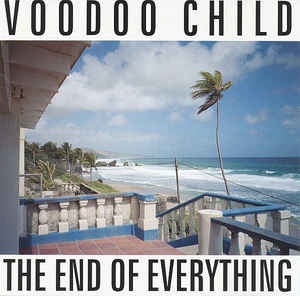
In any case, for all the pessimism of that title, the sleeve images – aside from the gust of wind blowing at the palm tree on the front cover – are actually pretty tranquil. True, there’s no-one in the pictures, and sure, the unpredictability of the ocean can inspire fear in lots of people, but it looks like a nice enough beach. The sense of peacefulness I take from the images are a decent enough clue to the music on The End Of Everything. It doesn’t look like the worst sort of end to me.

Moby has done ambient before – a whole album of the stuff back in the Instinct days, the remix of ‘Hymn’, the bonus Underwater album that accompanied Everything Is Wrong, soundtrack stuff and plenty of other things since – but he’s never done anything like The End Of Everything. This is fragile, emotive electronica dominated by crisp beats, noodling layers of liquid synth modulation and those trademark string lines that really started to sound like a proper orchestra here rather than the occasionally bad looping evident on other Moby records.

‘Patient Love’ is what happens when the intro to Kraftwerk‘s ‘Neon Lights’ doesn’t suddenly open out into a shimmering cinematic pop soirée; instead this is gentle, lilting synth pop with all the analogue wobbliness an electronic music fan could ever need in their lives, and a patient, slowly-developing progress that seems several worlds away from the freneticism of earlier Voodoo Child tracks. It’s also rather jolly, in a wonky sort of way, though a sequence of unexpected chord changes around the halfway mark muck around with your senses cruelly. ‘Great Lake’ is ‘Go’ all over again, just with chiming synth notes and jazzy piano sprinkles struggling to know where they’re supposed to be heading, and that classic Moby moment deconstructed into the territory of textured nuance.

Elsewhere it’s all serene washes of colour, those heart-wrenching strings, gentle phasing, meditative bass lines, clusters of devastatingly accomplished piano sprinkles and beats that chug along wearily like they’ve been burned out from too many nights of intensive partying. Yes, there are moments of darkness that befit the mood evoked in the title of the album (‘Slow Motion Suicide’, somewhat predictably, is pretty bleak), but generally this is a slick, absorbing collection of listening electronica with enough quiet flair and looseness to separate it comfortably from the bland direction that some ambient music opted to take.

All taken together, The End Of Everything feels a lot like watching a big screen blockbuster on a mobile phone – it somehow seems far too bold and expansive a body of work to have been delivered as a low-key side project; it needs, almost demands, a larger presence than it rather anonymously has. Consequently, it stands as one of the most discreetly accomplished, enduring and satisfying releases in the entire Moby back catalogue. The End Of Everything was released on Moby’s Trophy Records sub-label of Mute and the US version of the album featured a different tracklist. In a typical Moby act of self-depreciation, the catalogue number for the Trophy release was idiot1. The inside of the sleeve includes a brief and heartfelt mini-essay from Moby on animal welfare.

First published 2013; re-posted 2018

(c) Mat Smith / Documentary Evidence

Parallax – Push For The Love Of Life (Mute Records single, 1993)

According to something I read back in 1993, Mute had not signed any new artists to the label for some time, the last new artist being Moby who joined the label the year before. Parallax, whose first single ‘Push For The Love Of Life’ was released by Mute that summer, were supposed to be Mute’s hot new talent. The project of Jason Young, Parallax were a bratty outfit grappling with the vernacular of hardcore rave, mixing those sounds with harsh industrial noise blasts and the type of rapping favoured by the likes of Pop Will Eat Itself. ‘Push For The Love Of Life’ would prove to be one of just two singles released by the band before promptly disbanding. ‘Push For The Love Of Life’ was written and produced by Jason Young and engineered by Julian Briottet, brother of Renegade Soundwave‘s Danny Briottet.

Though at times it feels barely a fraction above demo quality, ‘Push For The Love Of Life’ remains a personal favourite. The song is characterised by a frantic (if far too quiet) 4/4 drum rhythm and urgent bass line. Over that Young drops in a concise array of droning sounds, rave whistles, sampled snarling metal guitar, sirens and so on, topped off by impassioned and defiant rap. Whilst this brand of agit-rap hasn’t aged terribly well, there is a desperate quality to it, the track ending with a frustrated ‘never let go‘ from the frontman. In addition to the main single-length Savage Mix, the 12” and CD also features two further versions – the Valentine Mix and an instrumental version (credited on the promo 12” as an extended instrumental mix). The Valentine Mix ditches the vocal and adds acid-style synths which would give this mix a dancefloor appeal were it not for the simplicity and lack of club-friendly punch that characterises the track’s beat. Some ‘Join In The Chant’-style insistent howling is a nice touch and there’s still nothing quite so thrilling to me as a 303 sound operating on the edge of being out of control.

The release is rounded off by a demo version of the track ‘No Concept’ which was mixed by Paul ‘PK’ Kendall. Someone has said that the track samples Faith No More’s ‘Crack Hitler’ but I wouldn’t be able to verify that. ‘No Concept’ has a nice breakbeat, droning washes of nagging feedback and a distorted rap that feels like it would have suited Nitzer Ebb‘s Douglas McCarthy. There’s a sense of dystopian helplessness on this track, signalling the rise in quality that would characterise Parallax’s second (and final) release, the Bullet-Proof Zero EP.

First published 2012; re-posted 2018.

(c) 2012 Mat Smith / Documentary Evidence

Frank Tovey & The Pyros – Grand Union (Mute Records album, 1991)

1991’s Grand Union should by rights be lauded as a masterpiece of alternative rock, however Frank Tovey’s reclusive persona ensured that this overlooked gem has slipped through the net. Produced with PK (Paul Kendall), the album is both musically and lyrically enveloping. Something of a ‘concept’ album, Grand Union is ostensibly a collection of skiffly, folksy and vaguely country tracks accompanied by Tovey’s East End stories of the old, the new and the salient. There are many themes here, but one gets the impression that Tovey’s vision of a re-developing East End, with Canary Wharf’s landscape-altering construction in full swing, and the docks that made Britain what it once was turned into luxury restaurants and appartments invoked in him some sort of passion to head back in time and preserve the dirty Docklands spleandour of old in song.

At times melancholy (the WW2-recounting tale on ‘Bethnal Green Tube Disaster’), at others joyful in a ramshackle fashion (the opener ‘Bad Day In Bow Creek’), the album is largely subtle and blissfully easy on the ear. Semi-acoustic guitars, banjos and clever percussion evoke all manner of moods, and when they head into indie-rock territory, as on the Morrissey-esque ‘Cities Of The Vain’, The PyrosPaul Rodden (banjos and guitars), John Cutliffe (bass and acoustic guitars, plus strings on the closing track ‘The Great Attractor’) and Charlie Llewellyn (drums, percussion) – more than prove their adaptability around Tovey’s poetic lyrics. Additional contributions come from Steve Smith on various keyboards, Tracey Booth (bodhran on ‘IKB (RIP)’) and Elliot Carnegie, who plays Jew’s harp on the opener, ‘Bad Day In Bow Creek’. Somewhat more unusual, Tozie Lynch is credited with ‘bones’ on the same track. One imagines those bones may be among the detritus dredged up by the great Thames on a daily basis.

It is actually quite fantastic to hear just how well some primitive music forms lend themselves so well to Tovey’s Cockney vocals. His vocal is somewhere between Wreckless Eric and James’ Tim Booth, both folk and punk at the same time. His hero-worship of the great pioneering British engineer Isembard Kingdom Brunel on ‘IKB (RIP)’ is one of this album’s many high points, a time-travelling trip that leaves the grey towerblock-dominated modern London skylines far behind to witness at first hand the master engineer’s many achievements. And while we’re on the subject of masterful achievements, Paul Kendall’s excellent productions deserve a special mention. Best known for his electronic production for many Mute artists, PK brings a depth and precision to these tracks, using occasional effects with considerable restraint, but pushing the rhythm high up in the mix in an echo of his work with Nitzer Ebb.

With Grand Union, I continue to be impressed by the quality of songwriting, playing and production on display here. Intensely captivating and wonderfully unique, it is difficult to hear it without feeling some great sadness over the fact that the erstwhile Fad Gadget is no longer with us. A truly emotive gem, filled with grief, joy and a yearning for simpler times. Ironically, I wrote this while heading glumly toward my own shiny modern City offices on a train wildly rushing through some of the tunnels that Brunel’s colleagues were famed for.

First published 2003; re-posted 2018

(c) 2003 Mat Smith / Documentary Evidence

Electronic Sound Issue 42 – Mute Cover Feature & The Normal Clear Vinyl 7″

ES42_BUNDLE-SQUARE

Electronic Sound have today announced their Mute-focussed latest issue, featuring a major new interview with Daniel Miller and an exclusive clear vinyl pressing of The Normal‘s ‘Warm Leatherette / T.V.O.D.’ 7″.

The issue also features a rundown of Mute’s 2018 artist roster and a new interview with the longest-serving member of the Mute community, Erasure‘s Vince Clarke, wherein he talks about joining the label with Depeche Mode, Miller’s influence on him as an electronic musician, and how he approaches running his own label, VeryRecords.

The full announcement from Electronic Sound is included below.

“I honestly didn’t think anybody would like it,” says Daniel Miller, talking about The Normal’s ‘TVOD’ / ‘Warm Leatherette’, which we are delighted to be reissuing with this issue of Electronic Sound. While The Normal was where Mute Records all started, this month’s cover story finds Daniel Miller discussing how his label is shaping up for the future. We also profile the artists that make up Mute’s Class of 2018, as well as catching up with Vince Clarke, a man who has only ever been signed to one label for his entire recording career. Click here to order now.

This issue also includes a rare interview with David Sylvian, discussing his soon-to-be reissued work with Can’s Holger Czukay, a chat with Finiflex, the artists formerly known as Finitribe, and a drinking session with post-punkers Sink Ya Teeth, who put us under the table. Elsewhere, we speak to Klaus Schulze, Claudia Brücken & Jerome Froese, The Orb, A Flock Of Seagulls and LUMP, a new project from indie folkster Laura Marling and Tunng’s Mike Lindsay. Plus there’s our usual bumper mix of tech, toys, books, gadgets and, of course, the very latest must-hear album releases.

This month’s exclusive music offer is a limited edition reissue of The Normal’s ‘TVOD’ and ‘Warm Leatherette’ seven-inch on crystal clear vinyl. Recorded by Daniel Miller using just a Korg 700S and a four-track tape machine, the single was the first release on Mute Records and is recognised as one of the most important electronic music records ever. Our reissue comes in a replica of the original 1978 picture sleeve. Click here to order now.

(c) 2018 Electronic Sound

Barry Adamson – Queen Elizabeth Hall, London, 9 February 2012 (Clash concert review)

To support the release of I Will Set You Free, Barry Adamson played a show at London’s Queen Elizabeth Hall on 9 February 2012. Adamson and his band – Ian Ross on drums, Nick Plytas on keys, Bobby Williams on guitar and Maxwell Sterling on bass, with the Trinity Strings and Steve Hamilton’s horn quartet – tore through tracks mostly taken from I Will Set You Free and its predecessor, Back To The Cat. Support came from The Gilded Palace Of Sin and comedian Simon Day reading poems as Geoffrey Allerton.

I reviewed the concert for Clash‘s website with photos by Andy Sturmey. The full review can be reached by clicking here.

Barry Adamson live at Queen Elizabeth Hall, 9 February 2012 - my ticket

Thanks to Stuart Kirkham for confirmation of the setlist.

setlist:
1. Destination
2. I Will Set You Free
3. Whispering Streets
4. You Sold Your Dreams
5. If You Love Her
6. Turn Around
7. Black Holes In My Brain
8. Looking To Love Somebody
9. The Power Of Suggestion
10. Psycho_Sexual
11. Civilization
12. Straight ‘Til Sunrise
13. Stand In

14. Jazz Devil

(c) 2012 Mat Smith / Documentary Evidence for Clash // photo (c) 2012 Andy Sturmey for Clash

Note: this was my first piece written for Clash. Up to that point, everything I had ever written had been for Documentary Evidence or its predecessor blogs.