The Ministry Of Wolves – Music From Republik Der Wölfe (Mute Records album, 2014)

The Ministry Of Wolves 'Music From Republik Der Wölfe' LP artwork

mute artists | lp/cd/i stumm360 | 10/03/2014

Republik der Wölfe is a theatre production commissioned by Theatre Dortmund’s artistic director Kay Voges and directed by Claudia Bauer which premiered on 15 February 2014. The music for the production comprised collaborations between Mick Harvey, Alexander Hacke, his girlfriend Danielle di Picciotto and Paul Wallfisch. Harvey is a veritable Mute stalwart given his tenure with bands like The Bad Seeds, and as a multi-instrumentalist and producer he has a reputation as being a highly skilled and versatile addition to any line-up. Hacke is a veritable Goliath – in both stature and reputation – who formed a crucial component of the noise onslaught of Einstürzende Neubauten and found himself offering a more nuanced role in Simon Bonney‘s Crime & The City Solution. Di Picciotto is an accomplished artist who formed part of the new Crime lineup that released American Twilight in 2012, and whose live visuals accompanied that album’s tour. Keyboard player and singer Wallfisch is founder of the New York group Botanica, a group whose music is variously described as ‘gypsy and punk-cabaret infused chamber rock’ and who have collaborated with Kid Congo Powers, another Bad Seeds alumnus.

The music takes its principal inspiration from the fairytales of Jacob and Wilhelm Grimm, the stories of whom will be familiar to more or less any child albeit viewed through a distinctly Disneyfied lens. The original stories by Grimm were a mix of the ethereal and macabre, drawing inspiration as much from folklore as the frighteningly original imagination of the two brothers. (By way of a recent anecdotal footnote, I was in a shop in the Germany pavilion at Disney’s EPCOT last month where they had copies of the collected Grimm tales for sale. Two Americans next to me were dumbfounded as to why these fairytales were in the Germany pavilion, so co-opted have they been by Hollywood over the past century that they are regarded as quintessentially American in origin.) Just like the original fairytales on which they are based, the music written by this group has an authentic air of dark mystery, sorcery and otherworldliness, making for an original body of work that exists happily – if strangely – without the visuals for which they were intended.

First, let us deal with the songwriting. My only real awareness of the original Grimm fairytales come from a combination of the sanitised Ladybird books and Disney movies of my youth, and my two daughters’ enduring fascination with fantastical princesses and mythical creatures. Consequently I have no real understanding of what the band are going on about here, though it’s clear from titles and some of the subject matter as to which particular story they are dealing with. Whether in the ethereal spoken word tracks from di Picciotto, the fragile double-tracked musings of Mick Harvey or Alex Hacke’s ominous intonation on ‘Rumpelstiltskin’ the guts of the story are evident, even to an ignorant like me. Only, the tone here is fundamentally dark, linking the songs to the original stories albeit through a thoroughly contemporary lens – the mischievous dwarf Rumpelstiltskin wasn’t, as far as I can tell, ever exhibited at a Coney Island funfair, for example. The whole thing is shrouded in a sinister, almost violent mysteriousness, knocking for six most versions of these tales.

Next, consider the music. Neither Harvey nor Hacke are strangers to composing music for theatre, and both Neubauten and Harvey (with Nick Cave) have albums in the Mute back catalogue that were commissioned for plays. Between the two of them their sense of space and detail is second to none, and when combined with Wallfisch’s piano – somewhere between bar-room blues and jazz – the whole thing swings with a depth and inventiveness that is in many ways more interesting than making sense of the vocals. An obvious reference point would be The Bad Seeds between Tender Prey and Let Love In (‘The Little Peasant’ even has ‘Red Right Hand’-esque organ vamps), but there’s also a relaxed, jazz-inflected dimension here too, cutting gently through the gloom. The start of ‘Cinderella’, with di Picciotto on vocals even sounds a lot like ‘The Carny’ from Cave’s The Firstborn Is Dead. For this reviewer the highlight is ‘Little Red Riding Hood’, a edgy stew of droning guitars, grungy vibes and a storyline delivered in German and English by Wallfisch that seems to relocate Little Red to a New York gangland scene.

Above all, this is an inventive album based on an interesting concept, produced by four individuals who, in their own right, are incredibly talented but who together can create something very special indeed. My only gripe is that it feels like this music really needs its visual dimension to completely make complete sense of this theatrical offering.

Listen to ‘Rumpelstiltskin’ and watch di Picciotto’s making-of documentary below.

Track listing:

lp/cd/i:
1. The Gold Key
A1. / 2. Rumpelstiltskin
A2. / 3. The Frog Prince
A3. / 4. Cinderella
A4. / 5. Rapunzel… (As Isdora Duncan)
B1. / 6. Hansel And Gretel
B2. / 7. Snow White (Heptagon)
B4. / 8. The Little Peasant
B3. / 9. Sleeping Beauty
A5. / 10. Iron Hans
11. Little Red Riding Hood
B5. / 12. White Snake Waltz

(c) 2014 Mat Smith / Documentary Evidence
Nick Cave Introduces The Gospel According To Mark (Canongate book, 1998)

'The Gospel According To Mark' book artwork

canongate | book | 1998

Nick Cave supplied an illuminating introduction to this small book, which formed part of a series of £1 editions of Biblical chapters. Other works in the series saw Will Self scribing an introduction to Revelation, and Fay Weldon introducing Corinthians.

I consider this illuminating, principally because it seems to offer up something of an explanation for the transition that Nick Cave’s music underwent as The Bad Seeds extrapolated the visionary fire and brimstone works that fell easily out of The Birthday Party‘s howling reverie, stretched that until it snapped, leaving a more mellow, almost meditative sound. ‘Up Jumped The Devil’, so the song goes, but despite running amok through Murder Ballads, it was pretty clear he was running away from Nick Cave.

Cave’s initial disdain for everything New Testament stems, according to his introduction, from his time in the Wangarafta Cathedral Choir in his pre-teens, and he uncharitably describes the book as ‘wishy-washy’ at best and ‘the decaf of worship’ at worst. The interest in the vengeful God of the Old Testament, meting out punishment and retribution to the nascent residents of his planet came from Cave’s interest in violent literature in his early twenties, fully explaining the nihilism which dominated both The Birthday Party and Nick’s own self-abuse.

So, what prompted the shift in focus from the Old to the New, the angry to the reflective? ‘You grow up,’ Cave explains. ‘You do. You mellow out. You no longer find comfort watching a whacked-out God tormenting a wretched humanity as you learn to forgive yourself and the world.’

Cave attributes his turn toward the New Testament to a vicar who suggested he start with this very gospel, ostensibly because it was the shortest. He enthuses over Mark’s grasp of enthralling narrative gestures and mysterious simplicity, his portrait of Christ as a solitary figure and one focussed on the fate that he knew was ahead of him. Cave also cites Mark as continuing to influence his spirituality and religiousness: ‘The essential humanness of Mark‘s Christ provides us with a blueprint for our own lives, so that we have something that we can aspire to, rather than revere, that can lift us free of the mundanity of our existences, rather than affirming the notion that we are lowly and unworthy.’

It’s a long, long way from ‘Nick The Stripper’ but delivered with such a compelling grasp of theology that it may well have prompted a religious conversion among a few fans with its enthusiastic words, much like Mark did for Cave himself.

(c) 2014 Mat Smith / Documentary Evidence

Nick Cave & The Bad Seeds – Push The Sky Away (Bad Seed album, 2013)

Nick Cave & The Bad Seeds 'Push The Sky Away' LP artwork

bad seed ltd | lp/cd/cd+dvd/box/dl bs001 | 18/02/2013

Push The Sky Away is the first Nick Cave material to emerge since he parted company with Mute in the wake of his terminated Grinderman project, and the first Bad Seeds album since 2008’s Dig!!! Lazarus Dig!!!. Now bereft of long-term arranger Mick Harvey, the Dirty Three multi-instrumentalist Warren Ellis steps in and takes the role vacated by Harvey; since 2007 Ellis’ playing has filled the void left by Blixa Bargeld‘s guitar, he was Cave’s foil in Grinderman and the pair have realised several soundtracks together, showcasing a symbiotic relationship that has produced some of the best material in Cave’s back catalogue.

It’s precisely thirty years since the volatile young Nick Cave formed The Bad Seeds in Berlin following the demise of post-punk’s ravaged Birthday Party. Much has changed. Aside from a surprise reappearance of original Bad Seeds bassist Barry Adamson on two tracks here, not one of the original Bad Seeds line-up features in the group that bears the name today, but the core group of musicians that have been with Cave the longest remain in situ – Warren Ellis, Jim Sclavunos (percussion), Thomas Wydler (drums), Martyn P. Casey (bass) and Conway Savage (piano, organ). The fire and brimstone seems to have been exorcised effectively by two raucous Grinderman records and the Dig!!! Lazarus Dig!!! album in the middle, leaving Cave and co focussing more or less completely on the beautiful melancholia of the more serene moments of Abbatoir Blues / The Lyre Of Orpheus.

Your reaction to Push The Sky Away will thus depend on whether what you want from Cave is howling, just on the edge of being out of control blues-informed punk, or the mature ideology that has coincided with the establishment’s embrace of Cave as one of the finest songwriters of the past thirty years. If the former is what you’re looking for, you’ll be disappointed, since Push The Sky Away generally has the slightly maudlin atmosphere that provided the mood on The Lyre Of Orpheus‘ closing track ‘O Children’; all of which is fine, but as anyone who’s listened to the Velvet Underground’s lovely third album for a while will tell you, sometimes you just want to hear ‘Waiting For The Man’. The closest Push The Sky Away gets to anything like the Cave of his earliest Bad Seeds work is on ‘Water’s Edge’ or ‘We Real Cool’, where the growling bass that dominates the low-end reminds listeners of the apocalyptic ‘Tupelo’ from The Firstborn Is Dead. The rest of the album is delicate balladry, with almost psychedelic arrangements (such as the ephemeral title track), quiet musings and bewildered observations on subjects ranging from mermaids to Wikipedia to teenagers cavorting carelessly on the beaches of Hove outside Cave’s window. In the press release, Cave describes Push The Sky Away thusly: ‘I don’t know, this record just seems new, you know, but new in an old school kind of way.’

That sense of the ‘new’ comes through in the remarkable palette of sounds deployed on the album, much of it purportedly derived from loops prepared by Ellis. With Mick Harvey gone and Cave seemingly unwilling to pick up a guitar after Grinderman, the album is largely devoid of any six-string action, with only the stand-out ‘Jubilee Street’ carrying anything close to a guitar line. Ellis shines through as effective lead musician, tracks filled-out with his loops, violin, mandolin and other assorted instruments. The rest of The Bad Seeds literally seem to play second fiddle to the dominance of Ellis, offering up loping basslines, intricate percussion and sprinkles of beautiful piano. Nevertheless, it’s reasonably clear – and not necessarily a bad thing – that Ellis is the primary mood-maker here. The upshot is some of the most advanced music that the Bad Seeds have ever realised, often bordering on a sort of synth music offshoot that no-one has named yet.

Cave’s singing has matured into a distinctive, varied and considered voice over time. The rough edges are all completely gone, leaving a honey-coated rasp that feels a long way from the guttural bleatings of the Cave of the past, hunched over a microphone in apparent pain, spitting words and sibilant sounds forth like a man possessed. The pretty ‘Wide Lovely Eyes’ Cave – with Cave observing the funfare being dismantled and images of departure set to a backdrop of shoes being arranged carefully on a pebble beach – sees the beautiful pairing of Cave and Conway Savage reminding us of some of the most brittle moments of the Bad Seeds catalogue, wherein the tenderness long ago replaced the anger; on this and a number of other songs, Cave reminds me of Ed Harris’s character in The Hours, sat in his window watching the world go by, a resigned, tired air colouring proceedings.

The frontman reprises some of his humourous bluesy story-telling and diverse intonations on the obscure centrepiece, ‘Higgs Boson Blues’, namechecking everything from Hannah Montana / Miley Cyrus, Wikipedia, Robert Johnson, vague mythologies and Switzerland’s Large Hadron Collider; that and ‘Jubilee Street’ are the clear highlights of the album, both being the most fully-formed and musically complete pieces here. The former has a skittish, absorbing jazz-blues dimension; the latter has a rousing, slowly-developing mix of lovely rolling drums, acoustic guitar, percussion, full orchestration and a muted intensity as Cave rises up into the sky toward the end in angelic contrast to the devilish way he flew forth in ‘Mutiny!’ back in the day. ‘Jubilee Street’ (which may or may not be set on the much-altered street in Brighton now devoid of any of its original charm) has a strong and compelling narrative, touching on the darker side of life with a bleak tale of what sounds like a prostitute who gets moved on from Jubilee Street by Russians.

The rest of the album is sonically clever and absorbing, even if Cave sounds like he might be sleepwalking through his songwriting at times. Nevertheless, he’s managed to produce some truly lovely songs as well as a new-found observational capacity in tracks like ‘Water’s Edge’, wherein the opposing forces of London girls looking for a good time and local boys looking for something to do clash; like Quadrophenia for vampires and party girls. There’s also moments where his particular brand of Viz-style smuttiness and wry humour shine through. Overall, it feels like Laura Ashley wallpaper – nice to look at, perfectly inoffensive and fine in the background, but you wouldn’t decorate your whole house with it.

Thanks to Rhian at Big Mouth.

***

I’m reposting this on the occasion of the Push The Sky Away receiving the prestigious Ivor Novello Album Award, an incredible achievement for both Nick Cave and his publisher Mute Song.

Cave has deserved greater recognition for his songwriting for far too long, and I’m delighted that the rest of the music world seems to have caught up with those of us who always knew where his songs would ultimately take him. I just wish that it had been another album that had secured him that recognition; a year on, I still haven’t warmed to this album, and I personally feel that there are far better works than this in the Cave back catalogue.

Track listing:

lp/lp+7″/cd/cd+dvd/dl:
A1. / 1. We No Who U R
A2. / 2. Wide Lovely Eyes
A3. / 3. Water’s Edge
A4. / 4. Jubilee Street
A5. / 5. Mermaids
A6. / 6. We Real Cool
A7. / 7. Finishing Jubilee Street
A8. / 8. Higgs Boson Blues
A9. / 9. Push The Sky Away

7″/dvd:
C. Needle Boy
D. Lightning Bolts

First published 2013; edited 2014.

Mick Harvey – Sketches From The Book Of The Dead (Mute Records album, 2011)

Mick Harvey 'Sketches From The Book Of The Dead' CD artwork

mute artists | lp+cd/cd stumm329 | 02/05/2011

Unbelievably, despite being in his fifth decade of making music, this is Mick Harvey‘s first album of totally self-penned songs. Time spent in the bands of Nick Cave, Simon Bonney and PJ Harvey, plus all that time devoted to poring over the Serge Gainsbourg legacy for two albums, has evidently paid off; Sketches From The Book Of The Dead is an accomplished, yet understated, collection of eleven songs, all of which ruminate on death. The album was produced by Mick, who also plays guitars, piano, organ, electric bass and percussion. Harvey was also joined by Rosie Westbrook (double bass), J.P. Shilo (accordion, violin, electric guitar) and Xanthe Waite on backing vocals.

According to my new best friend Wikipedia ‘the Book of the Dead is the modern name of an ancient Egyptian funerary text, used from the beginning of the New Kingdom (around 1550 BC) to around 50 BC.’ So now you know.

Overt reference to the Book of the Dead, or at least Harvey’s version, comes in the lyrics of the opening track, ‘October Boy’, which was made available as a free mp3 a few months before the album was released. ‘If you’re writing a song for the Book of the Dead / Then write one, write one for me,‘ sings Harvey in the voice of the October Boy of the title, while a dark, filmic, almost Morricone-esque backdrop underpins the black tale of a man anointed with a ‘sonic gun‘ who takes ‘rock ‘n roll poison’; that October Boy is almost certainly Rowland S. Howard, departed to the afterlife in recent years, and whose birth month was October. It is an unopinionated obituary to one of Howard’s earliest musical allies, the writer of the haunting ‘Shivers’ and his co-creator of amazing sounds in The Birthday Party.

‘The Ballad Of Jay Givens’ will be familiar to anyone who picked up a copy of Mute‘s Vorwärts compilation from earlier this year. This is Mick, with accompaniment from guitar, strings and organ, telling a dark tale of Givens, apparently his father’s best friend, a chap with a pretty dark and shady past. As a story set to music it’s absorbing and mysterious. ‘Two Paintings’ exists on a haunting musical tapestry of looping, often elegiac noise and mournful piano, depicting it seems, the separation from a loved one, featuring the descriptions of two paintings by Gustav Pillig. There are some truly moving moments in this song, particularly Mick’s wordless vocal harmonies at the very end. Pillig’s artwork adorns the sleeve and booklet, along with other paintings from Katy Beale.

‘Rhymeless’ is a clever, folksy piece whose verses are structured from fragments of well-known nursery rhymes. ‘All the songs that you never sang / To your little ones,‘ is a line which fills me with much regret. The song deals with children moving from being cherished to being effectively abandoned, neglected, deserted, forgotten, none of which I am remotely guilty of when it comes to my two wonderful daughters. But it does sadden me that my children seem to know the nursery rhymes that Harvey quotes from without me ever having once sung them those words. ‘Frankie T. & Frankie C.’ describes the love shared by the two characters of this song, a man and a woman both sharing the same first name; the way Harvey describes the spark shared between them reminds me of the way people of my grandparents’ generation might have described the first flushes of romance. Alas, the love of the two Frankies was to be short-lived, the death of Frankie C. leaving Frankie T. alone and mourning the loss of his beloved, finding himself spending his days longing after her and ultimately fading away in a bid to join her. While most of the backing has Harvey plucking elliptical patterns on his guitar over droning, carefully-sculpted sound, there are some fantastically heavy guitar crescendos at the end of the chorus.

In a neat play on words, ‘A Place Called Passion’ – a tale of someone lost during World War One – the front-line assault on Passchendaele and the word ‘passion’ are forced into an unhappy marriage, Harvey’s story of a relative who lost his life during the Great War evoked through the artefacts handed down to him – books bearing futile inscriptions from that relative’s parents pointing him toward a bright, but ultimately thwarted, future. This is the realities of conflict distilled into personal impact and significance. Like so many of the tracks on Sketches From The Book Of The Dead, ‘A Place Called Passion’ is extremely poignant. ‘To Each His Own’ is mysterious, a spoken-word poem of sorts over whining noise, with an intonation not unlike his former Bad Seeds bandmate Blixa Bargeld‘s spoken word pieces.

‘The Bells Never Rang’ is one of my personal favourite tracks, a ballad which takes us to Paris, rural Australia and Geneva over its three verses set to layers of strummed guitar that rise in intensity and urgency, only to drop away into a chorus of vocal harmonies and thin, reedy organ. This appears not to be a reflection on death of people per se, but on wasted opportunities, lost chances and relationships that fizzled out. ‘That’s All, Paul’ has a title that wouldn’t have gone amiss on one of Harvey’s Gainsbourg albums. Who Paul is we never know, but it would seem from the lyrics that young Paul, seemingly cut short in his prime, probably never really got to know himself either; Harvey is evidently bitter toward this pointless loss of life, which sounds as if it was caused by a single moment of recklessness. For that reason alone it reminds me of Rebel Without A Cause.

The album, fittingly, closes with the rousing single ‘Famous Last Words’, but it is preceded by one of the most evocative, moving love songs I’ve ever heard, ‘How Would I Leave You?’. Accordion, dramatic but sparse drums, piano and strummed guitars underpin Harvey reflecting on his attempts to leave somewhere (home?), his decision, or indecision, influenced by the wondrous nature he sees all around him. It all sounds idyllic, pristine, Walden-like, Harvey laconically and benevolently forced into inaction by the world he sees enveloping him.

Track listing:

lp+cd / cd:
1. October Boy
2. The Ballad Of Jay Givens
3. Two Paintings
4. Rhymeless
5. Frankie T. & Frankie C.
6. A Place Called Passion
7. To Each His Own
8. The Bells Never Rang
9. That’s All, Paul
10. How Do I Leave You?
11. Famous Last Words

First published 2011; edited 2014

(c) 2014 Mat Smith / Documentary Evidence

Anita Lane – Dirty Pearl (Mute Records album, 1993)

Anita Lane 'Dirty Pearl' LP artwork

mute records | lp/cd stumm81 | 10/1993

Dirty Pearl is a rag-bag collection of newly-recorded Anita Lane tracks produced by Mick Harvey as well as older material, the entire Dirty Sings EP and collaborations with Die Haut, Einstürzende Neubauten, Barry Adamson and The Birthday Party. The album is as much a collection of Lane’s work as it is a showcase for the seemingly unlikely cross-pollination of scenes that emerged when The Birthday Party moved from Australia to the UK, followed by a brief and fortuitous sojourn in Berlin; that productive Kreuzberg stop-over was responsible for Nick Cave‘s Bad Seeds being swelled by the likes of Neubauten’s Blixa Bargeld and Die Haut’s Thomas Wydler, as well as some of Cave’s most inventive and inspired early musical work.

The collection covers the period 1982 to 1993 and presents the tracks in reverse chronological order. Overall, the compilation shows just how integral Lane was to the whole scene that formed between London and Berlin in the mid-Eighties, with characters such as Chrislo Haas and Adamson appearing on various tracks. As Nick Cave’s girlfriend and muse, Lane co-wrote a number of The Birthday Party’s songs, including the likes of ‘Dead Joe’, and was credited as a founding member of Cave’s subsequent Bad Seeds though her participation in the group was never exactly clear. What’s also immediately apparent from this collection is just how little music Lane has herself released – over half of Dirty Pearl was already released by the time this compilation was released, and Lane would only come to release her first (and to date only) ‘proper’ LP in 2002 with Sex O’Clock. Whilst Dirty Pearl provides a comprehensive overview of Lane’s music, one notable omission is 1991’s collaboration with Adamson on the excellent cover of Lee Hazlewood’s ‘These Boots Were Made For Walking’ which Adamson crafted for his Delusion soundtrack.

Opening track (and therefore most recent) ‘Jesus Almost Got Me’ is a countrified, Triffids-esque song of drunkenness, cruel love and regret, beautifully carried forward on Harvey’s sensitive drumming and ‘Evil’ Graham Lee’s genteel slide guitar. Immersed in the background are spirals of grainy feedback and some lovely vocal harmonies from Harvey. ‘Jesus Almost Got Me’ has a tired, resigned quality to it. In contrast, ‘The Groovy Guru’ is a funky, psychedelic trip, filled with wild face-melting guitar and wayward organ creating a vibe that felt about twenty-five years old too late, the lyrics describing a sort of pervy Cassanova character with a number of Satanic traits.

The cover of Marvin Gaye’s ‘Sexual Healing’ was produced by Mick Harvey with artist Johannes Beck and Sven Röhrig, finding Lane cooing girlishly over a sick, phasing breakbeat, shimmering vibes from Barry Adamson and some leaden (and less-than-romantic) backing vocals from Beck and Moritz Wolpert. At times Lane sings with a strained needfulness that can feel quite uncomfortable at times, but it’s quite hard to think of this as being too serious. Both ‘Blume’ (from Neubauten’s Tabula Rasa LP) and ‘Subterranean World (How Long…?)’ (from Die Haut’s Head On) highlight how well Lane’s voice matches Blixa Bargeld’s distinctive own. Bargeld’s transition from the howling, shredded vocal style displayed on Neubaten’s earliest material to the sensitive, half-spoken, almost Scott Walker-esque voice of their later material is continually surprising, and that softer side shines through on these two songs. ‘Subterranean World’, with its duet chorus of ‘How long have we known each other now?‘ brings to mind those clips in romantic films where couples explain to camera how long they have been together, except that by the end of this darkly humorous song Lane and Bargeld decide that they’ve never actually met before.

‘Picture Of Mary’ is an atmospheric piece written with Bargeld, dominated by Lane’s ghostly singing and a backdrop of dramatic piano, mournful violin and jangly Latin guitars (from Blixa) which threaten to swell up in the mix but never quite do. The only thing that lets this track down is Lane’s vaguely tuneless musings which bring to mind some of Nico’s material, but that is more than made up for by the intricate backdrop. Latin guitars and strings also colour the maudlin ‘Stories Of Your Dreams’, which possesses a strong narrative and theatrical mood. The song was co-written with Neubuaten’s Alexander Hacke, who also plays guitars on the song, while Crime And The City Solution founding member Bronwyn Adams plays violin.

The CD release of Dirty Pearl also includes ‘A Prison In The Desert’ by Nick Cave, Mick Harvey and Bargeld, taken from their soundtrack to Ghosts… Of The Civil Dead. The piece sees Lane mostly wordlessly singing over a backdrop of droning strings, industrial sounds and high-pitched noises, her voice providing a gentle counterpoint to what is otherwise a reasonably harrowing piece of music, a bit like a Graeme Revell soundtrack.

Eschewing all the released tracks from The Birthday Party canon that Lane contributed to, Dirty Pearl instead offers ‘The Fullness Of His Coming’, an unreleased track which features Lane on lead vocals, serving as strong reminder of why The Birthday Party were a musical force to be reckoned with at the start of the Eighties. The song is dominated by grinding guitar riffs from Rowland S. Howard that sounds like they might have been fed through an organ, Tracy Pew‘s ludicrously prominent bass and insistent and quickening drums from Mick Harvey. Lane murmurs and squirms provocatively through the track, particularly as the pace begins to quicken, the assembled Party members providing a nasty mantra of the track’s title while Lane writhes rapturously in the foreground.

Track listing:

lp/cd:
A1. / 1. Jesus Almost Got Me
A2. / 2. The Groovy Guru
A3. / 3. Sexual Healing
A4. / 4. Blume (Einstürzende Neubauten feat. Anita Lane)
B1. / 5. Subterranean World (How Long…?) (Die Haut feat. Anita Lane)
B2 / 6. Picture Of Mary
B3. / 7. The World’s A Girl
B4. / 8. Stories Of Your Dreams
9. A Prison In The Desert (Nick Cave / Mick Harvey / Blixa Bargeld feat. Anita Lane) – CD bonus track
10. If I Should Die – CD bonus track
11. I’m A Believer – CD bonus track
12. Lost In Music – CD bonus track
13. Sugar In A Hurricane – CD bonus track
B5. / 14. The Fullness Of His Coming (The Birthday Party feat. Anita Lane)

First published 2012; edited 2014

(c) 2014 Mat Smith / Documentary Evidence

Nick Cave & The Bad Seeds – He Wants You / Babe, I’m On Fire (Mute Records single, 2003)

Nick Cave & The Bad Seeds 'He Wants You / Babe, I'm On Fire' 10" artwork

mute records | 10″/cd mute290 | 02/06/2003

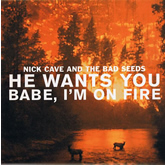
The contrast between the two tracks from Nocturama that were released together as the album’s second single couldn’t be more divergent. ‘He Wants You’ is the sort of high balladry that Nick Cave had made his own by the time of the fourteenth Bad Seeds album, a sort of more embellished and plaintive version of the introspection that had first become evident around the time of The Boatman’s Call. Only, somehow, with its filigree piano lines and quiet, romantic murmurings, it seems a more exaggerated version of that period. It really is a beautiful song, one that crams so many illustrative gestures into its verses before an elegant simplicity takes over. The song appears to describe a man who will do absolutely anything he can do to get the woman of his dreams; but this isn’t the kind of obsessed character a far wilder Cave described on something like ‘From Her To Eternity’ – this is a far gentler, resolute and upstanding man. ‘He is straight and he is true,‘ he sings and we’re left thinking the persuer is a pretty nice bloke.

The wilder side of Nick Cave and his Bad Seeds comes to the fore on the edit of ‘Babe, I’m On Fire’, cut down from its fourteen minute album version to a tidy four minutes, wherein frantic organ lines and stream-of-consciousness lyrics cover everything from terrorism, right-wing politics, agriculture and even manages a nice backslapping name check of the members of the band. ‘Babe, I’m On Fire’ is urgent, messy and a bit of a musical trainwreck that feels improvised and sprawling and doesn’t appear to want to take itself too seriously, a band letting their collective hair down at the behest of their leader.

The single was backed with two extra tracks from the Nocturama sessions. ‘Little Ghost Song’ hinges on the same chorus from the album’s ‘Right Out Of Your Hand’ but sees Cave and Conway Savage harmonising unevenly together. Previous vocal pairings of the two have always been pretty tight, but this one doesn’t gel so neatly, leaving the listener wondering whose voice they’re meant to follow. ‘Everything Must Converge’ is far better. A spare, loose reflection that fate ultimately binds us all together, ‘Everything Must Converge’ has a lovely gospel quality to it, lots of reference points from nature and a really beautiful sound. It’s bold and romantic without ever becoming over-sugared, featuring some restrained organ riffing and a fantastic wandering harmonica melody that seems to usher in a totally unexpected reggae-infused segment. Understated and remarkable.

Track listing:

10″/cd:
A1. / 1. He Wants You (Edit)
A2. / 4. Everything Must Converge
B1. / 2. Babe, I’m On Fire (Edit)
B2. / 3. Little Ghost Song

Written 2013 / published 2014

(c) 2014 Mat Smith / Documentary Evidence
The Birthday Party – Mutiny / The Bad Seed EP (4AD EP, 1983)

Image

4ad | cd cad301cd | 1983

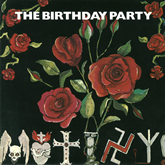
I’ve always been of the opinion that if an artist or band is going to make a final statement, then it should be well-executed and tightly-delivered. This holds true for The Birthday Party’s final two EPs, which are collected together onto this single CD by 4AD. The Bad Seed (originally released as a 12″ on the band’s UK home of many years, 4AD) and Mutiny (originally released on Mute) were both recorded at the famous Hansa Studios in Berlin and produced by the band themselves, with uncredited assistance from Einstürzende Neubauten’s Blixa Bargeld.

By now the erstwhile drummer Phil Calvert was long disposed with in favour of Mick Harvey; Rowland S. Howard became the sole guitarist and the creative dynamic had shifted toward the writing partnership of Nick Cave and Harvey (with the exception of the opener, ‘Sonny’s Burning’, the last track written by all four members of the group). The sound is raw and urgent, but well-honed and less prone to excess, while still retaining enough of the rough edge that set The Birthday Party apart from their contemporaries.

‘Wild World’ stands out as a highlight, blessed by its sludgy blues ethic and restrained vocal performance from Cave, whose vocal has become more direct and confident throughout this awesome collection. Tracy Pew’s bass is close-mic’d to allow the resonant twang of the strings to be heard. Elsewhere, Howard’s guitar is fed through numerous effects boxes, in particular deploying his famous ‘infinite reverb’ on several tracks, which allowed cycles of feedback to spiral, ebb and flow. While recorded no doubt at the height if the band’s drug abuse, the collection is markedly more controlled than Junkyard, as if recorded in a brief moment of lucidity. Nothing is more true of this approach than the final track, ‘Mutiny In Heaven’ (featuring Bargeld on guitar), which sees the band playing with studio effects with Cave’s vocal lines overlapping and multi-tracked, while the guitars are processed into ringing bells of sound. ‘If this is heaven I’m bailing out,‘ sings Cave. The Party was nearly over, and Cave thus signalled that the last guest should leave. ‘Mutiny In Heaven’ deals with the concept of euphoric God-like feelings following a hit of smack, but I’m not clear on whether it glorifies or condemns it. More extreme than the Velvet Underground’s opium hymn, ‘Heroin’, ‘Mutiny In Heaven’ has an edge that is as marvellous as it is malevolent.

Two previously-unreleased demos from the Mutiny sessions are included on the CD – ‘The Six Strings That Drew Blood’ (a totally different track from that which later appeared on Cave’s The Firstborn Is Dead) and ‘Avalanche Of Sound’, both of which are stripped and raw and perfect even as unfinished works.

Although a year away, Bargeld’s appearance on the final track heralded the approach of The Bad Seeds, the band Cave formed around Bargeld and Harvey. As final statements go, this stacks up very higly indeed, leaving you unsure as to whether it’s enough as it is or whether you’re in need of more.

Track listing:

cd:
1. Sonny’s Burning
2. Wildworld
3. Fears Of Gun
4. Deep In The Woods
5. Jennifer’s Veil
6. Six Strings That Drew Blood
7. Say A Spell
8. Swampland
9. Pleasure Avalanche
10. Mutiny In Heaven

First published 2004; edited 2012; re-edited 2014

(c) 2014 Mat Smith / Documentary Evidence