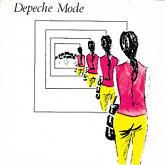
Erasure – The Violet Flame (Mute Records album, 2014)

Video

Erasure release their new album, The Violet Flame, on 22 September through Mute.

Listen to an extract from a new track from the Richard X-produced album via YouTube.

The album will be released as a CD, 2CD, download and obligatory, financial destitution-ensuring boxset and will be accompanied by a global tour.

More info at erasureinfo.com

Erasure – A Little Respect (HMI Redux) (Mute Records single, 2010)

Erasure 'A Little Respect (HMI Redux)' download artwork

mute records | i mute451 | 05/12/2010

Erasure re-recorded what might well be their signature song, ‘A Little Respect’, in 2010. Released as a one-track download, the single was issued in support of the Hetrick-Martin Institute, a New York-based non-profit organisation for lesbian, gay, bisexual, transgender or questioning (LBGTQ) youths between the ages of 13 and 24.

The charity’s name is taken in honour of its founders, psychiatrist Dr. Emery Hetrick and NYU professor Dr. Damien Martin who founded the Institution for the Protection of Lesbian and Gay Youth (IPLGY) in 1979. The organisation was renamed following the deaths of its co-founders and states its aim as follows: ‘The Hetrick-Martin Institute believes all young people, regardless of sexual orientation or identity, deserve a safe and supportive environment in which to achieve their full potential.’ (Source: HMI website)

‘A Little Respect’ has always had an anthemic quality, whether in the hands of Erasure themselves or in the likes of Wheatus or the many other acts who have subsequently co-opted the song for themselves (and there are plenty). At its heart is a simple, understated message of defiance and a polite demand for equal treatment. As a spirited call to respect a person just because they don’t fit in, have a different sexual orientation, a different belief system or any number of personal values that might not quite fit with the homogeneity that is the so-called ‘norm’, ‘A Little Respect’ has a universally simple appeal and it lends itself perfectly to HMI’s laudable goals. It’s an organisation that Erasure’s Andy Bell is a major supporter of, hence the re-worked version of the track that he and Vince Clarke put together – aided by the Hetrick-Martin Institute Youth Chorus – with proceeds going to the charity.

Fans of the original Stephen Hague-produced track will no doubt bemoan the springy, updated new arrangement (which ditches Vince’s guitar in favour of a crisper beat and shimmering electronic palette), but Andy Bell could probably sing this backward and it would still sound just as uplifting. The addition of the choir inevitably reminds the listener of the crowd at Rangers who seem to have co-opted the track as an unofficial anthem, but some deep soulful ad libs at the very end brings this right back into the warm nod to Motown that many of the tracks on The Innocents carried.

More information on HMI can be found here. A video for the single was released and can be viewed below.

Thanks to Jorge.

Track listing:

i:
1. A Little Respect (HMI Redux)

(c) 2014 Mat Smith / Documentary Evidence

Erasure – I Say I Say I Say (Mute Records album, 1994)

Erasure 'I Say I Say I Say' LP artwork

mute records | lp/cd/lcd/c stumm115 | 16/05/1994

Erasure‘s 1994 album found Andy Bell and Vince Clarke getting warm and tender. Compared to the previous album, Chorus, which had a grit to its analogue construction, the oddly named I Say I Say I Say – whose electronic backdrops were again created entirely using retro synths – has a serene, enveloping tone. Andy’s lyrics too veer toward the affectionate and romantic. Rightly or wrongly, I like to think of this as Erasure’s album of love songs, eschewing some of the more wordly-wise themes of the previous albums.

Curiously, this is also the Erasure album I have listened to the least. I put this down to the limited edition CD that I bought – a beautifully-designed 12″ box with a pop-up fairytale castle with the CD itself intended to look like a shimmering lake at the foot of the castle, everything swathed in shades of blue from a gibbous moon. Great idea, but it meant that this got stuck in a box with my vinyl for safekeeping, rather than being accessibly on the shelf with my other CDs. ‘Fairytale’ is not a bad description for this album, as producer Martyn Ware (ex-Human League and Heaven 17 and future project partner of Vince as The Illustrious Company) wraps a dream-like, sommnambulent atmosphere around many of the songs, particularly those featuring St. Patrick’s Cathedral choir (‘So The Story Goes’ and ‘Miracle’). I Say I Say I Say yielded three singles – the gorgeous ‘Always’, the chart success of which Erasure would not match until 2005, ‘Run To The Sun’ and ‘I Love Saturday’ – but sadly marked the start of a long period of poor singles success for the duo.

‘Take Me Back’ has a beautiful, extended introduction, which unfolds into a multitude of cascading melodies, Andy delivering a strident, impassioned vocal, wishing to return to the safety of his childhood. There is a brief section where the layers are sloughed off, leaving an intricate drum pattern built of springy, metallic synth sounds and what can only be described as a distorted attempt to replicate vinyl scratching using a synth. ‘Man In The Moon’ runs in waltz time and includes some almost classical keyboard work (albeit an elastic synth rather than piano or harpsichord) and a melody played on a flute-esque synth, while Andy delivers a cosy, romantic lyric. The track concludes with Andy singing solo over what sounds suspiciously like the tinkly opening bars of the Velvet Underground’s ‘Sunday Morning’, and overall this track has a quirkily similar, enveloping sound. ‘So The Story Goes’ is another waltz, and the first to feature the choir. Andy’s vocal is full and theatrical, while Vince offers a deep bassline similar to Chorus‘ ‘Turns The Love To Anger’ and flutters of synth arpeggios. Andy delivers a solo monologue at the end of the song, while the choir achieve an atmospheric discord that is as much mysterious as it is chilling.

‘All Through The Years’ has a country twang to it, and plenty of sterling synth work from Vince. Its autumnal imagery and warm tones mark this out as one of the best songs on the album, Andy bathing the track with mystery and misery with the addition of some beautiful backing vocals. ‘Blues Away’ is also one of the outstanding tracks here, a mellow soulful tune with sparse synths and a vocal from Andy delivered in a difficult falsetto while his own backing vocals cover all the mid- and low-range harmonies – he single-handedly (single-voicedly?) covers the full range without any signs of difficulty, and rightly so Vince takes a back seat on this song, although there is another great midsection that finds shards of electronics pealing off in random directions over a detuned beat.

‘Miracle’ is simultaneously inspiring and moving, a beatifully simple electropop track blessed by a harmony-filled chorus where Andy is ably aided by the St. Patrick’s choir. ‘We’ll be going home / Where the passion finds the perfect love‘ runs the chorus, sung with a melody similar to The Cranberries’ ‘Dreams’. Closing track, ‘Because You’re So Sweet’ is a sugary sweet ballad with some very meditative synthwork from Vince and an innocence and naivety that is both brave as it is beguiling.

***

I’m reposting this review since its now twenty years since I Say I Say I Say was released. It’s nearly ten years since I wrote this review, and my opening comments about not having listened to this that much compared to other Erasure albums still holds.

The album turning twenty years old inevitably encourages comments of the ‘where does time go?’ variety; for me it signifies that it’s twenty years since I went to look around the university campus that would become my home from 1995 to 1998. My family and I drove from Southend-on-Sea, where we were staying in a guest house, to Colchester to visit the university, and I insisted on playing the cassette of this album that had come out that week.

Some years after I wrote this review I alighted upon an old VHS video cassette which included a short interview with Andy Bell and Vince Clarke on some Saturday morning kids’ TV show; Andy attempted to explain the title of the album using a joke. It fell flat on its face, wasn’t funny and didn’t help explain the daftness of this title. It’s always struck me as odd – this is a comparatively serious LP, but its title suggests a lightheartedness that just isn’t there in the music.

Track listing:

lp/cd/lcd/c:
A1. / 1. Take Me Back
A2. / 2. I Love Saturday
A3. / 3. Man In The Moon
A4. / 4. So The Story Goes
A5. / 5. Run To The Sun
B1. / 6. Always
B2. / 7. All Through The Years
B3. / 8. Blues Away
B4. / 9. Miracle
B5. / 10. Because You’re So Sweet

First published 2005; edited 2014

(c) 2014 Mat Smith / Documentary Evidence

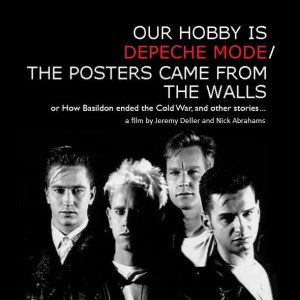
Jeremy Deller & Nicholas Abrahams – Our Hobby Is Depeche Mode / The Posters Came From The Walls (Mute Film, 2007 – unreleased)

Jeremy Deller & Nick Abrahams 'Our Hobby Is Depeche Mode' artwork

‘I love Martin’s hair.’ – a tweet posted during the live stream of Depeche Mode’s tour announcement, Paris 23 October 2012

With a new Depeche Mode album and mega-tour just around the corner, and with fans evidently getting excited on social media sites like Twitter, it feels like an appropriate moment to write about Turner Prize-winning artist Jeremy Deller and director Nicholas Abrahams‘ film, Our Hobby Is Depeche Mode. The film, also known as The Posters Came From The Walls, was commissioned by Mute MD Daniel Miller and focusses its lens on the fans of the band, rather than acting as a strict biography of the group.

When I first saw clips of Our Hobby Is Depeche Mode on the BBC documentary about Deller in 2012, I was prepared to think of the film as ridiculing devoted fans of the band; people I’ve spoken to over the past year or so, generally hard-core followers of the band, have all told me that the film is universally disliked by most fans as it casually mocks what for many people is a huge obsession. Whilst there are a couple of segments that feel a little too devoted, such as German couple Claudia and Ronny dressing their young son in home-made costumes from Depeche Mode videos like ‘Enjoy The Silence’ or Muscovites Ruslan, Marta, Margo and Elena delivering awful versions of DM songs complete with home-made videos, Our Hobby Is Depeche Mode is in reality a very sympathetic and sensitive portrait that shows just how much a band can influence, help and shape peoples’ lives.

Throughout interviews with fans in St. Petersburg, Moscow, Bucharest, California, New York, Berlin, Iran and Canada, Depeche Mode emerge as a band that appealed to people who just didn’t fit in. Alex, a fan from Bucharest, explains that in the early Nineties the long-haired guys were into metal, the ugly guys were into folk, and the sensitive, clean-shaven, good-looking guys who wanted to know about the best clothes and fragrances were all into Depeche Mode; Orlando, a young fan from California dancing in the car park of the Pasadena Rose Bowl where the band played the 101 concert before he was even born, explains how Depeche Mode’s music helped him through the darkest days of his teenage years, saying ‘Martin Gore’s lyrics speak for me’; a Russian pirate TV performance sees a fan grabbing the microphone and stating that ‘it’s music for the lonely’; celebrity fan and self-confessed outsider nerd Trent Reznor says that for him Depeche Mode played ‘music for someone who felt like they didn’t fit in’; Andy, an Iranian fan now living in Canada explains that if you were caught listening to, or dressing like, Depeche Mode in Iran you would be beaten by authorities, and that for many in Iran Depeche Mode represented an outlet from an oppressive society. Even Marta, with her dreadful but heartfelt singing over Depeche Mode’s own songs, nails the message home when she says that the band’s music helped her to find her friends.

If seeing obsessed Russian fans dressing like members of the band on ‘Dave Day’ – 9th May, Russia’s Military Day and Dave Gahan‘s birthday – seems a bit too much, English fans will probably never appreciate how important Depeche Mode’s music was to people whose democratic rights were managed entirely by the state. Albert, a hairy-backed melancholy chap with a huge tattoo of Gahan from his shoulders to his waist, explains that for many Russians, ‘this new music coincided with the fall of the Soviet Union so I see it as having been the music of freedom.’ For Alex, the well-groomed fan from Bucharest, Depeche Mode’s music was synonymous with freedom, with Violator arriving just three months after the bloody fall of Ceaucescu and becoming the music of a generation of young people whose cultural exposures had been dictated to them before. A trio of East Berliners speak about the seismic impact Depeche had in the East when they played the Free German Youth Concert in 1988. In contrast, Peter Burton from Basildon explains that even now Depeche Mode aren’t well known in the town they came from whilst offering a pretty colourless picture of the Essex new town back in the late Seventies.

Taking the ‘back home they just don’t get it’ notion frequently attached to Depeche Mode one major step forward, the emphatic Francisca explains that Martin Gore‘s lyrics have a natural sense of tragedy and despair, something that she feels is central to Russian fans’ adoption of the band. She then goes on to brusquely tell the translator that English fans couldn’t understand or appreciate the lyrics in the same way as a Russian could. I perhaps don’t fully appreciate what she describes as the ‘transcendent nature’ of the Russian psyche, but I’ve read enough translations of Chekhov, Tolstoy and Solzhenitsyn in my time to see more or less where she’s coming from.

One of the most powerful stories comes from Mark, filmed at Hammersmith Bridge, under which he would sleep as a homeless resident of London. Mark’s story perhaps punctures a large hole in Francisca’s logic about English fans – here is an individual who spent most of his homeless years listening to 101, scraping together enough cash to buy a ticket to see one of the band’s watershed concert at Crystal Palace on the Songs Of Faith And Devotion tour and drawing so much inspiration from the powerful feeling of togetherness that he experienced at the show to get himself off the streets.

Two things aren’t featured in the film – first and foremost, the band themselves. They’re clearly a current that runs through the documentary, their music runs through the film throughout and their images are plain as day on posters, t-shirts, sketches and all manner of personal tributes in the bedrooms of the profiled fans, but there’s no interview footage here. Their absence makes the enthusiasm of the fans all the more powerful in many senses. The other thing that’s missing are the fans who collect each and every format of every record the band have released, from every country they’re released in. By focussing on the impact of Depeche’s live shows, it highlights the powerful way that concerts – or even fans dancing to concert footage in nightclubs – can bring people together, reminding me of something I once heard about fans being more interested in going to Depeche concerts to sing along rather than hear the band play.

Our Hobby Is Depeche Mode has never been officially released, though it is screened occasionally. The precise reason why Mute have never issued it remains something of a mystery to Deller and Abrahams, though I have heard a rumour that despite the band liking it, there was some pressure behind the scenes to prevent it from being released. The pair even compiled a whole series of extra interviews with artists who were influenced by Depeche Mode, including techno pioneers Derrick May and Kevin Saunderson, the idea being that these would appear as bonus features on a DVD release. It remains a real shame, almost a tragedy of Russian proportions, that such a vivid and affectionate overview of what this band means to many people won’t get seen or appreciated by more fans, many of whom will find reflections of their own reasons for being attracted to the band mirrored in the stories here.
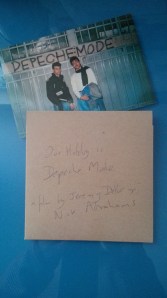
DVDr review copy and signed photograph. Thanks to Nicholas Abrahams.

Thanks to Jeremy and Nick for the DVD copy of the film for this review.

First published 2013; edited 2014.

(c) 2014 Mat Smith / Documentary Evidence

Depeche Mode – Dreaming Of Me (Mute Records single, 1981)

Depeche Mode 'Dreaming Of Me' 7" artwork

mute records | 7″/cd mute13 | 20/02/1981 [cd released 1991]

‘Dreaming Of Me’ was Depeche Mode‘s first single, released by Mute Records in February 1981. Written by Vince Clarke and produced, like Speak & Spell, by the band and Daniel Miller, the track failed to dent the UK singles chart and was possibly a big disappointment for Miller, whose ambition had been to create a good-looking, radio-friendly electronic pop group. The single did, however, top the UK indie charts.

‘Dreaming Of Me’ is a simple, naive example of early electronic pop. Tinkly rhythms, thudding, bouncy drums and an aggressively phased bassline underpin a shouty, butch lead vocal by Dave Gahan that seems, like ‘Photographic’ from the Some Bizarre compilation album, to be concerned with introspection and cameras (very early Eighties). There’s a central melody on the middle eight which sounds like it was played on the same synth Miller used (as Silicon Teens) on his cover of ‘Red River Rock’, and the end section is all wordless vocal harmonies and spoken missives, almost as if the boys realised they needed a few more euphoric pop staples to make the grade. Unlike Miller’s previous works, either as producer of the likes of Missing Scientists or Fad Gadget, or with his own work as The Normal and Silicon Teens, ‘Dreaming Of Me’ has a clean sound and none of the rough edges associated with those other works.

‘Ice Machine’ signals that Depeche Mode always had a germ of darkness inside them. Imagine Metropolis’s dystopian landscape being transferred instead to the Ford plant in Dagenham and then imagine Kraftwerk providing the soundtrack; even that doesn’t come close to this almost industrial piece. There’s a stalking bassline and a fluttering, spiralling background melody that I’m sure Vince Clarke would go on to use again on Yazoo‘s Upstairs At Eric’s; clattering percussive sounds and whining, almost droning synths dominate the foreground. It is the sound of a brutal, grey production line but does seem to stretch out towards some sort of vague euphoria at the very end.

Note that I’ve not included ‘Dreaming Of Me’ as a single from the debut Depeche Mode album, Speak & Spell, which was released much later in 1981, as it wasn’t actually included there (though it did appear on the US version instead of ‘Sometimes I Wish I Was Dead’). The 1988 CD reissue of the album tacked the track (and ‘Ice Machine’) on at the end. The version included there is a slightly different mix – much more sparse low end evident underneath the phasing and a non-faded ending. That ending finds the track collapsing in on itself; it’s the type of messing ending that the fade usually rubs out, all dud notes, missed beats and vocals suggesting they’d done enough work that day.

Thanks to David McElroy for his help with this review.

Track listing:

7″/cd:
A. / 1. Dreaming Of Me
B. / 2. Ice Machine

First published 2011; edited 2014

(c) 2014 Mat Smith / Documentary Evidence

Erasure – Chorus (Mute Records single, 1991)

Image
mute records | 7″/12″/cd/c mute125 | 17/06/1991

‘Chorus’ was Erasure‘s first single since ‘Star’, the final single from the Wild! project. The difference between those two songs couldn’t be more stark, since ‘Chorus’ heralded a period of completely analogue focus for Vince Clarke, returning in many senses to the sounds and synths he had first used ten over years previously during his brief period with Depeche Mode. The intro to ‘Chorus’ is every bit as thrilling as the opening section of ‘Sometimes’, except here it’s a sound like an synth air-raid siren that kicks off the song, followed by some sonar sounds and an impassioned cry from Andy Bell before thudding, crisp metallic beats and a hypnotic, modulating bass melody and counterpoint bass pads drive the whole thing forward with a malevolent urgency. Andy Bell sings a cautionary tale that has post-nuclear overtones, appeasing the Body Shop doom-mongers of the day with a chorus that describes the sun dying, birds disappearing and fishes going to sleep; analogue intricacy in abundance, and a very deep message of impending environmental disaster (a la ‘Drama!’). ‘Chorus’ charted well and topped the indie charts. To me this still sounds perfect, unique and timeless and it will always have a place in my heart (to read more about this song’s influence on me, and the reason it is responsible for the idea of this site, click here).

The 7″ and cassette single feature the blissful pop of ‘Over The Rainbow’ (not the song from The Wizard Of Oz), which starts with a muffled German speaking clock, and whose line in the chorus ‘The boys are back in town / They’ll never let you down‘ always makes me smile, as Erasure have indeed never let me down. Andy sings about listening to ABBA – a clue to the later ABBA-esque EP? – and paints a beautiful picture of summering in Oslo. It has one of the best Vince Clarke synth riffs too, and all in all is one of my personal favourite Erasure b-sides. ‘Snappy’ is mostly an instrumental, featuring a nagging bassline, robotic sounds, a scary voice intoning ‘welcome to the world’, Nineties dancefloor-friendly beats and snatches of an Andy Bell vocal that has almost Indian spiritual overtones. Like a lot of dance music at the time, it moves around from idea to idea, but that bassline remains a constant force. (The US Maxi-CD labels this a 12″ remix, which it may be; I dimly remember having a shorter version of ‘Snappy’ as a bootleg, but I can’t find it now.)

Remixes come from Youth and Justin Robertson. Youth turns in two mixes, both having a leaning toward an early version of trance music, namely the entrancing vibe that emerged from the crossing-over of ambient and house which producer and Killing Joke bassist Youth was involved in via The Orb, Blue Pearl and others. His Transdental Trance mix (either the faded or unfaded versions which are on the CD and 12″) is a shifting, barely-there mix which takes recognisable sections from the Erasure original but gives the version a layered, dark, noxious ambient edge. The Pure Trance mix does the same but adds urgent breaks and beats and a sense of mysterious euphoria. Even Andy’s chorus shifts into view at one point.

Justin Robertson is a Manchester DJ / producer / remixer who has been spinning tunes since the early, hazy Balearic days of UK club music. His Spice Is Risen mix of ‘Snappy’ is a world away from his later trip-hop work as Lionrock, blending that track’s spiritual dimension with a more pronounced percussive beat and a dose of dancefloor kudos, making this a Leftfield / Spooky-esque slice of early progressive house.

The US vinyl and CD maxi-single releases retitled the song ‘Chorus (Fishes In The Sea)’ and included an additional mix by Youth (the Aggressive Trance Mix, which is a longer and harder extended take on the Pure Trance mix, and includes Andy’s full vocal).

Track listing:

7″/c:
A. Chorus
B. Over The Rainbow

12″:
A1. Chorus (Pure Trance Mix)
A2. Chorus
B1. Snappy (The Spice Has Risen Mix)
B2. Chorus (Transdental Trance Mix (Fade))

cd:
1. Chorus
2. Chorus (Transdental Trance Mix)
3. Snappy
4. Over The Rainbow

First published 2013; edited 2014.

(c) 2003 -2014 Mat Smith / Documentary Evidence