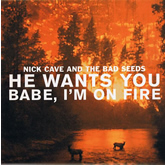
Nick Cave & The Bad Seeds – He Wants You / Babe, I’m On Fire (Mute Records single, 2003)

Nick Cave & The Bad Seeds 'He Wants You / Babe, I'm On Fire' 10" artwork

mute records | 10″/cd mute290 | 02/06/2003

The contrast between the two tracks from Nocturama that were released together as the album’s second single couldn’t be more divergent. ‘He Wants You’ is the sort of high balladry that Nick Cave had made his own by the time of the fourteenth Bad Seeds album, a sort of more embellished and plaintive version of the introspection that had first become evident around the time of The Boatman’s Call. Only, somehow, with its filigree piano lines and quiet, romantic murmurings, it seems a more exaggerated version of that period. It really is a beautiful song, one that crams so many illustrative gestures into its verses before an elegant simplicity takes over. The song appears to describe a man who will do absolutely anything he can do to get the woman of his dreams; but this isn’t the kind of obsessed character a far wilder Cave described on something like ‘From Her To Eternity’ – this is a far gentler, resolute and upstanding man. ‘He is straight and he is true,‘ he sings and we’re left thinking the persuer is a pretty nice bloke.

The wilder side of Nick Cave and his Bad Seeds comes to the fore on the edit of ‘Babe, I’m On Fire’, cut down from its fourteen minute album version to a tidy four minutes, wherein frantic organ lines and stream-of-consciousness lyrics cover everything from terrorism, right-wing politics, agriculture and even manages a nice backslapping name check of the members of the band. ‘Babe, I’m On Fire’ is urgent, messy and a bit of a musical trainwreck that feels improvised and sprawling and doesn’t appear to want to take itself too seriously, a band letting their collective hair down at the behest of their leader.

The single was backed with two extra tracks from the Nocturama sessions. ‘Little Ghost Song’ hinges on the same chorus from the album’s ‘Right Out Of Your Hand’ but sees Cave and Conway Savage harmonising unevenly together. Previous vocal pairings of the two have always been pretty tight, but this one doesn’t gel so neatly, leaving the listener wondering whose voice they’re meant to follow. ‘Everything Must Converge’ is far better. A spare, loose reflection that fate ultimately binds us all together, ‘Everything Must Converge’ has a lovely gospel quality to it, lots of reference points from nature and a really beautiful sound. It’s bold and romantic without ever becoming over-sugared, featuring some restrained organ riffing and a fantastic wandering harmonica melody that seems to usher in a totally unexpected reggae-infused segment. Understated and remarkable.

Track listing:

10″/cd:
A1. / 1. He Wants You (Edit)
A2. / 4. Everything Must Converge
B1. / 2. Babe, I’m On Fire (Edit)
B2. / 3. Little Ghost Song

Written 2013 / published 2014

(c) 2014 Mat Smith / Documentary Evidence

Liars – There’s Always Room On The Broom (Mute Records single, 2004)

Liars 'There's Always Room On The Broom' 10" artwork

mute records | 10″/cd mute317 | 09/02/2004

New York’s Liars made their transition from Blast First to Mute with this, their second UK single, and the first track to be taken from They Were Wrong, So We Drowned. A marked change in direction, ‘There’s Always Room On The Broom’ – albeit rather nursery rhyme-esque in it’s title – takes an influence from the paranormal, using German witchcraft mythology to provide its themes. This release comes in a very tongue in cheek sleeve that rips off Einstürzende Neubauten‘s sleeve for Strategies Against Architecture. (Just over ten years after this single was released, I found myself at a Laibach concert in London talking to a member of the Mute team, who was sporting a Neubauten t-shirt, which he said he wire to Laibach gigs just to piss off the band; we got to talking about the pastiche that was created for the sleeve of ‘There’s Always Room On The Broom’. He said that Mute approached Blixa Bargeld to ask for permission to use his original sleeve for Strategies…; apparently Blixa loved it and thought it was pretty funny.)

How to describe this music? Well, on the lead track, an exciting meeting of Neubauten and Sonic Youth wouldn’t actually be a bad starting point. Vocalist Angus Andrew bears a striking aural similarity to the Youth’s Thurston Moore in his early, naive, punked-up deadpan style. Musically, with its breakdown into fuzzy whitenoise and lo-fi percussion – cardboard box rhythms a la Moe Tucker duelling with Neubauten’s N U Unruh – this could be from almost any combination of points along indie rock’s ancestry. Some ghoulish whining reminds you of the Germanic folklore which inspired the album’s creation. Some densely-savaged organ sounds leads you to imagine Clint Boon inside a cauldron with The Lonesome Organist playing devil with a distortion pedal.

Track 2, ‘Scull And Crossbrooms’ [sic], is a miniature percussion and feedback affair, lasting just over 1.5 minutes, with some early Aphex-esque grainy synths evoking a ritualistic, covenly atmosphere. ‘Broom’ is similarly atmospheric, straight outta Bad Moon Rising, featuring some soft vocals and rolling, reverberating timpani and percussion, with which William Winant would be suitably impressed.

Despite its slightly goofy leanings, this is a pretty earnest slab of prime rump post-rock, and if you’re getting bored of that whole flavourless low-carb Strokes / nu-punk-lite nonsense, then this could be just what you need in your diet.

Track listing:

10″/cd:
A. / 1. There’s Always Room On The Broom
B1. / 2. Scull And Crossbrooms
B2. / 3. Broom

First published 2004; edited 2014

(c) 2014 Mat Smith / Documentary Evidence
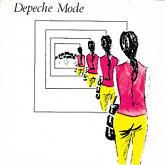
Depeche Mode – Dreaming Of Me (Mute Records single, 1981)

Depeche Mode 'Dreaming Of Me' 7" artwork

mute records | 7″/cd mute13 | 20/02/1981 [cd released 1991]

‘Dreaming Of Me’ was Depeche Mode‘s first single, released by Mute Records in February 1981. Written by Vince Clarke and produced, like Speak & Spell, by the band and Daniel Miller, the track failed to dent the UK singles chart and was possibly a big disappointment for Miller, whose ambition had been to create a good-looking, radio-friendly electronic pop group. The single did, however, top the UK indie charts.

‘Dreaming Of Me’ is a simple, naive example of early electronic pop. Tinkly rhythms, thudding, bouncy drums and an aggressively phased bassline underpin a shouty, butch lead vocal by Dave Gahan that seems, like ‘Photographic’ from the Some Bizarre compilation album, to be concerned with introspection and cameras (very early Eighties). There’s a central melody on the middle eight which sounds like it was played on the same synth Miller used (as Silicon Teens) on his cover of ‘Red River Rock’, and the end section is all wordless vocal harmonies and spoken missives, almost as if the boys realised they needed a few more euphoric pop staples to make the grade. Unlike Miller’s previous works, either as producer of the likes of Missing Scientists or Fad Gadget, or with his own work as The Normal and Silicon Teens, ‘Dreaming Of Me’ has a clean sound and none of the rough edges associated with those other works.

‘Ice Machine’ signals that Depeche Mode always had a germ of darkness inside them. Imagine Metropolis’s dystopian landscape being transferred instead to the Ford plant in Dagenham and then imagine Kraftwerk providing the soundtrack; even that doesn’t come close to this almost industrial piece. There’s a stalking bassline and a fluttering, spiralling background melody that I’m sure Vince Clarke would go on to use again on Yazoo‘s Upstairs At Eric’s; clattering percussive sounds and whining, almost droning synths dominate the foreground. It is the sound of a brutal, grey production line but does seem to stretch out towards some sort of vague euphoria at the very end.

Note that I’ve not included ‘Dreaming Of Me’ as a single from the debut Depeche Mode album, Speak & Spell, which was released much later in 1981, as it wasn’t actually included there (though it did appear on the US version instead of ‘Sometimes I Wish I Was Dead’). The 1988 CD reissue of the album tacked the track (and ‘Ice Machine’) on at the end. The version included there is a slightly different mix – much more sparse low end evident underneath the phasing and a non-faded ending. That ending finds the track collapsing in on itself; it’s the type of messing ending that the fade usually rubs out, all dud notes, missed beats and vocals suggesting they’d done enough work that day.

Thanks to David McElroy for his help with this review.

Track listing:

7″/cd:
A. / 1. Dreaming Of Me
B. / 2. Ice Machine

First published 2011; edited 2014

(c) 2014 Mat Smith / Documentary Evidence

The Birthday Party – Mutiny / The Bad Seed EP (4AD EP, 1983)

Image

4ad | cd cad301cd | 1983

I’ve always been of the opinion that if an artist or band is going to make a final statement, then it should be well-executed and tightly-delivered. This holds true for The Birthday Party’s final two EPs, which are collected together onto this single CD by 4AD. The Bad Seed (originally released as a 12″ on the band’s UK home of many years, 4AD) and Mutiny (originally released on Mute) were both recorded at the famous Hansa Studios in Berlin and produced by the band themselves, with uncredited assistance from Einstürzende Neubauten’s Blixa Bargeld.

By now the erstwhile drummer Phil Calvert was long disposed with in favour of Mick Harvey; Rowland S. Howard became the sole guitarist and the creative dynamic had shifted toward the writing partnership of Nick Cave and Harvey (with the exception of the opener, ‘Sonny’s Burning’, the last track written by all four members of the group). The sound is raw and urgent, but well-honed and less prone to excess, while still retaining enough of the rough edge that set The Birthday Party apart from their contemporaries.

‘Wild World’ stands out as a highlight, blessed by its sludgy blues ethic and restrained vocal performance from Cave, whose vocal has become more direct and confident throughout this awesome collection. Tracy Pew’s bass is close-mic’d to allow the resonant twang of the strings to be heard. Elsewhere, Howard’s guitar is fed through numerous effects boxes, in particular deploying his famous ‘infinite reverb’ on several tracks, which allowed cycles of feedback to spiral, ebb and flow. While recorded no doubt at the height if the band’s drug abuse, the collection is markedly more controlled than Junkyard, as if recorded in a brief moment of lucidity. Nothing is more true of this approach than the final track, ‘Mutiny In Heaven’ (featuring Bargeld on guitar), which sees the band playing with studio effects with Cave’s vocal lines overlapping and multi-tracked, while the guitars are processed into ringing bells of sound. ‘If this is heaven I’m bailing out,‘ sings Cave. The Party was nearly over, and Cave thus signalled that the last guest should leave. ‘Mutiny In Heaven’ deals with the concept of euphoric God-like feelings following a hit of smack, but I’m not clear on whether it glorifies or condemns it. More extreme than the Velvet Underground’s opium hymn, ‘Heroin’, ‘Mutiny In Heaven’ has an edge that is as marvellous as it is malevolent.

Two previously-unreleased demos from the Mutiny sessions are included on the CD – ‘The Six Strings That Drew Blood’ (a totally different track from that which later appeared on Cave’s The Firstborn Is Dead) and ‘Avalanche Of Sound’, both of which are stripped and raw and perfect even as unfinished works.

Although a year away, Bargeld’s appearance on the final track heralded the approach of The Bad Seeds, the band Cave formed around Bargeld and Harvey. As final statements go, this stacks up very higly indeed, leaving you unsure as to whether it’s enough as it is or whether you’re in need of more.

Track listing:

cd:
1. Sonny’s Burning
2. Wildworld
3. Fears Of Gun
4. Deep In The Woods
5. Jennifer’s Veil
6. Six Strings That Drew Blood
7. Say A Spell
8. Swampland
9. Pleasure Avalanche
10. Mutiny In Heaven

First published 2004; edited 2012; re-edited 2014

(c) 2014 Mat Smith / Documentary Evidence
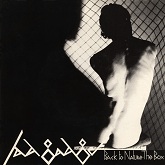
Fad Gadget – Back To Nature (Mute Records single, 1979)

Fad Gadget 'Back To Nature' 7" artwork

mute records | 7″ mute2 | 01/09/1979

If The Normal’s punk-inspired DIY single ‘Warm Leatherette / TVOD’ launched Mute Records then Fad Gadget truly made Mute a label, rather than a clever moniker attached to a one-off cult indie single: Frank Tovey was Daniel Miller‘s first signing to his label, with ‘Back To Nature’ the first single. Tovey, studying at Leeds Poly alongside the likes of Marc Almond, was a performance artist looking to integrate sound into his antics; he bought a Korg synthesizer, recorded a demo, sent it to Miller and launched Mute along a trajectory of signing uncompromising, inventive artists that continues to this day.

‘Back To Nature’ shares some of The Normal‘s bleak Ballardian reference points. Notwithstanding the dark tones that run through the track, Tovey’s lyrics have a whiff of the dystopian about them, with references to burning bodies under ozone-depleted skies, fake trees, people being high on sugar and kissing on the beach in amongst all of that… But then, perhaps it’s just a series of wry observations on what a typical British beach would have looked like back then (the references to it raining all night is probably the tell-tale signal there), headlines on tabloids insisting that ‘It’s a scorcher!’ while using showing some slightly sun-burned beauty in a bikini, eating rock or ice cream, memories of kiss-me-quicks at the Kursaal and over-priced inflatable water floats in the beach shop. So it’s either a nuclear-blasted wasteland or Tovey’s postcard from a mundane family holiday he didn’t want to be on; sadly, we don’t have the opportunity to ask Frank now.

Musically, ‘Back To Nature’ is formed of a generally polite, dry, almost funky electronic rhythm, offset by a menacing bassline and a simple melody that could soar majestically but which is so distorted that it almost growls in your ear whenever it comes to the fore. There are also drones, small synth shapes and interjections, what sounds like (but isn’t) distorted guitar feedback fuzz and electronic manipulations that sound like seagulls circling overhead. It’s cloying and unpleasant, sonically arresting and nasty at the same time, and proof that you didn’t need banks of electronic equipment to create electronic music. If Suicide had summered in England, this is probably how it would have sounded.

B-side ‘The Box’ takes together the same elements – pulsing, steady rhythm and angular, robotic Düsseldorf sparseness mixed in with harsh drones and grainy, oscillating electronic texture – and adds a increasingly-desperate lyric about needing to be let out of a metaphorical box, along with detached observations on overweight people and their pets, feeling like your life is a film, poisonous gases, Tovey feeling like he’s stuck inside a machine or industrial production line, and a bunch of other politically-charged vivid scene changes. The track’s final moments feature what sounds like electronic static moving uncontrollably toward you, reaching out talons of enveloping electricity, even that feeling like a welcome respite from the allusions to desperation and mental claustrophobia on the non-chorus.

Although he’s not credited as such, according to the liner notes that accompanied The Best Of Fad Gadget confirmed that Daniel Miller produced these two songs, and played synth on ‘Back To Nature’. The rear sleeve lists out the economy of equipment deployed to realise these two tracks – ‘Fad’s Gadget’s [sic.]: synthesizer, voice, electronic piano, rhythm generator.’ It was a statement of a fundamentally new approach, the essence of 1976’s Punk Year Zero realised through electronics. Like ‘Warm Leatherette’, the sleeve for ‘Back To Nature’ was designed by Simone Grant.

In the second line of ‘Back To Nature’, Tovey sings about a caravan at Canvey Island in Essex, legendary birthplace of pub rock and only a few miles from Southend-on-Sea where members of Depeche Mode and Alison Moyet were studying. Now a faded seaside resort, Canvey was once Britain’s fastest-growing holiday destination until a devastating flood prompted the construction of huge ugly concrete walled sea defences in the Fifties and foreign package holidays in the Seventies just kicked the body when it was already terminally ill; an unlikely bomb attempt from the IRA later in the decade disposed of the corpse. On a wet mid-Eighties evening while we were on holiday in Southend, my family and I took a trip to Canvey. It was one of the most uniformly terrifying experiences of my young life, starting with the drive past numerous deserted amusements, crazy golf courses and the like, and on onto those concrete walls, where we didn’t see a single person despite it only being early evening; a nihilistic young guy on a 50cc motorcycle emerged out of nowhere and was riding precariously on the top of the wall, a gust of wind or minor adjustment of his balance the only thing preventing him from crashing onto the concrete several feet below; a lone tractor raked over the sand, needlessly given the absence of any holidaymakers. And then there was the smell and looming presence of the island’s oil storage facilities. A solitary tanker, far out to sea, was causing huge waves to crash onto the beach. It is tempting to see how such a bleak, industrial wasteland might have inspired the young Tovey.

Canvey Island seawall. Photo courtesy of beatifulengland.net. Photo by Alison Avery.

courtesy: beautifulengland.net / photo: Alison Avery – permission requested

Track listing:

7″:
G. Back To Nature
F. The Box

First published 2013; edited 2014

(c) 2014 Mat Smith / Documentary Evidence. Canvey Island photograph (c) Alison Avery / beautifulengland.net

Erasure – Chorus (Mute Records single, 1991)

Image
mute records | 7″/12″/cd/c mute125 | 17/06/1991

‘Chorus’ was Erasure‘s first single since ‘Star’, the final single from the Wild! project. The difference between those two songs couldn’t be more stark, since ‘Chorus’ heralded a period of completely analogue focus for Vince Clarke, returning in many senses to the sounds and synths he had first used ten over years previously during his brief period with Depeche Mode. The intro to ‘Chorus’ is every bit as thrilling as the opening section of ‘Sometimes’, except here it’s a sound like an synth air-raid siren that kicks off the song, followed by some sonar sounds and an impassioned cry from Andy Bell before thudding, crisp metallic beats and a hypnotic, modulating bass melody and counterpoint bass pads drive the whole thing forward with a malevolent urgency. Andy Bell sings a cautionary tale that has post-nuclear overtones, appeasing the Body Shop doom-mongers of the day with a chorus that describes the sun dying, birds disappearing and fishes going to sleep; analogue intricacy in abundance, and a very deep message of impending environmental disaster (a la ‘Drama!’). ‘Chorus’ charted well and topped the indie charts. To me this still sounds perfect, unique and timeless and it will always have a place in my heart (to read more about this song’s influence on me, and the reason it is responsible for the idea of this site, click here).

The 7″ and cassette single feature the blissful pop of ‘Over The Rainbow’ (not the song from The Wizard Of Oz), which starts with a muffled German speaking clock, and whose line in the chorus ‘The boys are back in town / They’ll never let you down‘ always makes me smile, as Erasure have indeed never let me down. Andy sings about listening to ABBA – a clue to the later ABBA-esque EP? – and paints a beautiful picture of summering in Oslo. It has one of the best Vince Clarke synth riffs too, and all in all is one of my personal favourite Erasure b-sides. ‘Snappy’ is mostly an instrumental, featuring a nagging bassline, robotic sounds, a scary voice intoning ‘welcome to the world’, Nineties dancefloor-friendly beats and snatches of an Andy Bell vocal that has almost Indian spiritual overtones. Like a lot of dance music at the time, it moves around from idea to idea, but that bassline remains a constant force. (The US Maxi-CD labels this a 12″ remix, which it may be; I dimly remember having a shorter version of ‘Snappy’ as a bootleg, but I can’t find it now.)

Remixes come from Youth and Justin Robertson. Youth turns in two mixes, both having a leaning toward an early version of trance music, namely the entrancing vibe that emerged from the crossing-over of ambient and house which producer and Killing Joke bassist Youth was involved in via The Orb, Blue Pearl and others. His Transdental Trance mix (either the faded or unfaded versions which are on the CD and 12″) is a shifting, barely-there mix which takes recognisable sections from the Erasure original but gives the version a layered, dark, noxious ambient edge. The Pure Trance mix does the same but adds urgent breaks and beats and a sense of mysterious euphoria. Even Andy’s chorus shifts into view at one point.

Justin Robertson is a Manchester DJ / producer / remixer who has been spinning tunes since the early, hazy Balearic days of UK club music. His Spice Is Risen mix of ‘Snappy’ is a world away from his later trip-hop work as Lionrock, blending that track’s spiritual dimension with a more pronounced percussive beat and a dose of dancefloor kudos, making this a Leftfield / Spooky-esque slice of early progressive house.

The US vinyl and CD maxi-single releases retitled the song ‘Chorus (Fishes In The Sea)’ and included an additional mix by Youth (the Aggressive Trance Mix, which is a longer and harder extended take on the Pure Trance mix, and includes Andy’s full vocal).

Track listing:

7″/c:
A. Chorus
B. Over The Rainbow

12″:
A1. Chorus (Pure Trance Mix)
A2. Chorus
B1. Snappy (The Spice Has Risen Mix)
B2. Chorus (Transdental Trance Mix (Fade))

cd:
1. Chorus
2. Chorus (Transdental Trance Mix)
3. Snappy
4. Over The Rainbow

First published 2013; edited 2014.

(c) 2003 -2014 Mat Smith / Documentary Evidence