Nick Cave & The Bad Seeds – The Boatman’s Call (Mute Records album, 1997)

Nick Cave & The Bad Seeds 'The Boatman's Call' LP artwork

mute records | lp/cd/c stumm142 | 03/03/1997

I was tempted to write this review with just one word. That word is ‘beautiful’. Allegedly written by Nick Cave at exactly the same time as Murder Ballads, these songs were written with simplicity in mind, and as such the majority of these superior compositions feature a stripped back Bad Seeds, and a heavy dose of piano. The contrast with Murder Ballads could not be greater, taking a deeply intimate, romantic and often spiritual tone. No-one dies here, one may be relieved to know.

But maybe a little part of Nick Cave died in order to make a collection of songs; that part of him was the preacher, the aggressor, the dervish spirit howling and caterwauling over a maelstrom of sensational music, and that character wouldn’t emerge again until the later Grinderman project. It genuinely isn’t a criticism – I happen to think that The Boatman’s Call is among Cave’s finest work. Everything about album is black and white – the Johnny Cash-esque Anton Cobijn photo of a particularly troubled Nick Cave on the front cover, through the predominance of the piano keys across the LP, through to the downright clarity of Cave’s songwriting. What’s most clear about The Boatman’s Call is the often obvious theme of these songs, for this is Nick Cave’s most directly personal collection of ideas, from the post-PJ Harvey reflectiveness of the quirky folk leanings of ‘West Country Girl’ and ‘Black Hair’, through to his ruminations on his failed marriage on ‘People Just Ain’t No Good’ or ‘Where Do We Go Now But Nowhere’.

However, aside from a fair amount of openness from our tortured songsmith, The Boatman’s Call also features two genuinely beautiful love songs – ‘Lime Tree Arbour’ and ‘Brompton Oratory’. Like much of the album, these have a musical accompaniment from The Bad Seeds that is directly informed by subtle jazz but the latter also features a perfectly twee Casio rhythm that sounds like it survived from Cave’s original demo. The latter describes a trip made by Cave to Kensington’s famous, and imposing, landmark, and finds Cave wishing he were one of the stone apostles therein, just so that he wouldn’t have to deal with his muse’s intense beauty. It perfectly captures the intensity of romance’s first flourishes, that feeling of not being able to cope anymore. ‘Lime Tree Arbour’ is just mystical and beautiful, its waterside setting making me think of Murder Ballads’ ‘Where The Wild Roses Grow’, with all the same romantic longings, just none of the death; an alternative ending, perhaps?

The album features the full Bad Seeds line-up (Mick Harvey, Blixa Bargeld, Thomas Wydler, Conway Savage, Martyn P. Casey, Jim Sclavunos and Warren Ellis), albeit in controlled doses, and benefits from an unusually restrained production job from Flood, who also produced the oft-slated U2 album Pop the same year. The style of production is subtle and delicate, and Cave’s vocal is dominant in the mix, casting a personal, intimate shadow over proceedings, making this the closest Cave has yet come to the introspection of Leonard Cohen. It feels like a one-to-one connection between the narrator and sympathetic listener. Warren Ellis’ violin is also an important element here, receiving greater space in the mix than previously, bestowing the gypsy folk of ‘West Country Girl’ with a rabidly maudlin edge. His work on ‘Idiot Prayer’, perhaps the track closest to a classic Bad Seeds ballad sees his violin overtaking Blixa’s fuzzy guitar as lead instrument, a sign of the sea change that was to come.

I have my own, highly personal reasons, for counting this among my favourite albums of all time. Suffice it to say, seven years on, it’s the more miserable tracks here – like the personally chord-resounding ‘Far From Me’ – that I find myself reflecting on of that period in my life. ‘Can’t you find somebody else / That you can ring and tell?‘, Cave sings on that penultimate, delicately poignant song. Those would become wise words for my younger self.


I was minded to re-post this review after hearing the lead single from this album, the delicate ‘Into My Arms’ at the end of Richard Curtis’s About Time movie. It’s been a long time since I heard this album and for the personal reasons alluded to above, it’s one that I now find relatively hard to contemplate listening to. In the movie, Cave’s track is chosen by the dying Bill Nighy as the soundtrack for his own wake, lending the track a greater poignancy than perhaps Cave ever even intended.

A couple of years ago someone at Mute sent me a link to a YouTube rip of some songs that were recorded for The Boatman’s Call sessions but which have never surfaced except for on an expensive bootleg CD. The tracks that didn’t make it to the final album were every bit as perfect as the ones that were on the final release, a telling testament to the furious level of output that Cave was enjoying in this period of his life. The twin albums of Murder Ballads and The Boatman’s Call thus stand as one of the most pivotal periods in Cave’s career as a songwriter, marking a crossing place, a transition and the start of his wider public acceptance as one of the finest lyricists of our generation.

Track list:

lp/c/cd:

A1. / 1. Into My Arms
A2. / 2. Lime-Tree Arbour
A3. / 3. People Ain’t No Good
A4. / 4. Brompton Oratory
A5. / 5. There Is A Kingdom
A6. / 6. Where Do We Go Now But Nowhere?
B1. / 7. (Are You) The One That I’ve Been Waiting For?
B2. / 8. West Country Girl
B3. / 9. Black Hair
B4. / 10. Idiot Prayer
B5. / 11. Far From Me
B6. / 12. Green Eyes

For information on other formats go to: http://www.discogs.com/master/view/18393

First published 2004; re-edited 2014. This review focusses on the 1997 original release, not the remastered, expanded 2011 edition.

(c) 2014 Mat Smith / Documentary Evidence

S.C.U.M – 568 (Mojo covermount, 2011)

Various Artists 'Power, Corruption & Lies Covered' CD artwork

Power, Corruption & Lies Covered | mojo covermount cd | 2011

This track was recorded by S.C.U.M for a Mojo compilation celebrating the release of New Order‘s Power, Corruption & Lies thirty years before. Thomas Cohen‘s boys joined the likes of Errors, Walls and Zombie Zombie who recorded a track apiece for the compilation which, given the participants and the different music worlds they individually occupy, has a natural unevenness, unlike the sleek production of the New Order original.

‘568’ was never my personal favourite song, either in the New Order back catalogue or on Power, Corruption & Lies. It was, to me, ‘Blue Monday’-lite, with none of the classic moments that the track it was so similar to contained. Mercifully, I’m able to put that to one side with the S.C.U.M version, which dispenses with the shameless (but careless) bounce of the original and moves proceedings into a far darker place than New Order’s version suggested was possible. Cohen’s vocal is detached and sinister (but also strangely authentic compared with Bernard Sumner‘s original), while the serenity of the lengthy build up provides no clue to the musical handbrake-turn that the band are about to pull when grainy distortion and a twisted bass arpeggio swing into view. Their version is more linear, less stop-start, and winds up sounding a lot like ‘New Gold Dream (81/82/83/84)’ by Simple Minds.

Sadly this was probably among the last recordings S.C.U.M ever made and it’s yet another reminder of how disappointing it was that they called it quits.

I thought it high time to post this for two reasons: the occasion of Mute announcing the somewhat unexpected signing of New Order to the label that was revealed earlier this week, and also because occasionally I like to depress myself about S.C.U.M’s untimely demise.

(c) 2014 Mat Smith / Documentary Evidence

Tegan And Sara – Closer (Yeasayer Remix) (Sire single, 2013)

Tegan And Sara 'Closer (Remixes)' download artwork

Closer (Remixes) single | Sire | 2013

Yeasayer remixed ‘Closer’ by Calgary’s identical twins Tegan and Sara Quin. The result is a frantic, jerking sprawl of electro beats and buzzing synths that seem to be operating on the very edge of control while retaining a hypnotic, human quality. Tegan and Sara offer a delicate, warm and sensual delivery, full of yearning, desire, Eighties New Wave vocal reminiscences and sweet harmonies. Yeasayer’s approach to reconstructing and redeveloping the track’s music offsets that longing with a more desperate, needful edge, like a horny malfunctioning robot with its circuits focussed on one singular deviant goal.

First posted 2013; re-posted 2014.

(c) 2014 Mat Smith / Documentary Evidence

Richard X – Into You (Virgin, 2003)

Richard X 'Richard X Presents His X-Factor Vol. 1' CD artwork

Richard X Presents His X-Factor Vol. 1 album | Virgin | 2003

Richard Hawley added subtle, discrete slide guitar and backing vocals to this pretty ballad from Richard X’s solitary album, with his old Pulp bandmate Jarvis Cocker on strangely maudlin lead vocals. ‘Into U’ has the disctinction of being one of the only tracks on X-Factor that doesn’t feature X cheekily sampling and mashing up bits of other pop songs, but the chiming melody sounds like it’s copying the sound of well-known bells peeling. Richard X thanks Daniel Miller in the liner notes. The track was co-written with Mazzy Star’s Hope Sandoval.

Richard X produced the new Erasure album The Violet Flame which will be released in September 2014.

First published 2013; re-posted 2014

(c) 2014 Mat Smith / Documentary Evidence

Gotye – Eyes Wide Open (Yeasayer Remix) (Universal single, 2012)

Gotye 'Eyes Wide Open' download artwork

Eyes Wide Open (Remixes) single | Universal | 2012

Yeasayer remixed Dutch-Australian Gotye’s ‘Eyes Wide Open’ single in 2012. Their version is a slow, sensual mix that sounds like it should have been recorded many, many moons ago for one of those late-night radio request shows where people dedicate songs to people they love / want to hook up with / need a soundtrack for sex with, though backward sounds, metallic snares and big synths provide a modern twist. It’s a side to Yeasayer not heard on their own material, but it lacks that ingredient that makes their own music so utterly confounding.

First published 2012; re-posted 2014

(c) 2014 Mat Smith / Documentary Evidence

Orbital – Beelzedub (Danny Briottet Mix) (ACP single, 2012)

IMG_0015.JPG

Beelzedub single | ACP | 2012

Former Renegade Soundwave member Danny Briottet reworked this menacing track from Orbital’s 2012 Wonky LP. A sort of spiritual (or maybe that should be anti-spiritual) descendent of the Hartnoll brothers’ ‘Satan’, ‘Beelzedub’ is here recast as a bass-heavy cut with lots of ground-out distorted moments that recall Briottet’s work in Soundwave, as well as offering a nod toward the more contemporary mood – if not the stop-start mantra – of dubstep. The fusion of dark, ominous soundtrack strings with Briottet’s sprinkles of melody and his comprehensive knowledge of the mechanics of dub makes this an essential re-imagining of the Hartnoll schtick.

Listen to the mix below.

Thanks to Jorge.

(c) 2014 Mat Smith / Documentary Evidence

Hope & Harrow – Sufferhead (Workhouse Digital single, 2013)

IMG_0013-1.JPG

workhouse digital | dl | 23/10/2013

After almost twenty-eight years, Pete Hope and Dave Harrow have decided the time is right for a follow up to their 1985 EP, also titled Sufferhead.

Vocalist Pete Hope is a stalwart of the Sheffield post-punk scene, which meant that some sort of collaboration with someone from Cabaret Voltaire was always a possibility – in Hope’s case it was working with Richard H. Kirk on the album Hoodoo Talk. Hope has also worked with Jono Podmore (Kumo, Metamono, Cyclopean) and in The Box with members of Clock DVA. As for Harrow, he has occupied a shadowy presence in the world of electronic music, working with Psychic TV, Adrian Sherwood’s venerable On-U institution (overseeing mixes for Depeche Mode, Mark Stewart and others), Anne Clark, Andy Weatherall and working as Technova and other aliases.

Some things are worth waiting for, as proven by this five-track EP. Sufferhead is an understated, assured release wherein electronics flutter and stalk with repetitious dark menace and vocals growl with thinly-concealed threat, anger and cynicism. Standout track ‘Revolution Train’ (see the clip below) is like an amalgam of everything Nitzer Ebb were trying to do around the time of Belief, only with more depth and attention to detail, while ‘Tongue Tied’ takes a crisp, jittery IDM pulse and adds in suggestive low-pitched spoken vocals that probably aren’t about getting your words muddled up. At opposite ends of the spectrum, ‘Sparticus’ might sound aggressive and disappointed by turns but it conceals a hidden sincerity, while the electronic dub of ‘Turn Up The Fuzz’ comes with a punkish social awareness suggesting that things are just as rubbish today as they were in the mid-Eighties.

Labelling this a comeback would be an insult; against a backdrop of electronic music regaining visibility with critically-acclaimed albums from bands and artists that have been treading the boards since the early Eighties, Sufferhead is a lot like a grenade being tossed casually into the fray, its impact proving categorically that much more interesting music is made just below the surface.

Sufferhead can be bought from Juno, Amazon or iTunes.

Thanks to Jono.

dl:
1. Perfect Rain
2. Tongue Tied
3. Revolution Train
4. Sparticus
5. Turn Up The Fuzz

First published 2013; edited 2014

(c) 2014 Mat Smith / Documentary Evidence
Link

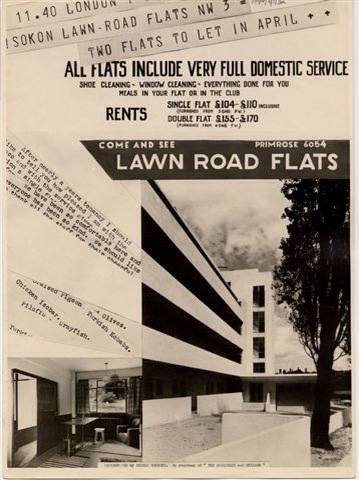
An advert for the Isokon buildings, Hampstead, London

This short 2011 BBC post on the future of British social housing includes a soundtracked by ‘The Set Up by Cabaret Voltaire, as well as extracts from pieces by Vaughan Williams, Karlheinz Stockhausen, Edgard Varese and The Jam.

Click here to view the slideshow – requires Flash

(c) 2014 Mat Smith / Documentary Evidence
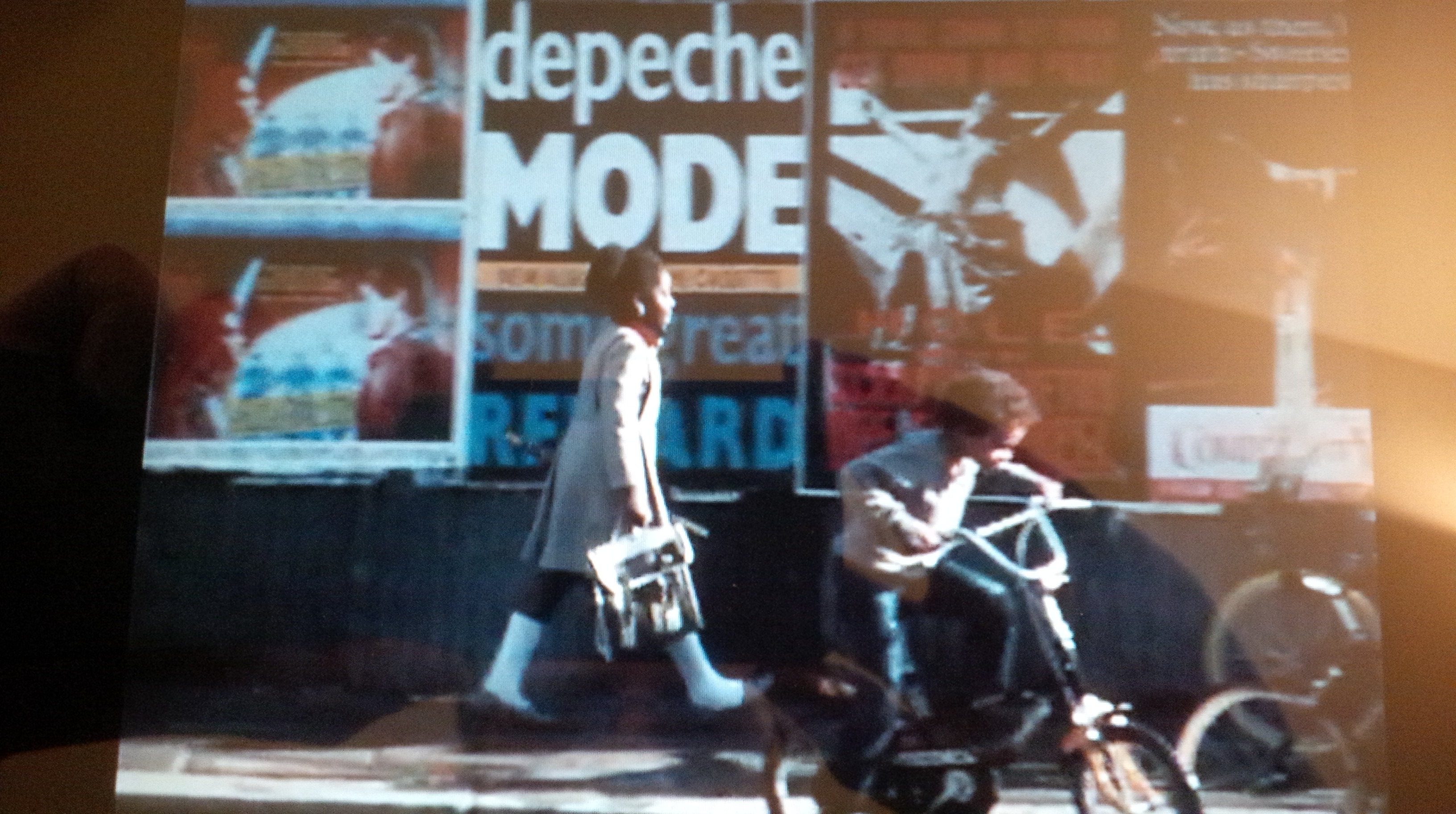
Depeche Mode – Some Great Reward (billboard poster, 1984)

Depeche Mode 'Some Great Reward' (billboard poster)

A billboard poster for Depeche Mode‘s Some Great Reward, London 1984.

Still taken from To The World’s End: Scenes And Characters On London Bus Route, a BBC programme first broadcast in 1985. Available on BBC iPlayer.

(c) 2014 Mat Smith / Documentary Evidence
Land Observations – The Grand Tour (Mute Records album, 2014)

Land Observations 'The Grand Tour' LP artwork

mute records | lp/cd/i stumm369 | 28/07/2014

2012’s Roman Roads IV – XI by Land Observations (aka James Brooks) was among this reviewer’s favourite albums of that year. Having spent a pleasant hour or so wandering round James Brooks’s exhibition The Information Exchange at the Domo Baal gallery in London that same year, Brooks’s compositional approach, like his approach to his artworks, was much clearer to me than if I’d just listened to the album; the works on display at his show were intricately layered, imaginatively conceptual and yet somehow deceptively simple, precisely the same as the music offered up for scrutiny on Roman Roads IV – XI. Later still, at an intimate show at London’s Rough Trade East, I was able to see the artist at work as he faithfully reproduced the album’s layers and textures live on the venue’s tiny stage using only a guitar and a bank of pedals. To suggest he was focused would be an understatement.

For this follow up, Brooks once again returns to the layered networks of melody, rhythm and rich textures of the first album, only this time the conceptual departure point is rather more, well, grand.

At EPCOT’s Spaceship Earth attraction, the narrative from Dame Judi Dench describes the original, pioneering roads built across their empire by the Romans as ‘the first information superhighway’, a web of interconnecting routes that revolutionised the transportation of troops, cargo and messages. Just as with today’s internet, it wasn’t long before the application of those roads became something that allowed for altogether more leisurely pursuits – namely travel for recreational purposes, usually by the wealthier citizens who could afford to do so.

Brooks’s second Land Observations album takes its inspiration from the Grand Tour, which saw rich 18th Century university graduates schlepping off to Africa and Europe to experience Old World culture and broaden their horizons. (Quite how this changed from being a wealthy pursuit to the pre-university ‘gap year’ beloved of impoverished students heading out to Thailand with nothing but a few baht, a rucksack and a supply of Rizlas is beyond me.) Thus The Grand Tour, taking in everything from the streets of Vienna and the mountains of Switzerland, is a generally more austere album than its predecessor, less urgent perhaps, more languid, evoking the lazy, unhurried passage of the environment from a carriage window rather than the firm, resolute industrious progress suggested by Roman Roads.

Though his raw materials are of the stringed variety, there is something distinctly ‘electronic’ about James Brooks’s music, a Kraftwerkian simplicity and starkness perhaps. On the faster tracks, the ghost of Neu! and sundry other German bands can be heard in his long-form, repetitious guitar melodies, while the textures evoke the ideas of Robert Fripp only with more structure and less inherent Progishness. The opening bars of ‘The Brenner Pass’ even have an almost bluesy, early rock ‘n’ roll dimension, and for a brief moment you expect a jazzy beat to creep in; but Brooks is far too clever for that. Through the continual layering, these tracks are adept at giving the impression of height and depth, as well as the wide-screen expanse of open landscapes. That’s a significant sleight of hand on the part of Brooks, and one that would be easy to overlook.

In context, Brooks calling himself Land Observations for what is hopefully becoming a series of such albums, is utterly appropriate, all told.

Track listing:

lp/cd/i:
1. On Leaving The Kingdom For The Well-Tempered Continent
2. Flatlands And The Flemish Roads
3. From The Heights Of The Simplon Pass
4. Nice To Turin
5. Ode To Viennese Streets
6. The Brenner Pass
7. Walking The Warm Colonnades
8. Return To Ravenna

(c) 2014 Mat Smith / Documentary Evidence