Dave Ball (2019 Interview)

Dave Ball (photo: Mike Evans)

On 9 February 2019, I had my one and only conversation with Soft Cell’s Dave Ball. The intention was to use this in a project I was working on at the time that ultimately never got finished.

On the sad occasion of Ball’s passing, I decided to revisit the conversation. I remember it was a Saturday afternoon, and took place during the halftime break of a football match he was watching on television. This was before I regularly used video conferencing for music interviews and so I just called the mobile number that his PR contact had passed over to me.

On Frank Tovey and Leeds Polytechnic

I knew Frank Tovey before he started Fad Gadget. He was a student at Leeds Poly. I was in the first year and he was in the third year. This was 1977, when I joined.

The new kids used to hang out with the older students, and I remember Frank being a performance artist and very intense guy. He was southern, from London, and there was a North-South divide among the students. That really pissed him off. I used to see him around Leeds Poly a lot. There was one performance he did called Berg, which I can vaguely remember going along to watch.

There was a small recording room at Leeds Poly. It was mostly designed for people that studied performance art to make soundtracks. Before I got a synthesiser, I used to muck about in there with a guitar and an echo chamber. And one day I was in there and there was an Crumar Compac electric piano. I thought, ‘Fucking hell, I’m going to have a fiddle around with it,’ and I put it through my effects pedals and recorded some bits and then put the piano back to how I’d found it.

Frank heard what I’d been doing and said, ‘Where did you get that keyboard sound from?’ And I said, “Oh, it was from this electric piano that was in the studio.’ And he said, ‘That’s my keyboard! You never fucking asked me if you could use it!’ He hated me for a while because of that. We didn’t really hit it off, and I imagine it was was because I’d used his electric piano.

He was probably the reason I bought a synthesiser because I thought, ‘I won’t bother using his one again!’ It pricked up my ears to messing about with electronic music.

On performance art and the origins of Soft Cell

Leeds Poly was very encouraging of people who wanted to do performance art as opposed to acting. Quite a lot of the lecturers there did performance art. I don’t know what you would call it – it was radically different theatre, using your bodies as art, almost like living human sculptures. I mean, I was never that much interested in it.

I started working with Marc Almond at Leeds just after I got my synthesiser. He’d heard me doing these bleeps and sounds, and he asked me if I do some music to go with his performances. And so, originally, I was just doing the sounds for Marc’s performance art pieces, and then that evolved into Soft Cell.

It was mostly just sounds. There were a few songs in these early performances of Marc’s. I was writing these funny little quirky songs at the time. Marc heard some, and he said, ‘Can I have a go at singing some of these?’ And I said, ‘Yeah. Why not?’

This developed, and it sounded much better with him singing than me. I wasn’t a singer. And then he said, ‘Can I write some lyrics? Some new ones?’ And I said, ‘Of course,’ so then the relationship developed as a writing partnership. And then we talked about calling it something, and it became Soft Cell. It was The Soft Cell, originally, but we decided to drop The.

On his first synth

It was a Mini Korg 800DV. I still have it. I got it just after I’d started at Leeds Poly.

Before I got it, it had belonged to the drummer out of the band Jethro Tull. It’s quite ironic, really, because Marc’s been working with Ian Anderson, the singer from Jethro Tull. I grew up in Blackpool, and Ian’s also from Blackpool. That’s where I found the synthesiser, in a music shop in Blackpool.

It cost me £400 second-hand, which was a lot of money. My dad had just died and I’d been left some money. Originally I’d played guitar but I wasn’t very good, but then I heard Kraftwerk, so I did a part exchange for this synth with my Fender Telecaster guitar. I lugged it back to Leeds and it was a it was a permanent feature in the little sound recording room. I mastered how to use that synth over the next few weeks.

On Mute Records

Apart from seeing Frank’s performance of Berg, the next thing I remember about him was a post-punk college band, and he was the singer. I can’t remember the name. There was a few of them in the band, and they were mostly the London students. They did a couple of shows. They weren’t that good. I remember saying to Frank before he went on, ‘Are you nervous?’ And he just glared at me and said, ‘Fuck off!’

Marc kept in touch with him. After he’d left Leeds, we heard that he’d put a record out with this new label called Mute. This was ‘Back To Nature’. Marc and I heard that and thought it was brilliant.

There used to be a punk club in Leeds called The Warehouse, where loads of really amazing bands used to play and I saw tons of stuff there. Frank did a gig as Fad Gadget. He’d totally gone away from the New Wave band he’d been singing with at Leeds. He had his keyboard, and he was wearing what looked like a karate outfit. He had this microphone which was plugged into a length of grey plastic drain pipe. He was shouting into it and he was jumping up and down on his keyboard and throwing himself around. He was like an electronic Iggy Pop. He was quite wiry, and tall, and sinewy, so he was very agile, and very fit. And that was a great performance. That was one of his first gigs in Leeds as Fad Gadget. It was the only time I ever saw him live.

Marc had given Frank a Soft Cell demo, and asked if he could pass it on to Daniel Miller at Mute. We’d heard his single as The Normal, and then we’d heard ‘Back To Nature’. He did ‘Ricky’s Hand’ with Frank, and then Daniel had done the Silicon Teens album. We thought, ‘This guy sounds fantastic!’

It was just before Depeche Mode signed to Mute. So we said to Some Bizarre, who we were working with, ‘Can we get Daniel to produce Soft Cell?’ And because of that we did end up working with Daniel. We did ‘Memorabilia’, our first proper single, with Daniel. And the original demo of ‘Tainted Love’ was done with him. We did a load of backing tracks with with him for our live shows at the time, which people probably didn’t know he’d worked on with us.

When we signed to Phonogram, they decided they wanted to get a different producer in, which was Mike Thorne. Daniel was great, but I think he was a bit too techno for us at the time, with the benefit of hindsight. His style was suited to Depeche Mode with that sequenced techno-pop sound. Whereas with Soft Cell, it was still meant to sound like a group – it was just a group that was made up from synthesisers.

I don’t know – our sound was, I don’t like using the word, but more organic. The Human League were using Roland Micro Composer. Daniel was using an ARP sequencer. They were very machine-driven productions. We used a drum machine, but I just used to have to play it as tight as possible. You can hear it. It’s very tight, but I still had to play it by hand. It’s like having a bass player playing the bass, but instead of playing a guitar, they’re playing the bass on the keyboard, and still using their hands.

In memory of Dave Ball, 3 May 1959 – 22 October 2025.

With thanks to Debbie, Barbara and Paul.

Interview: Mat Smith

(c) 2019 – 2025 Documentary Evidence
Depeche Mode: M (Clash review)

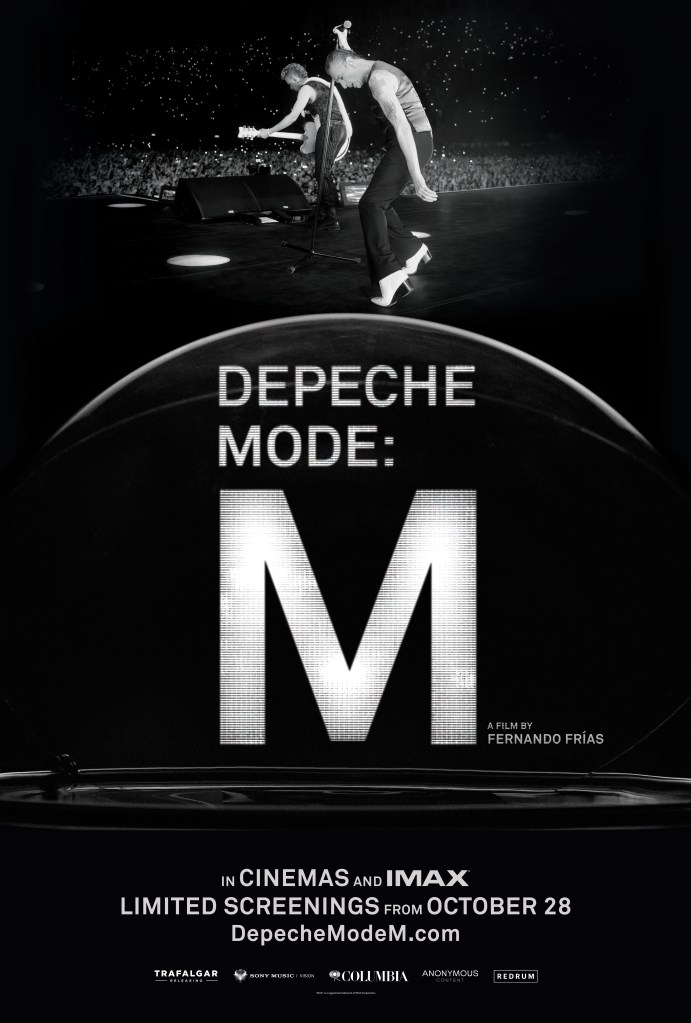
Depeche Mode: M poster

Last night, I attended a London screening of Depeche Mode: M, the new Fernando Frias film surveying the three nights that Depeche Mode played at Foro Sol, Mexico City in 2023.

Read my review for Clash here.

Words: Mat Smith

(c) 2025 Mat Smith / Documentary Evidence for Clash

Sketching Venus – lvu (Edvard Graham Lewis Venursion)

One of the great pleasures of my Mortality Tables collaborative projects is being able to collaborate with artists who’ve released material through Mute. So far I’ve worked with Vince Clarke, Simon Fisher Turner, Gareth Jones and Maps, and there are several more collaborations in the works.

Yesterday, I released a new / old release which included a completely new version by Edvard Graham Lewis (Wire / He Said / Dome etc).

Full press release details below.

///

In 2000, I made an album under the alias Sketching Venus. Hardly anyone heard it, and that’s how it should probably stay.

While revisiting and archiving old files, I came upon one track from the album, ‘lvu’, which stood out, and which I felt like I needed to do something with. It is unique, in the sense that it is the only song where you’ll hear me singing. It is also unique within the sound pieces that I’ve made over the years, in that every highly processed sound was made with a guitar.

Specifically, it was my ex-girlfriend’s guitar who I’d messily broken up with during the Millennium celebrations. ‘lvu’ was made at the very start of a new relationship, with my future wife. I think of it as a reflection on endings and beginnings.

Around this time, I was listening to a lot of Wire. My lyrics and vocals were a crude attempt to channel the band’s songwriter, bassist and occasional vocalist Edvard Graham Lewis, who has created a new version of ‘lvu’ that includes his own vocals.

The single is rounded out by a hypnotic remix by frequent Mortality Tables collaborator Rupert Lally.

Available at  mortalitytables.bandcamp.com

[1] lvu (Original Version)
[2] lvu (Rupert Lally Remix)
[3] lvu (Edvard Graham Lewis Venursion)

‘lvu’ originally appeared on the mostly unavailable Sketching Venus album svUTLD01abm (NominalMusics, 2000).

released March 28 2025 

[1] Written and produced by Mat Smith (2000) 
[2} Additional production and remix by Rupert Lally (2024) 
[3] Additional production and vocals by Edvard Graham Lewis (2025). Edvard Graham Lewis appears courtesy of Upp Records. 

Mastered by James Edward Armstrong 

Original photography by unknown photographer, Orlando, FL on 5 September 2001 

[1] Design and image processing by alka 
[2 + 3] Design and image processing by Andrew Brenza 
[3] Image re-processing by alka 

A Mortality Tables Product 
MTP38

Words: Mat Smith

(c) 2025 Mortality Tables / Documentary Evidende

I’m Dreaming Of A Mute Christmas

It’s that special time of the year where the sounds of well-worn Christmas hits from yesteryear fill playlists and people begin to debate whether ‘Fairytale Of New York’ really is the best Christmas song of all time.

With some help from my good friend and Mute afficionado Jorge Punaro, I here present a trawl through the back catalogues of Mute artists past and present to deliver an alternative compilation of seasonal songs; songs that range from the traditional, the just plain festive and on to the downright tenuous. Jorge has meticulously prepared a Spotify playlist containing everything we could get our hands on (and many more songs than I’ve covered here). For your optimal listening experience, Jorge’s should be listened to while drinking one of the cocktails from Erasure’s Snow Globe box set.

I often think of Erasure at Christmas, mostly because I remember receiving a 7″ of ‘You Surround Me’ in 1989 in my stocking. The year before, Vince Clarke and Andy Bell narrowly missed securing the coveted Christmas number one slot with Crackers International, an EP which led with ‘Stop!’ but also included the moving ‘She Won’t Be Home’ (renamed ‘Lonely Christmas’ on the slightly dubious The Erasure Christmas Gift 7″); elsewhere on the EP, the duo delivered a spooky version of the traditional carol ‘God Rest Ye Merry Gentlemen’ complete with authentic choir-boy vocals from Bell, while two years before the pair did a relatively throwaway take on ‘Silent Night’ for the US Yulesville promo LP (the same year that Clarke’s former Yazoo band mate Alison Moyet had contributed ‘The Coventry Carol’ to the compilation A Very Special Christmas). The limited formats of Erasure’s ‘Am I Right’ EP (1991) featured a festive Me Company design of Christmas trees with a photo of a young boy holding presents, while Andy Bell co-hosted Channel 4’s Camp Christmas in 1993, with musical accompaniment from Vince. Andy also featured in a short film called I Hate Christmas as a market stall worker.

2013 was the year that Erasure went all-out Christmas with the celebrated release of Snow Globe. The album collected a number of classic Christmas songs, including ‘Silent Night’ and ‘God Rest Ye Merry Gentlemen’ in updated splendour, as well as some of Vince and Andy’s own tracks. The limited-edition box – or should I say the obligatory limited-edition box, since if Mute did one thing in 2013 it was to ensure that their avid fans went without their turkey after spending out a small country’s GDP on ever more elaborate and expensive box sets – included a bauble, balloon, a packet of sweets and some Erasure-themed cocktail recipes. 

Other artists who’ve covered Christmas songs include Echoboy, who released a special split EP with Six By Seven for a Christmas show in Nottingham in 1999 which included a very alternative version of ‘Silent Night’. Richard Hawley also delivered a very easy listening take on ‘Silent Night’ for a special one-track CD given away to people who attended his show in Sheffield in December 2006, a track that was also included on his 2008 live album Live At The Devil’s Arse; during winter gigs and on radio Hawley has also covered ‘Blue Christmas’, made famous by Elvis Presley, but I haven’t heard a recording of that yet (if anyone feels charitable enough at this time of giving to send me one in the name of research, please get in touch).

In the wake of their 2008 album Seventh TreeGoldfrapp found time to record a beautifully jaunty version of ‘Winter Wonderland’ for a US Starbucks compilation, while former Blast First act Sonic Youth recorded a sketchy and somewhat unpleasant version of Martin Mull’s ‘Santa Doesn’t Cop Out On Dope’ for a 1996 compilation, which is definitely one for completists only. 

For Can completists, the veteran Krautrockers put out an ultra-twee take on ‘Silent Night’ way back in 1976 on Virgin in the UK. The Residents launched their audacious avant-garde music career with Santa Dog in 1972, a double 7″ single mailed out to various people featuring four tracks by various pseudonymous artists, all of whom were actually The Residents themselves (whoever they are). The band have released several other versions of Santa Dog since 1972 – in 1978, 1998, 1992 (‘Show Us Your Ugly’), 1999 (Refused), 2006, 2012 (SD12) and a fiftieth anniversary version in 2022. Way back in 1956, occasional Blast First artist Sun Ra co-opted the alias The Qualities and issued the doo wop 7-inch ‘It’s Christmas Time’. Backed with the sincere blues of ‘Happy New Year To You!’ this curiosity remains one of the most surprisingly accessible pop releases in the expansive Ra catalogue, and proof that they celebrate the holidays on Saturn just like they do here on Ra’s adopted home.

Einstürzende Neubauten stalwart F.M. Einheit and Caspar Brötzmann recorded an album called Merry Christmas which Paul Smith‘s label put out in 1994, but it isn’t at all festive and, besides, it was released in May that year. Still, the album’s sleeve of a hand-drawn tank reminds me of troops putting down arms during World War II, so maybe there’s a connection to the festive season somewhere on this album after all. Mute US duo The Knife recorded a song called ‘Reindeer’ for their eponymous album in 2001; as if the song wasn’t festive enough already with its lyrics about Santa, The Knife issued a version with Christmas bells (renamed ‘Christmas Reindeer’) in 2006 as a free download. In 2023, The Knife’s Karin Dreijer (Fever Ray) released a new album, Radical Romantics, featuring the track ‘North’. Jorge and I like to think she was referring to the North Pole.

Holger Hiller’s eponymous last album for Mute in 2000 included the track ‘Once I Built A Snowman’, while Ben Frost’s 2017 album Music From Fortitude opened with ‘This Is Not Christmas’. Andreas Dorau, he of one-time Mute group Die Doraus Und Die Marinas, has recorded two Christmas songs. ‘Weihnachten Ist Auch Nicht Mehr Das Was Es Mal War’ is a bouncy electropop track that appeared on Staatsakt’s Santo Klaus sampler in 2016, and just over ten years earlier, he released the track ‘Weihnachten Im Wald’ as a limited-edition of 100 CDs for a Carhartt jeans promotion.

The Jon Spencer Blues Explosion‘s 1992 Sub Pop Singles Club 7-inch paired together two excellent tracks – the wild rockabilly gestures of ‘Big Yule Log Boogie’ and the ‘Blue Christmas’-esque ‘My Christmas Wish’. Josh T. Pearson became the first Mute artist to deliver a whole EP of Christmas songs, with his maudlin Rough Trade Bonus disc getting released in 2011 as a Rough Trade shop exclusive accompanying his Mute debut, Last Of The Country Gentlemen. This year, Pearson issued a new song, ‘2020’s Silent Night Hindsight’ straight to YouTube, and a more perfectly cynical take on a shit year you will be hard-pressed to find.

In 2012, Canada’s Ladan Hussein, variously known as Al Spx and later Cold Specks covered Mary Margaret O’Hara’s ‘Christmas Evermore’ for a Christmas compilation, complete with brass and obligatory messages of peace and hope and a bit of Diamanda Galás-esque tremulous wailing. The debut Cold Specks album, I Predict A Beautiful Expulsion (2012) also features the stirring track ‘Winter Solstice’.

Looper‘s 2003 album The Snare features the haunting and evocative ‘New York Snow’, while the ‘Intro’ track on M83‘s Hurry Up, We’re Dreaming has dreamy lyrics about walking in snow. Way back in 1982, Yazoo’s Upstairs At Eric‘s included the sparse ‘Winter Kills’ and an orchestral version of ‘Only You’ was used in a Boots TV ad in 2017. A year before Upstairs At Eric’s, future Mute artists A Certain Ratio recorded the irrepressable long-form funk track ‘Winter Hill’ for their To Each album, while, some twenty years later, Nick Cave & The Bad Seeds released the wintery ‘Fifteen Feet Of Pure White Snow’ in 2001, regrettably the closest the songwriter has yet come to recording a seasonal song. Surely there’s a Christmas album in St. Nick somewhere? Moby‘s never officially done a Christmas track either, though he did remix the late arch-crooner Tony Bennett’s ‘I’m Coming Home For Christmas’ in 2007, but the track was only ever released as a promo.

Maps, known to his parents as James Chapman, kicked off his pre-Mute career as Short Break Operator, including the haunting ‘Some Winter Song’ as the first track on his debut EP from 2003. In fact, of all the Mute roster, Maps is easily the most prolific Christmas-loving artists. He recorded the frosty ‘Sparks In The Snow’ for his second single, went on to cover East 17’s ‘Stay Another Day’ for a promo CDr and released ‘Merry Christmas (My Friend)’ straight to Soundcloud in 2013, which is among the most atmospheric things Chapman has ever recorded. (Shameless plug: in 2024, I wrote a short story inspired by ‘Sparks In The Snow’. You can find that here.)

Later still, 2016 Chapman’s collaboration with former Mute artist Polly Scattergood, On Dead Waves, yielded two Christmas songs in the form of a cover of ‘In The Bleak Midwinter’ and the track ‘Winter’s Child’ that closed the duo’s only album together. In 2022, Polly Scattergood released her own Christmas track, ‘Snowburden’, which followed this year’s career-defining and intensely personal album In This Moment. The new song found the singer somewhere between Laurie Anderson-esque sound art and sensitive balladeering.

In 2020, one of Mute’s longest-serving sons, David Baker – one half of I Start Counting, Fortran 5 and Komputer – released ‘The Lights Of The Pub’, a charity single under his Joanna-tinkling alias Dave The Keys in aid of his local London boozer, The Lamb on Holloway Road. Dave (now working as lonelyklown) unwrapped another Christmas treat in 2022 with the emotive ‘Winter In London’, and in 2023 popped ‘I Believe In Snow’ under your burgeoning Mute Christmas tree. For 2024, Baker offered the rather lovely ‘Solstice Song’. With his seasonal deliveries, Baker is fast becoming as dependable at Christmas as Quality Street, speeches from the Monarch and really nasty hangovers.

Speaking of charity, here’s a shameless plug: in 2012, Documentary Evidence compiled MuteResponse, a double download charity compilation album intended as a tribute to Mute’s legacy, and also to rule off the first ten years of writing this very site. On MuteResponse #1, I was able to include one-time Credible Sexy Units act Vic Twenty‘s ‘Christmas In Korea (New Year In Japan)’. Angela ‘Piney Gir’ Penhaligon and Adrian Morris recorded the track years ago but it was never officially released until the MuteResponse compilation. I first heard this track years ago during an interview with Morris, and I always wanted to make sure that others would get to hear it, and so I was delighted to let the song see the light of day. Incidentally, Piney’s done plenty of other Christmas songs, one of my personal favourites being the lovely ‘For The Love Of Others’ in 2009. You can find MuteResponse over at Bandcamp.

So we’ve surveyed the traditional and the festive – what about the tenuous? Look no further than Mute’s most bankable act, Depeche Mode, whose only obvious Christmas connection was Dave Gahan delivering a festive message on the aforementioned Yulesville compilation. However, a year earlier, Depeche’s Alan Wilder and Martin Gore penned the track ‘Christmas Island’ as the B-side to ‘A Question Of Lust’; it isn’t remotely festive, it was released in May that year, it’s named after an island in the Indian Ocean, but it’s got the word Christmas in the title and so, dubious though it is, onto the Dreaming Of A Mute Christmas playlist it goes. Sticking with the theme of tenuousness, former Depeche member Alan Wilder (Recoil) included a track called ‘Freeze’ on 1992’ s Bloodline. And what do you know? Vocals on that track were provided by Moby. In 2024, Jorge added ‘Life On The Line’ by first Mute signing Fad Gadget. If you are wondering why, check out the outro of the track, where, if you use a bit of imagination, that twee little synth hook sounds a lot like ‘Jingle Bells’. I’m advised by a very reliable source that it was a little accidental, hence including it here in the tenuous section…

Another member of the extended Mute alumni family, Beth Jeans Houghton (Du Blonde) dropped the misanthropic ‘It’s Christmas And I’m Crying’ in 2023, a track that even Ebenezer Scrooge would find miserable. But hey! Christmas is supposed to be fun, and so here’s a version of The Normal’s ‘Warm Leatherette’ by The Bombshelter Brigade, re-titled ‘Merry Christmas’ and taken from the 1988 compilation Christmas At The Bombshelter.

In 2024, Mute delivered two festive treats in the form of Laibach‘s collaboration with Silence, ‘White Christmas’ (backed with ‘Silence Night’; LOL). It seems remarkable – but strangely fitting – that a band that have been disrupting convention since 1980 should finally offer their characteristically obtuse take on a Christmas classic. In what represented a bumper year for Mute acts offering up – er – festive cheer, A Certain Ratio landed their second place in the playlist with a seasonal EP, Christmasville UK.

Like the good Mute elf that he is, Jorge has done an exemplary job of fattening the Christmas turkey in 2024 with tracks we’d missed from Andreas Dorau (‘Mein englischer Winter’ from 2023), Ben Frost (‘Thundersnow’ from 2018; heck, with that surname, his whole catalogue should be in this playlist!) and my all-time favourite anonymous art punks The Residents, whose full 1995 Gingerbread Man album could have been added here; instead, Jorge opted for ‘The Gingerbread Man’ from the Icky Flix OST.

Next year, if you’re very good and very friendly children, we might include Throbbing Gristle‘s Christmas Eve Eve concert from Derek Jarman’s Butler’s Wharf pad on 23 December 1979. After all, that set featured ‘The First Noel’ and concluded with ‘Throbbing Gristlemas’. Who says TG lacked a sense of humour?

Happy Christmas to Mute fans everywhere. 

Words: Mat Smith 
Spotify playlist and Mute Navidad nous: Jorge Punaro 

(c) 2023 Documentary Evidence & Jorge Punaro. Earlier versions of this feature were published in 2012, 2013, 2020, 2022, 2023 and 2024. If we’ve missed anything let us know and we’ll get them added in.

Maps – Sparks In The Snow (Short Story, 2024)

It’s been a while, but I’ve written another short story inspired by the music and songwriting of Maps (James Chapman). As I’ve said before, there’s something indefinable in the emotional dynamics of James’s music that really inspires me to write short fiction. This time the track is ‘Sparks In The Snow’, the B-side of his second single ‘Lost My Soul’.

This is the fourth of these I’ve written, and when completed, the collection will be published as A Small Book Of Maps through my Mortality Tables collaborative project.

It is bundled with a collaboration with Maps that kicked off the Mortality Tables releases for 2024, ‘LF15 / A 4’33” Walk To Woburn Sands Station’. This formed part of Season 02 of the LIFEFILES series, where artists respond to my extremely basic lo-fi field recordings. In this case it was the sounds of the walk from my house to my local station, a walk that coincidentally takes 4’33”. I spoke to James about his versions of the John Cage piece for my other Mute blog, stumm433.com. You can read that interview here.

‘Sparks In The Snow’ is available through the Mortality Tables Bandcamp site here.

(c) 2024 Mat Smith / Mortality Tables

Maps – Lack Of Sleep (Short Story, 2023)

To coincide with the release of Counter Melodies by Maps earlier this year. I wrote a short story inspired by the track ‘Lack Of Sleep’. You can read this here.

This is the third short story I’ve written inspired by Maps tracks, following ‘Sophia’ (2019) and ‘A.M.A.’ (2013).

‘Lack Of Sleep’ refers to a storm which adds to the insomnia that the narrator experiences. This was Storm Eunice. In parallel to writing the story, I made some field recordings of the storm, initially from the top floor of our house and then as I repaired the damage to our shed in its aftermath.

These recordings, along with several others, were then used as the basis for The Naming Of Storms by Audio Obscura (Neil Stringfellow).

This is the 11th release in the LIFEFILES series, part of the Mortality Tables collaborative project that I began in 2019. The LIFEFILES series has also included four pieces from Mute artist Simon Fisher Turner.

The Naming Of Storms by Audio Obscura was released September 15 2023. Listen, download and follow Mortality Tables at mortality-tables.com

(c) 2023 Documentary Evidence

Miss Grit – Lafayette, London 04.04.2023

Miss Grit (New York’s Margaret Sohn) played a set at Lafayette in London’s Kings Cross, supporting Bartees Strange.

Consisting of tracks taken from the excellent debut Miss Grit album for Mute, Follow The Cyborg, Sohn seems to embody a certain captivating impassivity in their performance. It’s almost as if Sohn is playing the cyborg character that dominates the theming of their album: movements are scant, they cradle their white guitar like it’s another limb and there is a sort of emotionlessness etched on their face, even as the music on a track like ‘Follow The Cyborg’ reaches a climactic, feverish intensity.

Watching their guitar playing on ‘Like You’ is utterly mesmerising. Sohn is adept at affixing big, snarling riffs onto their songs in a style not dissimilar to Robert Fripp’s work on Bowie’s ‘Fashion’. These riffs arrive with an abruptness and intensity that’s often at odds with either Sohn’s vocals or their electronic arrangements, much as their smile at the end of a piece seemed incompatible with the detachment of the performance itself, or the philosophical gravity of the lyrics. The movements of Sohn’s hands along the neck of their guitar on ‘Like You’ was subtle, robotic almost, in spite of the noisy, grubby distorted blast of all-encompassing noise it produced.

The set concluded with ‘Syncing’, one of the many highlights from Follow The Cyborg. Here it was imbued with heavy emotion in spite of its stateliness and subtlety, the phrase ‘people change twice a year’ seeming to hang in the atmosphere of Lafayette like both a reassuring salve and futile acknowledgment of human weakness.

Thanks to Zoe and Paul.

Words: Mat Smith

(c) 2023 Documentary Evidence

Erasure: Behind The Sleevenotes

Being invited to write the notes for the reissue of Erasure was, as it was for I Say, I Say, I Say and Chorus, a humbling experience. A pinch-yourself moment. An honour. A privilege. All of these things. Whenever I’ve worked with Andy and Vince like this, I try to imagine what my younger self would think if he knew that one day he’d cross the rubicon between fan and employee of Erasure. I doubt he would believe it. I still can’t believe it.

I found myself reflecting on my younger self as I began the Erasure project. I very often mark out the significant events in my life through Erasure albums, and this was no exception, though perhaps the memories were a little more prominent and poignant than they had been with the previous two albums.

Between the first single, ‘Stay With Me’, and the album’s release, I’d left home and moved to university in Colchester. ‘Stay With Me’ seemed to capture a specific and strange feeling that descended on me as I made my final preparations for leaving, a feeling that was somewhere between optimism and fear. My first year campus university accommodation was in a tower block, and I imagined the observational viewpoint of Andy’s lyrics as if they were looking in on me as I started a new chapter of my life.

By the time ‘Erasure’ was released, I was already at university. I now forget where I purchased the album from but I suspect it was Our Price and I seemed to remember that it was the first week I was there. I still had some wages left from my summer job and I remember I also bought a pair of Levi’s. A shop worker in Birmingham, where I’d bought a pair of Levi’s before, told me to buy them with a larger waist size to avoid them being too tight, and that’s what I did with this pair. Within a month I’d lost so much weight at university that they became way too big and I couldn’t wear them anymore. I wasn’t ill and it wasn’t that my diet was poor: I’d just decided to become vegetarian to save more money so I could afford to maintain my record buying habit.

I first listened to Erasure in my tiny room in my tower block the afternoon of its release. I played it while ironing my new jeans.

“You had a pair of white jeans!” said Vince, when I told him this story. The connection of our Zoom call had either broken; or, more likely, he had deliberately misheard me.

“No, not white jeans,” I protested. (They were blue.)

“Oh man, I can’t believe you wore white jeans,” he laughed, ignoring me, his face displaying the huge grin I’ve become accustomed to seeing over the years. “I don’t think I can talk to you any longer.”

If BMG don’t invite me to write the liner notes for any future reissues, you now know why.

Whenever I’ve approached Erasure liner notes, I’ve always followed two guiding principles. The first is to never rely on either my own personal recollections or the massive amount of magazine and newspaper clippings that I collected voraciously at the time. The other is to try and include as many voices as possible in the piece.

The first principle is important. I want these notes to tell the story of the album, and I can think of no better way of doing this than speaking to the people who made it. In many cases, a detailed account of the process of making an Erasure album has never really been written, which gives these notes – I hope – a certain freshness, rather than something familiar. I also go back to what I was saying at the beginning. I am, first and foremost, a fan. These albums are important parts of my life and I’m completely biased. I figure that the best way to avoid these pieces being nauseatingly gushing fanboy pieces is to focus on telling the story. I’m also naturally inquisitive. I like to get inside a story. I like the details.

The ‘many voices’ principle is one that I really, really enjoy following. This isn’t a reaction, by the way, to not getting much information out of Andy and Vince. Far from it. Both have always been incredibly forthcoming with their recollections, and I could easily write these pieces without relying on any other input. But there are always more than two characters in these stories, and those other characters always play an important role, not least because they give us the opportunity to see what it’s like to watch Andy and Vince at work. Those players give a totally different, external perspective on the Erasure creative process, as well as life beyond the studio.

Vince would, for example, never talk about his cumbersome coffee machine and the elaborate process of making cappuccinos before recording sessions at his 37B studio could begin; engineer George Holt did, because they were the best cappuccinos he’d ever drunk, and it was an important part of the daily routine in the studio. Andy wouldn’t necessarily talk about the different ways that his voice would be recorded; Gareth Jones, who produced Andy’s vocal, could explain how he suggested things like sitting on the sofa in his room at Strongroom, or lying on the studio floor to get the specific vocal texture he thought worked best.

For Erasure, I spoke to Andy first. Andy was at his house in Mallorca, where he has some of the original Ashley Potter paintings that were used across the album and single sleeves. He spoke to me from the room containing the piano that became the focal point of Herbie Knott’s celebrated press photograph for the album. I next spoke with Gareth Jones. Gareth and I sat in the artLab, his studio at Strongroom in Shoreditch, and listened back to the album. This is the third time he and I have done a playback like this, and it’s always a fascinating and illuminating experience to hear anecdotes and memories prompted by listening to the music. We spent an inordinate amount of time trying to identify Paul Hickey’s vocal contribution on the track ‘Love The Way You Do So’ and a long time debating whether I should try and speak to Diamanda Galás (in the end, I tried, but didn’t manage to secure time with her).

With Vince, apart from talking about my white jeans, we spent a lot of the time talking about Dark Side Of The Moon and how it influenced the sound of ‘Erasure’. Vince and I have spent a lot of time talking about this album over the years, and at his insistence he made me buy a vinyl copy because, in his emphatic view, Dark Side Of The Moon should only be heard on vinyl. When Vince is serious about something, I find its best to follow his advice, and he’s never wrong. The whole time I was compiling the liner notes, a copy of Dark Side Of The Moon sleeve was behind me in the room I do my writing in. I read up about the Pink Floyd classic voraciously, watched a documentary about it to understand its technical appeal to Vince, and listened to it almost as many times while writing the piece as I did Erasure.

Perhaps because he knows I am a bit of a technical Luddite, Vince and I rarely talk in detail about the process of making sounds. He once showed me how his studio works and how everything connects up, but I think he noticed quite quickly that I was confused and so anyone looking for my notes to explain precisely how he made that bass sound three minutes into ‘Rock Me Gently’ will always be disappointed. To me it’s basically just magic, and I’m happy for my understanding of what Vince does to stay that way.

Most of the technical detail for the liner notes came from Thomas Fehlmann and George Holt. Similar to when I spoke to Martyn Ware for I Say, I Say, I Say, what I got from Fehlmann and Holt was their awe at how Vince worked. They clearly both work on a technical level that most of us would only ever aspire to, yet they thought what Vince did was basically magic as well. Vince insisted that I should meet George and ask him to cook me Italian food, as he thought he was the best chef he’d ever met; alas, that didn’t happen, but George did offer. Food came up a lot in conversations with the Clarke / Fehlmann / Holt trio, as did lots of tales of larking about in the downtime around the sessions.

Vince encouraged me to speak to Lloyd Puckitt, the mix engineer who worked at Strongroom with François Kevorkian on the album. I tracked him down and was so pleased that Vince had suggested it. I couldn’t secure time with François (“He’s always so busy,” said Daniel Miller) but, in many ways, speaking to Lloyd was better. This was a man who, by his own admission, got to witness two geniuses at work – he would watch the meticulous way that François set up and managed a mix, and he gushingly recalled a moment when Vince brought his Arp 2600 into the mixing room at Strongroom to add additional percussion sounds to a track at the near-final stage. Few people have seen Vince making sounds up close like that, and for Puckitt it was a hugely memorable day on the job.

My final interview was Daniel Miller. Daniel’s involvement with any Erasure album is often understated and imperceptible, but it’s always important. His guiding presence – never controlling, always supportive, always honest – is all over Erasure. It didn’t trouble him at all that this album wasn’t going to yield lots of pop hits for Mute. He thought it made make sense for Andy and Vince to stretch out their sound expansively, though he quickly challenged my assertion that this was the duo at their most experimental. “I generally find the word ‘experimental’ a little bit tricky,” he said to me. “Whenever anybody goes into the studio there’s an element of experimentation.” Daniel was responsible for the art direction of the album, incidentally.

I find myself obsessed with the routines involved when making Erasure albums, especially when Andy and Vince were working apart. For me, that’s what allows me to move from being a mere listener to being a fly on the wall of the creative process. I loved George’s stories about hauling himself in his car (“A 1957 Land Rover with no roof.”) from his girlfriend’s house in Dalston, to Soho to collect Thomas, and on to Vince’s place in Chertsey. I loved knowing that Andy and Gareth were night owls, recording beyond the small hours and running up against the mixing deadline, their tight bond yielding hours and hours of vocal recordings, much of which is sitting, unused, on the master tapes.

I recently met up with Janet Gordon, who managed the Erasure Information Service when Erasure was released. We got to talking about the ‘Private Ear’ booklets she produced for fans, and the annual charts she would ask us to complete for our favourite songs, B-sides, remixes etc.

There was also a section for ‘worst remix’, and for as long as I can remember, the top slot was taken by The Orb’s Orbital Southsea Isles Of Holy Beats remix of ‘Ship Of Fools’. That always baffled and frustrated me, and I generally voted it my favourite remix because of that. I loved The Orb. I’d been to see them at Warwick Arts Centre in 1994 and it was a decidedly transformative experience. At university I often said it was more important than my first sexual experience. I loved what Alex Paterson and Thrash did with ‘Ship Of Fools’ – stretching it out, exposing its fragile beauty and taking it off along a course that only someone with Paterson’s imagination could. When I heard that Thomas Fehlmann was going to produce the album, I smiled to myself.

By then, Fehlmann was a member of The Orb, though he hadn’t been at the time the ‘Ship Of Fools’ mix had been completed. When I spoke to him, he was aware that Alex and Trash’s mix had been universally derided, and I think we both shared the view that encouraging Vince to work with a producer attached to a group that was wholly un-Erasure was a brave, bold and typically Daniel suggestion by Mute’s boss.

It’s not right to call it a gamble. It was far too calculated for that. But however you might describe it, it paid off. Fehlmann readily admitted that his role could never be to suggest how Vince should make sounds. That would be like me trying to convince Vince that I didn’t have a pair of white jeans. Fehlmann’s value to ‘Erasure’ was in the arrangement, and how a track was permitted to evolve freely along its own path and hugely exceed the accepted length of a typical pop song.

There are so many things going on in these tracks that I don’t think it will ever be possible to hear them fully, or ever fully know them, and that’s undoubtedly part of its charm. Andy said that these are among the songs he is proudest of. Vince said that it was an album he played repeatedly to friends on his very expensive home stereo, excitedly pointing out details and sounds that may have gone unnoticed.

I held back tears when I first played Erasure. I wasn’t remotely sad: these were happy, joyous tears that I wanted to cry. I remember that was the first time that had happened, but it’s happened every time they’ve released an album ever since. I was a fairly emotionally closed person back then, and I’m happier to let the tears of joy flow freely now. There’s always something poignant and reassuring about the band you love the most coming back into your life with something new.

Erasure was a transitionary album for Vince and Andy, released at a transitionary moment in my life. Listening back to the album, and listening to its creators reminiscing about its creation, allowed me to revisit my younger self all over again. A lot has happened in 27 years. We’ve all lived, and are living, through a messy cocktail of joy and sadness; we’re all significantly older than we were then; we’ve all experienced tragedy and hope countless times since Erasure was released. But for the briefest time, I was able to transport myself back to being a callow youth at the start of my adult life, with all of that ahead of me, and for that I’ll be eternally grateful.

Thanks to Shaun, Richard and Janet.

Words: Mat Smith

(c) 2022 Documentary Evidence

Miss Grit – Amazing Grace, London 01.11.2022

New Mute signing Miss Grit, New York’s Margaret Sohn, performed a small showcase set of tracks at Amazing Grace last night. The tracks were taken from her forthcoming debut album Follow The Cyborg, a concept record about the life of a cyborg, which will be released in February 2023. Fusing angular guitars, pitch-perfect vocals and inventive electronics, their sound effortlessly straddles the worlds of pop and leftfield experimentation.

The performance came on the same day as Miss Grit released their latest single, the title track from the album. In a break from steadfast and serious playing, Sohn gleefully announced the release of the track with a wonderful display of unbridled excitement and enthusiasm. Definitely one to watch, and an excellent addition to the Mute roster.

Setlist:

Perfect Blue / Your Eyes Are Mine / Nothing’s Wrong / Lain / Buffering / Follow The Cyborg / Syncing / Like You

Words: Mat Smith

Thanks to Zoe

(c) 2022 Documentary Evidence

Sunroof / Simon Fisher Turner / MICROCORPS / Nik Colk Void – IKLECTIC Art Lab, London 20.05.2022

MICROCORPS / Alexander Tucker

Mute and Mute Song artists took over the IKLECTIK Art Lab near London’s Waterloo on Friday 20 May 2022 for a night of electronic music adventures.

Alexander Tucker’s MICROCORPS project offered faltering, industrial beats that usually formed out of a noisy, joyous sprawl of rapidly switched patch cables, over which he was prone to howl processed, wordless missives. An element of surprise dominated Tucker’s set, with sounds and rhythms cutting out suddenly just as you’d figured out how to shuffle along. A final segment found Tucker accelerating a beat so harshly that it rapidly left gabba territory and more than likely broke Moby’s ‘Thousand’ record with its pacing before abruptly stopping.

Simon Fisher Turner

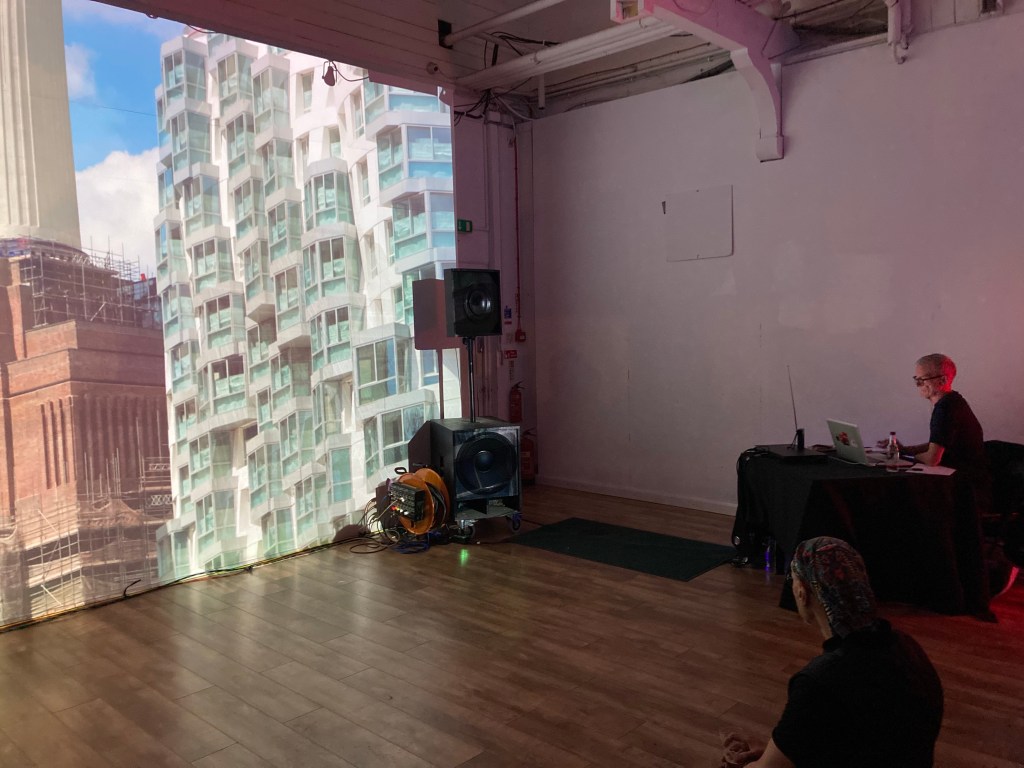
Simon Fisher Turner presented nowhereyet, his sounds – inchoate melodies, processed cello, clamorous beats – set to a slideshow of London photographs by Sebastian Sharples. There was something eerie about Sharples’ photos, appearing to show a mostly empty, lockdown-era vision of the capital. We cross-cross from Spitalfields to the bombed-out sanctuary of St. Dunstan in the-East; from monolithic skyscrapers to snow-covered residential streets; from Canary Wharf construction to a deserted Bond Street. Fisher Turner’s music seemed to carry the same sort of alien, mournful sparseness; it’s as if the sounds and images, to paraphrase the enquiry ‘if a tree falls in the forest and no one is around to hear it, does it make a sound?’, pondered the question as to whether a place devoid of its people can still be considered a place at all.

Sunroof / Daniel Miller & Gareth Jones

Daniel Miller and Gareth Jones resurrected their occasional Sunroof collaboration for a celebrated collection of modular synth improvisations, released last year as Electronic Music Improvisations Vol. 1. For their Iklectik set, they were seated opposite one another in a manner reminiscent of Marcel Duchamp and John Cage’s 1968 chess game, the board and its pieces replaced by innumerable boxes of flashing lights and tangles of coloured cables. In contrast to the pieces on their album, the set was intensely rhythmic, with grids of spare, almost skeletal beats instead of carefully-wrought, sinewy sequences. Miller and Jones have been friends and sonic adventurers together since 1982 and the symbiosis between them as they teased rhythms and patterns from their kit without ever seeming to communicate with one another was a testament to that enduring partnership.

The evening was interspersed with DJ sets from Nik Colk Void, ranging from juddering techno through to a memorable after-hours moment where she dropped Mudhoney’s socially-undistanced anthem, ‘Touch Me I’m Sick’.

Nik Colk Void / Mat Smith – photo by Leanne Mison

See Sebastian Sharples’ photos of the night at Instagram.

Words and bad photos: Mat Smith

(c) 2022 Documentary Evidence