HTRK – Chinatown Style (Ghostly International short film, 2014)

HTRK 'Psychic 9-5 Club' LP artwork

In my Clash review of HTRK‘s third album (Psychic 9-5 Club), I likened the smooth, sensual dubby soundscapes of Jonnine Standish and Nigel Yang‘s music to the ‘aural equivalent of Prozac’, an effect that leaves their music devoid of any discernible ups and downs.

The duo have worked with director Nathan Corbin on a short film for the track ‘Chinatown Style’, which finds the viewer following various Chinatown residents around seemingly quotidian pastimes – cooking octopus, jazz dancing and so on – all jarringly set to Standish and Yang’s ethereal ambience.

Here’s what Corbin had to say about the film: ‘I worked as a delivery boy in Manhattan in my early twenties. It’s an intimate way to experience the city. The delivery is a conduit into an extended, physical exchange. It can be erotic and psychedelic; the repetition of “opening” in a city full of guarded skyscrapers and locked doors. You float invisibly, drifting from one ambiance to the next.

‘In NYC there is fluidity between everyone. You’re constantly “encountering”people. Always entering. The energy can vary wildly with successive shifts from light to dark to light like yin-yang. You found luck! You find yourself in a utopian center: a Psychic 9-5 Club.

‘People are dancing.

‘I chose to work with people I didn’t know for the most part..so that our interaction was new, innocent..like a delivery.

‘The cinematography concept was crucial. Shoot with a wide angle lens to create that innocence. You see everything so the “gaze”… the obsessive and voyeuristic part of looking is reduced. The eye of an open heart.’

Chinatown Style can be viewed below. Probably not one to watch at work (or if you’re a vegetarian).

Thanks to Matthew @ Ghostly.

(c) Mat Smith / Documentary Evidence

Various Artists – The Tyranny Of The Beat (The Grey Area Of Mute album, 1991)

Various Artists 'The Tyranny Of The Beat - Original Soundtracks From The Grey Area' CD artwork

the grey area of mute | cd agrey1 | 1991

The Tyranny Of The Beat – Original Soundtracks From The Grey Area was a 1991 compilation issued by Mute to showcase releases from its Grey Area sub-label. The Grey Area specialised in reissuing the back catalogues of Cabaret Voltaire (their Rough Trade releases), Can, Throbbing Gristle (plus various Industrial Records acolytes), Graeme Revell‘s SPK and many others. The label also became home to early albums by artists that had been signed to Mute, such as Nick Cave‘s pre-Birthday Party band The Boys Next Door, D.A.F., Wire and Einstürzende Neubauten.

The reissue programme conducted by Mute through The Grey Area inevitably produced a varied counterpoint to the releases issued through the main Mute imprint, through Paul Smith‘s hugely diverse Blast First (which itself, at times, also reissued plenty of older material) and NovaMute. Alongside The Fine Line, specialising predominantly in soundtracks for TV, film and theatre, The Grey Area represented a hugely interesting opportunity to hear some out-of-print releases on CD for the first time.

There days, at least nominally, The Grey Area no longer exists. Can reissues have never officially carried the logo, and whilst Mute remains the custodian of the seminal Cologne unit’s back catalogue, it is done in partnership with Can’s own Spoon imprint; Cabaret Voltaire’s latest reissue programme through Mute is done through the main label and consequently all releases now carry stumm catalogue codes, and Throbbing Gristle effectively bought back their work to reopen the doors of Industrial Records. The opportunity to reinvigorate The Grey Area upon securing the opportunity to reissue the Swans back catalogue in 2014, alongside the Cabs programme, feels like something of a missed opportunity.

The Tyranny Of The Beat then serves as a useful overview of what The Grey Area were up to at this point in the early Nineties. A small four-page flyer inside the sleeve highlighted just how comprehensive the reissue programme undertaken by Mute was through the sub-label – after all, they were effectively re-releasing whole or sizeable elements of back catalogues, not sporadic releases. The flyer also included some items that were planned for releases but which have never materialised – chief among these was the Robert Rental / The Normal live album recorded at West Runton, which Rough Trade had released in 1980 as a one-sided LP.

The sleeve also features liner notes from Biba Kopf, famed NME journalist and currently (under his real name Chris Bohn) the editor of The Wire. Kopf also wrote the copy for the Documentary Evidence brochure which inspired this site.

The breadth of music included in sampler form on The Tyranny Of The Beat is impressive, taking in the grubby pulse of TG’s live track ‘See You Are’, their Industrial signees Monte Cazazza with the truly horrible ‘Candyman’, a bit of early electro from the Cabs, the detached punk of Swell Maps‘ brilliant ‘Midget Submarines’, the similarly aquatic ‘Our Swimmer’ by Wire (still one of their best Seventies pieces), a truly ethereal piece by Wire’s Bruce Gilbert / Graham Lewis as Dome with A.C. Marias and the still-devastating Rowland S. Howard-penned ‘Shivers’ by The Boys Next Door. Can’s ‘Oh Yeah’ – one of Daniel Miller‘s personal favourite tracks – provides a rhythmic counterweight to the urgent mechanical production-line beats of Neubauten’s ‘Tanz Debil’ and Die Krupps‘s ‘Wahre Arbeit, Whare Lohn’. Dark relief comes in the form of SPK’s ‘In Flagrante Delicto’, a track which suggests Graeme Revell was always destined to compose the scores for spooky, suspense-filled films like The Craft.

Like a lot of sampler albums, The Tyranny Of The Beat can sound a little uneven, and whilst a lot of these bands were part of common scenes – industrial, punk, the terribly-named Krautrock – it would have been a pretty weird festival if this was the line-up.

Kopf’s liner notes deserve a mention, if only for the way that he positions the concept of a grey area as a place that people run to for escape or as a means of consciously assaulting musical norms, a place that both acted as a reaction against the regimentation of beats and simultaneously gave birth to the repetitive rhythms of techno. ‘In The Grey Area you get the sense of limits being pushed up against and breached,’ he says, and even now, listening to Genesis P. Orridge deliver a maniacal vocal over corruscating waves of sinister noise from a distance of thirty-five years, or Monte Cazazza’s detached multi-channel reportage of a serial killer’s victims and the nauseatingly vivid listing of the savagery he put those victims through, you can see exactly where Kopf was coming from.

Track listing:

cd:
1. SPK ‘In Flagrante Delicto’
2. Throbbing Gristle ‘See You Are (Live, The Factory July 1979)’
3. Cabaret Voltaire ‘Automotivation’
4. Chris Carter ‘Solidit (Edit)’
5. Die Krupps ‘Wahre Arbeit, Wahre Lohn’
6. D.A.F. ‘Co Co Pina’
7. Einstürzende Neubauten ‘Tanz Debil’
8. NON ‘Cruenta Voluptas’
9. Can ‘Oh Yeah’
10. Wire ‘Our Swimmer (Live, Notre Dame Hall July 1979)’
11. Swell Maps ‘Midget Submarines’
12. The Boys Next Door ‘Shivers’
13. Dome ‘Cruel When Complete’
14. Monte Cazazza ‘Candyman’
15. The Hafler Trio ‘A Thirsty Fish / The Dirty Fire’

(c) 2014 Mat Smith / Documentary Evidence

Thomas Cohen – Honeymoon (unreleased single, 2013)

Seeing images of Thomas Cohen splashed all over the front page of yesterday’s Evening Standard – following the reports confirming that his wife, Peaches Geldof, died as a result of a heroin overdose – prompted the recollection that Cohen’s debut solo single had been unveiled on YouTube in October last year. To date the track has not seen the light of day through an official release, and presumably the tragedy in his personal life has quite rightly put any promotional activity to one side for now.

‘Honeymoon’ is a long, woozy number that’s impossible to consider now without thinking about Cohen’s loss. The song is a languid, heartfelt, romantic song that finds the singer dispensing with the gloomy goth overtones for something bordering on Leonard Cohen’s particular brand of introspective, poetic torch song. There’s a sense of Cohen here cradling his wife, telling her he’ll keep her safe from harm, that all they need is one another and nothing more; whether that’s just something you hear filtered through what you imagine he must be going through today is debatable, but irrespective, with its sparse arrangements, monolithic guitar riffs and plaintive sax, this shows that Cohen’s post-S.C.U.M work was likely to be heading in an interesting – if unexpectedly tender – direction.

The track can be heard above.

Stay strong Thomas.

Thanks to Jorge.

(c) 2014 Mat Smith / Documentary Evidence

Crown Estate – Lazers (Driver Sounds single, 2014)

Crown Estate 'Lazers' download artwork

driver sounds | download | 30/06/2014

‘Lazers’ is the follow-up single to last year’s ‘Battlesbridge’, Crown Estate‘s critically lauded debut single. For their second release, the duo of Julie and Sacha fuse the quirky electronics and sensibilities of today (references to texting, Twitter and Facebook) with a vocal vibe that stretches way, way back to the wry, detached style of classic Blondie.

Pop music doesn’t come more perfect than this: ‘Lazers’ is a vibrant, upbeat track with a wall of sound that positively shimmers with all manner of pretty glimmering textures and cutesy melodies. Stylistically, its themes of craving contact links it to Yazoo‘s ‘Bad Connection’ and Vic Twenty‘s ‘Txt Msg’, but this is at once something far fresher and more uplifting, propelled ever forward on a intricate beat that can’t help but make you smile.

Perhaps it’s the talk of heatwaves and transport meltdowns in the media today, but ‘Lazers’ could well be this reviewer’s summer anthem.

Get ‘Lazers’ on iTunes here. It could be the best 79p you spend.

Thanks to Clare at 1-2-hear and Julie.

Track listing:

Download:
1. Lazers

(c) 2014 Mat Smith / Documentary Evidence

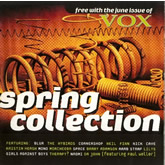
Various Artists – The Vox Spring Collection (covermount album, 1999)

Various Artists 'The Spring Collection' CD artwork

vox | cd sc99 | 06/1999

Ordinarily I wouldn’t mention Mute acts appearing on covermount cassettes or CDs on this blog unless a track was an exclusive mix or edit, or if the compilation itself was Mute-focussed. However, whilst clearing out old CDs recently I came upon this one, which I’ve always loathed because of its sleeve, and inside the sleeve I found two clippings from the issue of the long-defunct Vox that this came with (June 1999).

The clippings were taken from the customary page in the magazine that described the tracks, and included explanatory comments from Nick Cave and Barry Adamson on the songs that were included on the album (‘Red Right Hand’ from Cave’s best-of, and ‘Jazz Devil’ from Adamson’s As Above, So Below). These have been reproduced below, mainly because I thought they were quite useful to retain. Also reproduced are the comments from the liner notes to the CD itself.

The CD also includes ‘Suzy Parker’ by The Hybirds, Richard Warren‘s pre-Echoboy band who had just released their debut album on Heavenly. The liner notes for that have also been reproduced (one wonders what the band made of the ‘dadrock’ comment), but as I had no idea that Warren would metamorphose into Mute’s Echoboy, I never bothered to keep the magazine notes on this song. The inclusion of The Hybirds on this CD in turn prompts the recollection that I caught the tail end of a live set by the band at Colchester Arts Centre on 16 February 1997. The band were supporting Beth Orton, who at the time was my then-girlfriend’s favourite singer. A bunch of us went to watch Orton at our local music venue; it was supposed to be our first Valentine’s weekend together, but instead we seemed to spend most of that weekend either apart or in the company of sundry friends of hers. Consequently I approached the Orton gig, and the Hybirds songs I heard, with a degree of disdain and over-critical resentment.

Nick Cave ‘Red Right Hand’

Sleeve: Originally from Let Love In, perhaps Cave’s finest LP, this also (rather bizarrely) appeared on the Dumb And Dumber soundtrack. ‘You’re just a microscopic cog in his catastrophic plan‘ moans Old Nick in this semi-comically melodramatic take on Stephen King’s The Stand.

Magazine: ‘I had a really wild band then, the best I’d ever had. They could all play, but they were ragged and raw, too. With The Birthday Party there was blues, soul and country, but it was all exploded, there was no kind of respect for anything. It was a machine that was whirling in its own direction and nobody knew what was happening really. The same musical influences are there, but now we respect then more, hold then truer.’

Barry Adamson ‘Jazz Devil’

Sleeve: He played with Magazine, Pete Shelley, and with Nick Cave in The Bad Seeds. Then he went solo to delve deeper into blues / soul / torch / pop / pretty much everything else and somehow remained cool throughout. This is as new as it gets.

Magazine: ‘People talk about the devil as some trickster, a cunning little devil. As far as the darker stuff on the album [As Above, So Below] goes, I wanted to be completely bleak and then relieve it with a humorous look at the dark side with this character that is destined to always be on earth.’

The Hybirds ‘Suzy Parker’

Sleeve: A crazy stream-of-consciouness tribute to the 60s model, and a prime cut from this increasingly popular, thrillingly realist Mansfield band’s eponymously-titled *****-rated debut LP. Dadrock simmering in youthful bile.

(c) 2014 Mat Smith / Documentary Evidence

Erasure – Voulez Woo Woo (Cocktail)

Erasure - Voulez Woo Woo cocktail

I’m continuing my trawl through the Snow Globe cocktail box that came with last year’s boxset and this past weekend I turned my hand to this one, named crudely after the ABBA track that rounded off Vince Clarke and Andy Bell‘s only UK number one single, 1992’s ABBA-Esque EP.

The Woo-Woo is a terribly named drink – definitely one for the alcopop generation, I would say – but it is elegant in its simplicity, both in ingredients and the fact that any amateur mixologist could manage to make this without messing it up. A mix of vodka, peach schnapps and cranberry juice generally served as a highball, the peach counteracts the tartness of the cranberry juice and the sweetness of the peach is neatly offset by the cranberry. So if you can look past the abysmal triteness of the name, this is a pleasant long drink that could probably lead to many blurry nights.

(c) 2014 Mat Smith / Documentary Evidence
Electronic Sound: Issue 7 Reviews – Cabaret Voltaire, Plastikman, Fatal Casualties, Spacebuoy

Cabaret Voltaire '#7885' CD artwork Plastikman 'EX' CD artwork

Four of my reviews appeared in issue 7 of the digital magazine Electronic Sound, available for iPad or as a PDF file.

First up is the new Cabaret Voltaire album #7885 – Electropunk To Technopop (1978 – 1985) (Mute), the first Cabs compilation to bring together both their Rough Trade and Some Bizarre / Virgin periods. The album comes complete with revealing technical liner notes from Richard H. Kirk and longstanding fan and Mute MD Daniel Miller.

Richie Hawtin releases a new Plastikman album this month. EX (Mute) was recorded live at the Solomon R. Guggenheim Museum in New York at the personal request of Dior head designer Raf Simons for the museum’s annual fundraiser in late 2013, and saw Hawtin offer an entirely new suite of Plastikman tracks. Fans of dark acid ambience recorded in highbrow surroundings need look no further.

Fatal Casualties 'Psalm' LP artwork Spacebuoy 'Intoxicated' CD artwork

Issue 7 of Electronic Sound also includes my reviews of two non-Mute bands whose work I’ve featured on Documentary Evidence over the past couple of years. Swedish darkcore electronic duo Fatal Casualties have released their debut album Psalm on the consistently interesting Seja imprint. A dark, cloying album filled with intricate Depeche Mode-isms and Downward Spiral-era vibe of Nine Inch Nails, Psalm is far from an easy listen but fully realises the aesthetic that the duo of Stefan Ljungdahl and Ivan Hirvonen have painstakingly developed on their previous two singles for Seja.

Also delivering their much-anticipated debut, electronic duo Spacebuoy (Howard Moth and Jez Allan-Smith) release Intoxicated this month. Erasure fans will recall that Spacebuoy were the support act for the veteran synthpop duo’s warm-up for the Total Pop forest tour, and since 2013’s Breathe EP the pair have been hard at work crafting the tracks for their first album. Intoxicated straddles both classic electronic pop and harder trance and techno-inflected styles, making for an interesting and varied debut release.

The iPad edition of Electronic Sound can be purchased through iTunes. The PDF edition will be available through the Electronic Sound website soon.

(c) 2014 Mat Smith / Electronic Sound

Audio Journal 03/07/2014: Front & Follow

Audio Journal logo

Front & Follow are a Manchester-based label who I hadn’t noticed until Clash asked me to review Blind Mouths Eat by The Doomed Bird Of Providence earlier this year. That album really impressed me, even though I initially labelled it a concept album.

The Doomed Bird Of Providence are an Australian group presently based in my old residence of Colchester, and for Blind Mouths Eat the focus of their attention was on a devastating 19th century storm known as Cyclone Mahina. For me, Doomed Bird tapped into the same strand of folk and blues that bands like The Bad Seeds, The Triffids and Crime & The City Solution all made their own during their careers, and I happily gave the album 8/10. I described it as ‘a haunting exploration of hopelessness and violence’.

Blind Mouths Eat, in turn, begat To Mahina, an EP by fellow Front & Follow artist Kemper Norton. If Cyclone Mahina inspired Doomed Bird’s album, the album about the storm inspired Kemper Norton. The response is an EP that takes the mysterious fatalism of the original album and uses that feeling as the basis for a collection of electronic explorations that possess a natural dimension infused with a sort of sea shanty quality. This is all about texture, whereas Doomed Bird’s album was primarily about the narrative; To Mahina lies somewhere between a calm millpond and the terrifying stillness that returns after the devastation, making this an imaginative and captivating release.

Kemper Norton 'To Mahina' artwork

If Kemper Norton is mysterious, Pye Corner Audio are downright mythical. Their WordPress site proclaims them to have been active since the Seventies, but in what capacity it doesn’t say, raising eyebrows and leading the listener to ponder whether this isn’t some fanciful aspiration to create a history where one simply doesn’t exist.

Irrespective, Pye Corner Audio produce brilliant electronic music that has its head firmly placed in the world of analogue synthesis, back at a point where you were more likely to wear a suit and a lab coat to the studio, those early synths being akin to giant science experiments than real instruments. The new Pye Corner Audio 12″ for Front & Follow, The Black Mist EP, takes rich pulses, percussion and melodic sounds and infuses them with a chunky beat that sounds like it was borrowed from the Chemical Brothers’ early works. Towering washes of sculpted synth pads wash in like waves and buzzing drones have the distorted quality of punk guitars. Like the longform explorations of, say, Node, ‘The Black Mist’ has that mesmerising quality that I will use as evidence that electronic music has an inner human quality whenever detractors try to tell me otherwise.

Pye Corner Audio 'The Black Mist' artwork

The B-side features a remix of ‘The Black Mist’ and the detuned Plaid-esque deep ambient electro of ‘Bulk Erase’. Here is a track that could easily be a minimal, slowly-shifting exploration of rhythm and pulse, but Pye Corner Audio aren’t afraid of co-opting classical melodic sensibilities and that’s the case here with an arresting, emotive filmic passage that sounds like it’s begging for use by an independent director.

Front & Follow releases can be found here.

Thanks to Justin.

(c) 2014 Mat Smith / Documentary Evidence

Wire – 1985-1990: The A List (Mute Records album, 1993)

Wire 'The A List' LP artwork

mute records | 2xlp/cd stumm116 | 05/1993

1985 – 1990: The A List was released in 1993, by which time Wire as a four-piece band were no more. Robert Gotobed had left the band by the time The First Letter was released in 1991, the band ditching the last letter of their name and becoming Wir for that album. Wir themselves then promptly called it quits, leaving behind two further tracks which were released on Touch as the Vien single in 1997.

This is a compilation album of tracks recorded by Wire between the Snakedrill EP and the Drill album that included new versions and live takes of the amorphous-lengthed track that proved to be Eighties Wire’s mainstay, its relentless dugga-dugga-dugga rhythm providing the foundation for their material for Mute. So, yes, a compilation, but one with a difference: according to the sleeve notes, ‘The A List was drawn up by asking various compilers to name their “top 21” Wire tracks in order of preference. They were then arranged on a “football league” basis. The final choice and running order are based on this chart and the maximum time of a CD. There have been no edits.’

Those contributing to the vote included the band’s Colin Newman and his wife and Githead accomplice Malka Spigel, Bruce Gilbert‘s chum Russell Haswell, Touch co-founder Jon Wozencroft (who also did the typography for the album), Wire biographer Kevin Eden, England’s Dreaming author and punk authority Jon Savage and Mute’s Roland Brown, and for completeness the entire distribution of votes is included within the sleeve notes. The A List was compiled and edited by Brown, Newman and Paul ‘PK’ Kendall.

The result is a showcase of just how strong Wire’s body of work was in the Eighties. While the purist post-punk fans would no doubt bitterly complain that Wire had more or less left their late Seventies intensity and creativity behind, the Wire that reformed and signed to Mute in the mid-Eighties delivered a high quality pop-inflected ethos mixed in with some of the strangest lyrics that have ever been committed to record. So what if the snarling guitars had been left behind – that was yesterday’s news. The new tracks (mostly) had a smart sound, infused with greater use of technology, while the wry artsiness that dominated Wire’s trio of albums for Harvest / EMI was never more than a sneer away.

The only criticism I have of The A List is that ‘The Boiling Boy’ didn’t make the grade. The version of the track that appeared on IBTABA is probably my favourite track from Eighties Wire, a slow-developing, graceful but strangely linear piece (it scraped into number #56 on the league table with just 29 votes). However, this album was the product of a resolute democracy – how typically Wire to create a compilation this way – and thus I shouldn’t question its exclusion too much. It’s certainly a more considered compilation than the equivalent sweep-up of Seventies Wire, On Returning, which Harvest put out in 1989.

For sharp-eyed completists, note that this was given a stumm catalogue number, rather than the mutel mark used by Mute for some artist compilations.

Track listing:

2xlp/cd:
A1. / 1. Ahead
A2. / 2. Kidney Bingos
A3. / 3. A Serious Of Snakes
A4. / 4. Eardrum Buzz
B1. / 5. Drill
B2. / 6. Ambitious
B3. / 7. In Vivo (Remix)
B4. / 8. The Finest Drops
C1. / 9. Madman’s Honey
C2. / 10. Over Theirs
C3. / 11. Silk Skin Paws
C4. / 12. The Queen Of Ur & The King Of Um
D1. / 13. Torch It!
D2. / 14. Advantage In Height
D3. / 15. Point Of Collapse
D4. / 16. Feed Me

First published 2012; edited 2014

(c) 2014 Mat Smith / Documentary Evidence

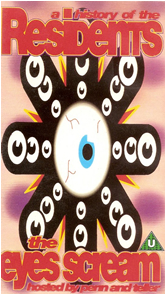
The Residents – The Eyes Scream: A History Of The Residents (Cryptic Corporation film, 1991)

The Residents 'The Eyes Sceam: A History Of The Residents' VHS artwork

cryptic corporation | vhs | 1991

One of the consistent things that has always hovered around The Residents is, of course, the identities of the members. This is hardly a surprise when the members have generally spent most of the last forty-odd years underneath various masks, the most obvious being the eyeballs that have become synonymous with the band for most of this time. The obsession with knowing the names of The Residents taps into a curious aspect of the human psyche – namely the need to know. It is simply not enough for us to appreciate their art – music, films, multimedia – as art; we need to know who is behind it.

But really, what would knowing their names actually achieve? Would our appreciation or comprehension of the work of The Residents really be any more enriched by knowing the names of these people? I think not. Nevertheless, we’re all still desperate to know, and The Residents themselves know this all too well; not too long ago they unmasked themselves and announced that their real names were Randy, Chuck and Bob. No-one believes that for a second, but it’s probably as much as we’re ever going to get.

The Eyes Scream, a 1991 documentary by the band flirts with the need to know those identities in the final few minutes. The host, long-term Residents accomplice Penn Jillette, stops reading the praise for The Residents from the autocue and storms off set, the camera following him as he walks off; as he does so, The Residents are there operating the cameras and microphones. Just before the credits roll, they lift up the eyeball masks, offering a brief and tantalising glimpse of who they might really be. But then, how do we know they really were the actual Residents and, once again, does it really matter? Probably not.

Given that The Residents are not a conventional group, The Eyes Scream is not a conventional documentary. The film takes the form of video selections from the band’s body of work, some live performances on various television shows and obligatory talking head interview footage. The videos show how richly inventive the band have always been when it comes to the use of visuals, whether that be in the early use of computer animation (Earth Vs. Aliens) or the art-house narrative of Whatever Happened To Vileness Fats? which feels a lot like David Lynch directing Elias Canetti’s Auto Da Fe on the set of Rentaghost. Vileness Fats was the mythical film that the band’s first single, 1972’s Santa Dog, was supposedly taken from the soundtrack for, and only extracts like the one included here have ever been released.

Then there’s the band’s tendency to dress up. Eyeballs aside, there are plenty of examples here of the band dressing up and clearly having a lot of fun, including some spirited cowboy clobber on a performance captured live in Munich – here the band are without eyeballs, but any hope of discerning features is thwarted by their faces being obscured by scary lights. We can all see the artistic side of the band, but what’s perhaps overlooked is their theatricality and sense of showmanship. Just check the Busby Berkeley-esque choreography on their rendition of ‘Jailhouse Rock’.

The documentary is hosted by Penn and his mute sidekick Teller. Penn has worked with the band in the past on a 1982 European tour and several albums (beginning with that year’s Ralph Records 10th Anniversary Radio Special!), even acting as a sort of spokesperson for the group according to some clips included here – as surreal as this band are, there’s little more weird than watching four eyeball-headed people playing ‘snookers’ (sic.) in a Brixton pub. The involvement of the duo briefly gives rise to the notion that maybe they may themselves have been Residents, but clearly you can spend too long thinking about these things. Penn and Teller’s own brand of comedy has always tended toward the somewhat bizarre, making them perfect presenters for this supposed (albeit loose) history of the band; the best section is one where Teller keeps on taking off layer upon layer of clothing to show the camera a variety of Residents t-shirts and sweaters, while Penn reels off a list of available merchandise such as a Residents pizza holder or a Residents yo-yo (‘so you can walk the Santa Dog’).

As this is a music documentary, it wouldn’t be complete without the addition of talking heads, in this case the Cryptic Corporation‘s Homer Flynn and Hardy Fox. Both have vehemently denied being Residents, but on the video evidence presented here, during one of the sections where the band are relatively shorn of masks, the lead singer looks a lot like Flynn. Flynn himself sums up the motivation of the band, explaining that they are constantly ‘creating their own reality’. In this sense, in a world of alternative reality, identities don’t matter a jot.

The Eyes Don’t Scream is a product of the Nineties – its presentation and garish graphics are reminiscent of MTV or The Word – but in the absence of anything more concrete, this documentary is essential viewing for anyone seeking to make sense of this most enigmatic of bands.

Featured Clips:
Don’t Be Cruel
Alter Image
Third Reich & Roll
Vileness Fats
Man’s World
Hello Skinny
One Minute Movies
Jailhouse Rock (Live in Oslo)
Cry For The Fire (Live in Oslo)
Man’s World (Live in Australia)
Burning Love (Live in Munich)
Earth Vs. Flying Saucers
From The Plane To Mexico

(c) 2014 Mat Smith / Documentary Evidence