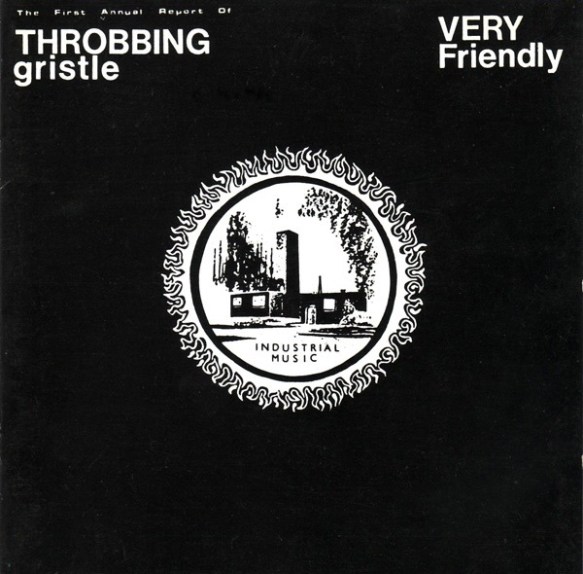
Throbbing Gristle – Very Friendly / The First Annual Report (recorded 1975)

  
The material on what has been variously described as Very Friendly and The First Annual Report represent the first recordings that Throbbing Gristle made under that name in 1975, in the midst of their transition from the COUM Transmissions moniker in a concerted effort toward making music rather than more eclectic arty initiatives.

These so-called “wreckers of civilisation” – Genesis P-Orridge, Cosey Fanni Tutti, Chris Carter and the late Peter ‘Sleazy’ Christopherson – were no strangers to controversy when they decided to focus on what became Throbbing Gristle. COUM, while including an element of sonic exploration, was fundamentally a multi-disciplinary project, with imagery and ideologies that were often challenging, even for the liberal approach often taken toward the arts during the Seventies. Throbbing Gristle extracted the confrontational artsy angle but focussed that around sound, developing an aesthetic that was contemporary with the genesis of punk but which split itself off in a uniquely devastating counterweight to the Transatlantic feedback loop between The Ramones and The Sex Pistols.

This so-called first annual report begins with an almost twenty minute dirge of sound that recounts, in blunt, detached detail, the Moors Murders of Ian Brady and Myra Hindley. Gen’s narrative on ‘Very Friendly’ spares no detail, taking on the dispassionate delivery that Patrick Bateman would deploy over a decade later in Bret Easton Ellis’s American Psycho; no detail is spared, whether that be the detailing of various proclivities on the part of the victims or the brutal violence that Brady / Hindley wrought upon those individuals. Gen’s voice takes on a manic, almost excitable and aroused quality as the sonic backdrop begins to pick up the pace to reflect the executions, with jarring synths and fuzzed-up guitars delivering the requisite nightmarish atmosphere for the story.

By the conclusion of TG’s opening gambit, the group are dealing in mere atmospheres, Gen’s voice stuttering the words ‘there’s been a m-m-m-m-murder’ with layers of echo that almost suggests a dreamy, sedated otherworldliness, as if what just played out couldn’t possibly be true. For a lot of people the serial killer antics of Brady and Hindley were something that couldn’t be rationalised, while for others they were a numbing tragedy that cast a pall over the North of England.

The rest of the album takes the same sonic foundations – the same grainy texture and noisy, clamorous atmospheres – and skews them, sometimes finding Gen vocalising some weird lament (’10 Pence’), adding TV news reportage while guitars and freeform noise structures push the TG sound closer to The Velvet Underground’s ‘Black Angel Death Song’ (‘Whorls Of Sound’), or into intriguing synth shapes (‘Dead Bait’) that belong on a Clive Barker soundtrack.

Though nowhere near as devastatingly confrontational as the opener, the most interesting piece here is ‘Final Muzak’, which propels itself forth on a dense, churning, sub-motorik metallic groove that’s part rhythm and part bass sequence. Noises whine and drone continually over that jarring rhythm, cycling round in queasy loops that suggest this early attempt toward the disciplinarian approach that would become one of Throbbing Gristle’s signature motifs could have run on far longer than the mere five and a half minutes presented here.

Very Friendly / The First Annual Report has never officially been released, but it has been bootlegged plenty of times over the years, with the name varying according to the release. I bought a CD copy of this released by the Genetic Terrorists label, with the above sleeve image and the name Very Friendly from an HMV on Oxford Street in 1997, which lead me to believe it was perhaps more official than it actually was. The most recent release was in 2001 on the Yeaah! label. Quite why the band never saw fit to release the record officially via their own Industrial imprint is something of a mystery, but just another strange decision in the history of this most uncompromising of British groups.

(c) 2016 Mat Smith / Documentary Evidence

Diamanda Galás with John Paul Jones – The Sporting Life (Mute album, 1994)

  
I’ve maintained a healthy interest in Diamanda Galás since hearing her vocal contributions to Erasure’s Erasure album in 1995, but I’ve always found her music a little too impenetrable. I fully appreciate her dexterity and range as a vocalist, but I’ve never really ‘got’ her, though not through lack of trying.

The Sporting Life, Galás’s 1994 collaboration with Led Zeppelin’s John Paul Jones was my first real concerted effort to get to grips with her music, and as an entry point to an artist that Daniel Miller signed to Mute precisely because she was ‘challenging’, it’s not a bad place to start.

A lot of what makes The Sporting Life relatively accessible is the multi-instrumentalist Jones’s arrangements. This is a a form of blues, accented with the kind of aggressively brutal funk shapes that draw parallels with the likes of Rage Against The Machine, particularly on tracks like ‘Do You Take This Man?’ and ‘Devil’s Rodeo’, where his low-slung bass anchors the whole track in rigid, unswerving time. Rooting the music in the blues seems to encourage Galás to play down some of the histrionics for which she is known, finding her instead singing relatively ‘straight’, especially on stirring numbers like the soulful ‘Dark End Of The Street’ or ‘Tony’ which are just about the most plaintive and troubled, almost theatrically soulful, moments in Diamanda’s catalogue.

The organ-led ‘You’re Mine’, with its Louisiana gumbo of reference points is where wildness starts to creep in, descending into a cacophony of tongues that render the tail end of the track a swampy mess, with the music feeling like it constantly wants to wrap up but where Galás just wants to keep going. It’s a definitive example of why less is more.

And that again is what I have a problem with. I could listen to Galás doing gravelly blues songs like ‘Dark End Of The Street’ all day, but I run out of patience when the vocal histrionics – irrespective of how technically accomplished her range and technique might be – reach the point of complete and noisy surrender. Even the masterful Jones seems to give up somewhere on this album, and the music begins to play a very clear second fiddle to the dominance of Galás’s voice. The only time I can really get on board with it is during the closing track, ‘Hex’, and that’s mostly because of the Nitzer Ebb-esque riff that runs through most of the track.

I’m honestly not sure what it is about her voice that troubles me so much; perhaps it’s that it carries a level of base anguish and emotional openness that I’m not prepared to give in to, or perhaps it’s a specific aversion that I have to vocal improvisation. I get jazz improv, but I’ve never developed a taste for either scat singing or the wordless vocalisations of people like Phil Minton, and I’m not sure I ever will. Whatever the reason, my relatively modest Galás collection is now up for sale via Discogs.

(c) 2016 Mat Smith / Documentary Evidence
Elevation – Can You Feel It / Spiral Trance (NovaMute single, 1992)


single // Can You Feel It / Spiral Trance

novamute | 12″/cd nomu3 | 1992

Ask any dance music fanatic what word they would associate with the year 1992 and the chances are they will reply, without hesitation, ‘hardcore’. Hardcore dance music was a fusion of sped-up breakbeats, thudding drums, speaker-wrecking dub bass, crowd noise, whistles and a synth effect that could only ever be described as sounding like a hoover; the effect was a sort of bludgeoning euphoria. Hardcore was, at times, ridiculous and the genre was ultimately short-lived, mutating quickly into a multitude of other genres, not least of which was the even more breakbeat-heavy jungle.

Elevation, a pseudonym of producer Shaun Imrei, has all the trademark hardcore traits listed above, plus housey piano and some gutsy, euphoric vocals courtesy of an unnamed contributor (she sounds a little like Sylvia Tella, who guested on Pop Will Eat Itself’s 92ºF) which rescues ‘Can You Feel It’ from the nihilistic quality of some other hardcore tunes, and also ensuring the track could work in a variety of DJ boxes. Okay, so the piano sounds a little weak and the whistles, bells and crowd noise may feel a bit contrived twenty odd years later, but there’s no denying the uplifting energy that ‘Can You Feel It’ possesses, marking the track out as a major highlight in a dance music style that rapidly went off the boil. And that manic ‘hoover’ sound still sounds as thrilling today, even if its potential as a rival to the TB303 was limited. The 12″ and CD released by NovaMute contains mixes taken from the tune’s original release on Creative Rhythm earlier in 1992, as well as a previously unreleased version (the Mutation Mix) which contains a breakdown filled with an excellent King Tubby-style dub passage.

For its NovaMute release, ‘Can You Feel It’ was backed by ‘Spiral Trance’ which was produced by Imrei and John O’Halloran. Starting with some ethereal vocals that sound like they belong on a Clannad record, ‘Spiral Trance’ retains only the barest trace elements of a hardcore aesthetic in some of its sounds, instead offering a deep, entrancing cut which doesn’t sound dissimilar to early Orbital or Juno Reactor. There’s not a heavy breakbeat in sight, Imrei and O’Halloran opting instead for a carefully-constructed 4/4 beat and a bass sound that could spill over into acid madness, but doesn’t, and for once this song is all the better for it.

12″/cd:
A1. / 1. Can You Feel It (Mutation Mix)
A2. / 2. Can You Feel It (Extended Mix)
B1. / 3. Spiral Trance (Into The Light Mix)
B2. / 4. Can You Feel It (Remix)

Originally posted 2012; re-posted 2015.

(c) 2015 Mat Smith / Documentary Evidence

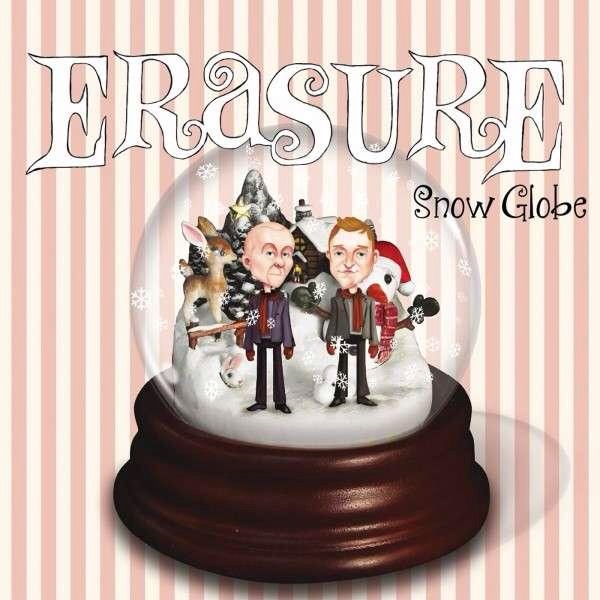
Erasure – Snow Globe (Mute album, 2013)

  
As its Christmas, I’ve found myself listening to Erasure‘s 2013 seasonal collection Snow Globe more than anything else over the last few weeks. I truly think it is one of the best Christmas albums ever made.

Here is the small review of the album that I wrote for Clash upon its release.

(c) 2015 Mat Smith / Documentary Evidence

The 7th Plain – Wishbone


The 7th Plain was an alias that future NovaMute / Mute artist Luke Slater used for a brief time, the first album issued under the name being the brilliant My Wise Yellow Rug released in 1994 by General Production Recordings (GPR). The 7th Plain found Slater operating in a firmly ambient mode, complementing the more dancefloor-friendly tracks he issued under his Planetary Assault Systems alias.

‘Wishbone’ doesn’t appear on My Wise Yellow Rug, but it sounds like it should have been included there. Here Slater lays down a rich, slowly-developing tapestry of mostly pleasant sounds underpinned by a hissing rhythm that sits somewhere between skeletal electro and the factory-like drum pattern from Depeche Mode’s ‘Ice Machine’. Toward the end Slater introduces a bassline constructed from a somewhat darker synth sound while a repetitive arpeggio sequence takes on a queasy insistence as the track concludes.

Throughout, even as Slater drops in what feels like a organic, jazzy looseness at the very beginning via vaguely piano riffs, there’s an underlying mechanistic, robotic quality to ‘Wishbone’; that reminds me of a review of one of the tracks on My Wise Yellow Rug which compared the track in question to Vince Clarke covering Vangelis’s theme to Blade Runner. In the interests of full disclosure, I actually bought the album on the strength of that line alone. At the time it wasn’t apparent that Slater would go on to become a Mute artist, but I was pleased he ultimately signed to the label, though I can honestly say that his work as The 7th Plain was always more interesting to me than the output under his own name.

Equanimity was released as a double compilation by the GPR label in 1995 and features some really good tracks from Max 404, D:Fuse, Beaumont Hannant, Russ Gabriel and other artists from the imprint’s roster. It sits squarely alongside the Warp series of Artificial Intelligence / listening electronica albums but at times seems to have much more of a concrete, robust edge compared to some of the ambient noodling that Warp’s series tended towards. With Max 404 and a crunchy Bari-speed rave track from the absurdly-named Radioactive Lamb being two possible exceptions, it would have been slightly inconceivable to find any of the tracks here finding themselves sitting comfortably in a techno set of the time, but an adventurous DJ could have probably found a way. They usually could.

(c) 2015 Mat Smith / Documentary Evidence
Richard Hawley – Down In The Woods @ 33rpm (Mute / Parlophone single, 2012)

  
single // Down In The Woods

One of the many loveable things about John Peel was his tendency, with alarming regularity, to play records at the wrong speed. For the masterful Peel, this was a natural consequence of packing his late-night shows with so much adventurous music that the odd RPM gaffe here and there was to be expected.

Somewhat less excusably, I did exactly the same with the 10” copy of this Richard Hawley single from his Singles Club series which left my music collection forever last week courtesy of a Discogs buyer. Long gone are the days of me sitting down and sticking on an LP in my lounge; in these time-pressed parental days, I often record the vinyl into my laptop with the volume set to mute (pun intended) and then listen to it back on the train to work the next day on my iPod. I know, I know; and to think I call myself a music writer. Don’t trust anything I say.

That’s exactly what I did with ‘Down In The Woods’ when I first received it three years ago, except that I either misread the label or the label didn’t say what the speed was, or I just figured the turntable was set to 45 when it was actually still set to 33, and I never went and recorded it again. As a result, this review is of ‘Down In The Woods’ and its B-side ‘Kindly Rain’ – at the Peel-friendly wrong speed. Read it faster if you want to guess what it really sounds like.

‘Down In The Woods’ is a long, sludgy piece of psychedelic blues wherein a gravel-voiced Hawley does his best impression of a robotic heavy metal vocalist whacked out on tranquillisers. The guitars fizz with astral aspirations and feedback drones reminiscent of something the Jesus And Mary Chain might have developed in a vague homage to The Velvet Underground. The whole thing has an epic, heavy density; a cloying, foggy, slightly threatening stew that Hawley’s demonic vocal does little to dispel, especially on his echoey delivery across the sparse and slowly rebuilding middle eight. This is possibly what it sounds like when you listen to ‘The End’ by The Doors within a lab-controlled LSD experiment.

‘Kindly Rain’ is pure angelic, ethereal texture, with lots of shimmering, mellow grandeur and atmospheric touches, at least until it tries, abortively, to push upwards into another lysergic jam; it just happens to be fronted by someone who sounds a lot like Iggy Pop does these days. Even at the wrong speed I can tell this is Hawley at his ballad-toting best.

(c) 2015 Mat Smith / Documentary Evidence

Kid Congo Powers & The Pink Monkey Birds – Conjure Man (In The Red single, 2012)

  
single // Conjure Man / Lose Your Mind

in the red | 7″/dl itr239 | 2012

Kid Congo Powers, as well as being Nick Cave‘s guitarist in the Bad Seeds and a founder member of The Gun Club, used to be in The Cramps. If you ever needed validation of his involvement in the band formed by the late, great Lux Interior and Poison Ivy, ‘Conjure Man’ is probably it, albeit what The Cramps might have become if they’d studied Morricone. Powers, or Brian Tristan to immigration, has a particularly distinctive tremolo guitar style which manifests itself here as a sort of desert-washed, dramatic blues, with all the insistent bleakness of a spaghetti western soundtrack in ‘Conjure Man’s spacious tumbleweeds-in-dystopia arrangement. His vocal may lack the stuttering jerkiness of Lux and the music some of the obtuse angles that made The Cramps such a compelling unit, but his echo-drenched Californian drawl has the same appealing blank weirdness, whilst lyrically here also recalling the wonderful anarchic mysticism of Screaming Jay Hawkins’ ‘I Put A Spell On You’.

The B-side is a cover of The Seeds’ ‘Lose Your Mind’ (misspelled, perhaps deliberately, as ‘Loose Your Mind’ on the 7″ label). That’s right, an ex-Bad Seed covering The Seeds. Powers captures the garagey rock ‘n’ roll blues of the original with ease, adding a lysergic, psychedelic quality to the arrangement via some sky-scouring synths and captivatingly frazzled, whining guitar trickery. It’s effortlessly cool, much like Kid Congo Powers himself.

The single was released in both red and black vinyl editions (100 and 400 copy editions), with both editions enclosed in a screen-printed sleeve printed onto cardboard cut from a Pabst Blue Ribbon box. If that doesn’t scream ‘carefully-produced lo-fi’ then I don’t know what else does.

First posted 2013; re-edited 2015

(c) 2015 Mat Smith / Documentary Evidence

Various Artists – Artificial Intelligence (Warp compilation, 1992)

  
compilation // Artificial Intelligence

Warp’s groundbreaking Artificial Intelligence compilation did what so many other seminal compilations did and effectively made a scene concrete. Like Eno’s No New York did for post-punk in the US, it could be argued confidently that Warp did the same for the particular brand of electronica over which the Sheffield label presided, spawning a series of intriguing albums by the label that gave voice to many of the artists that were showcased on the compilation.

Artificial Intelligence arrived in 1992, the same year that hardcore had rudely woken the listening public from their slumber, and on many of the tracks included here there’s still a whiff of detuned breakbeats as opposed to the haphazard glitch beats that the likes of Autechre would come to represent over the next two decades. In fact, Autechre’s ‘Crystel’, one of two tracks by Sean Booth and Rob Brown included here, sounds positively like a conventional instrumental synthpop track compared to the jagged rhythms and icy melodies they would become poster children for. Tracks like Musicology’s ‘Preminition’ are not exactly the bedroom listening we came to expect from the AI series, and instead sound like straightforward rave tracks, complete with menacing basslines and euphoric soul samples.

Of interest to Mute / NovaMute fans are three tracks from Speedy J and Richie Hawtin, here operating under his short-lived UP! alias. Hawtin’s ‘Spiritual High’ was originally released on a 12” song on Hawtin’s Probe label, and later released as one side of NovaMute’s Probe Mission 2 12” as part of a tentative partnership between the UK and Canadian labels (the other track on that 12” was by Public Energy, an alias of Speedy J). For a track taken from a relatively early part of Hawtin’s career, the format of his later work is immediately recognisable in the thudding snare-heavy beats, acid squelches and the way his track repeats endlessly but still builds toward several peaks over the course of its six minute duration.

‘Fill 3’ by Speedy J forms part of a series of tracks with that title, but as far as I can tell, was an exclusive to Artificial Intelligence. By the time Jochem Paap had arrived at NovaMute his music had undergone many changes, and ‘Fill 3’ sounds positively naïve in comparison with his later work, though with its synth pads and shimmering textures it is undoubtedly one of the most pleasantly ambient tracks on the whole collection. Given the momentum implied by its bubbling patterns and fragile melodies, it feels like it’s crying out for a beat sequence of some form, but to J’s credit he resisted the temptation of adding one. The other Speedy J track on Artificial Intelligence, ‘De-Orbit’, was featured on his Warp album Ginger and is a slowed-down, chilled-out affair with hip-hops breaks, wherein the languid pace allows for intricate details to emerge through the greater sense of space.

Alongside Autechre, Artificial Intelligence showcased Warp stalwart Aphex Twin, here in his Dice Man guise but with a track from his Polygon Window album for the label, as well as B12 (Musicology) and The Black Dog under the name I.A.O. The album also included Orb’s Alex Paterson with a live version of the classic ‘Loving You’, though it’s not immediately apparent what makes this a Paterson solo effort rather than an Orb performance.

1994’s follow-up compilation mined the same vein, with many of the same players, but branched out further, and also illustrated how much the electronic music could evolve in just two short years. For this reviewer, I bought Artificial Intelligence 2 before the first instalment, and listening in reverse made this first compilation sound decidedly tentative, but I nevertheless fully understood the importance of what Warp had assembled here.

(c) 2015 Mat Smith / Documentary Evidence

Maps – I Heard Them Say (Mute Artists single, 2013)


single // I Heard Them Say

mute artists | 12″ mute499 | 14/04/2013

‘I Heard Them Say’, the first taster from the third Maps album Vicissitude, was released as an exclusive 100-copy, hand-stamped* 12″ in association with Manchester mail-order outlet Boomkat. Set to become a contributor to the pension plan of a select few record collectors** in the future, the 100 copies sold out pretty much straight away, creating a bit of a justified buzz for Vicissitude, which will be released in the summer of 2013.

James Chapman‘s music as Maps feel a lot like being subjected to hypnosis: his voice on ‘I Heard Them Say’ is whispered meditatively like a therapist as you involuntarily recall events and emotions locked well inside, while musically he offers a shifting, amorphous palette of sounds that feels hazy, lush and entrancing by turns. Sounds are layered in dense seams of locked-up feelings to create a sensibility that the kids would probably label chillwave (or hypnogogic pop if you’re one of those academic types over at The Wire). ‘I Heard Them Say’ is brutal, in a very subtle way – by the end, after you’ve been subjected to those enveloping synth tones, drones and pulses and Chapman’s quiet musings, you’re left with an uncomfortable feeling of unease (heightened by detached references to insanity) laced with something vague on the periphery that could be, but probably isn’t, optimism.

The 12″ comes with two mixes, one from Maps and one from Andy Stott. Chapman’s remix is sparse, fragile and dark, ultimately reaching the same emotional place, just more slowly and deploying judicious use of treacly reverb along the way. Man of the (underground) moment Stott’s mix is filled with crunchy percussion and beats between which whole universes reside, the bassline burbling gently to the surface every so often and Chapman’s rearranged voice washing in like a sonic wave. Toward the end the emergence of droning synths offers some respite from relentless slow-motion techno minimalism, becoming the soundtrack to a very dark sci-fi flick instead.

A digital version of ‘I Heard Them Say’ was initially available with album pre-orders via the Maps webstore.

* Sadly, the 12″ singles were not stamped by Chapman himself but by a friend in the Mute office. Talk about an illusion-shatterer…

** My pristine copy is currently available for purchase on Discogs

12″:
A1. I Heard Them Say
A2. I Heard Them Say (Maps Remix)
AA. I Heard Them Say (Andy Stott Remix)

First posted 2013; edited 2015.

(c) 2015 Mat Smith / Documentary Evidence

Will Gregory – Dolphins: Spy In The Pod (BBC, first aired 2014)


Dolphins: Spy In The Pod soundtrack | BBC | first aired 2014

Continuing his parallel career as a soundtrack composer for innovative BBC nature documentaries, Goldfrapp‘s Will Gregory provided the music to Dolphins: Spy In The Pod, first broadcast in January 2014. Reflecting the playful scenes of dolphins interacting with each other and the cameras hidden in the likes of a robotic tuna and turtle, Gregory’s music occasionally sounds a lot like the calypso music made for Disney’s The Little Mermaid, so much so that you half expect Sebastian to start singing ‘Under The Sea’ at any moment. Elsewhere there’s a sort of dreamy, aquatic ambience filled with languid guitar lines and wave-like textures.

The music has never been released officialy to the best of my knowledge, but a DVD of the David Tennant-narrated documentary can be bought from Amazon etc.

First posted 2014; edited 2015

(c) 2015 Mat Smith / Documentary Evidence