The title of Laibach’s new EP reads like their own take on Silicon Teens’ Music For Parties, but the party in question here is not some convivial get-together but the Workers’ Party of Korea, the ruling administrative organisation of the Democratic People’s Republic of Korea (DPRK). I am in no position to say whether this party is as fun as the one that the revellers depicted on the sleeve of Music For Parties are at.
The EP collects together material prepared for the group’s mould-breaking show in the DPRK in 2015, and offers some insight into the control over their performances provided by their hosts. Three versions of the mournful, heart-wrenching aria ‘Honourable, Dead Or Alive, When Following The Revolutionary Road’ are included here, a piece originally intended for their concert at the Ponghwa Theatre in Pyongyang but axed when the hosts deemed it too confusing. If that by itself seems confusing, consider that the 1972 piece is taken from one of the five revolutionary operas approved by Kim Jong-il, and their sensitivity to Laibach’s tender interpretation is perhaps more understandable.
There is a haunting melancholia to the two studio versions on the EP, the band offering a largesse and stirring quality that is strangely moving, even when a surprising cluster of pulse-quickening jagged analogue synth squeals are ushered into view at the conclusion of the Arduous March version. (A third version arranged by pupils of the Kum Song Music School is more restrained, more operatic, and presumably deemed less confusing by the ever-watchful hosts – though its slightly murky recording suggests it may have been recorded covertly.)
Elsewhere, the EP includes a sweeping, epic English version of the evocative ‘We Will Go To Mount Paektu’, commissioned by the hosts for the Pyongyang performance but ultimately binned upon fears that it would not just cause confusion but also “anger and mayhem”. Consider that. “Anger and mayhem.” The song is poised on huge, reverberating rhythms and gentle electronic melodies and it’s hard to see why the hosts were especially concerned, but this DPRK pop song is an ode to the Mount Paektu Bloodline that begat the Kim dynasty, so ours is not to reason why.
“Was that what you were expecting?” asked a confused lady sat next to me as Simon Fisher Turner and Laura Moody concluded their opening set of electronics and expressive cello playing.
Being well-versed in Fisher Turner’s varied musical output I replied that it was exactly what I was expecting, at least in terms of approach; that said, even I was a little scared out of my wits as loud splinters of noise unexpectedly peppered a suite of sounds encompassing overheard recordings of what could have been people milling about in the bar before the show, the sound of plates being spun around on a tabletop, wonky rhythms created from breathy stutters and all sorts of intriguing, richly textured sonic events.
Alongside this, Laura Moody took a whole-instrument approach to her cello playing, striking the strings with the flat of her bow to create springy, bassy reverberations, tapping the back to develop rhythms, furiously sawing away to develop dissonant, upper-register squeals, or playing the bridge instead of the strings. Occasionally Fisher Turner would play sections of strings, and with that as a cue, Moody would then settle into what one might describe as a more traditional sort of playing, her cello cresting above the recorded strings without ever sounding too mournful or melancholy.
The pieces were taken from Fisher Turner’s forthcoming album with the ceramicist and author Edmund de Waal, with whom he recorded his version of John Cage’s 4’33” for Mute’s STUMM433 boxset. ‘Is this jazz?’ asked the lady next to me, largely unmoved by my explanation of what she’d just observed and my enthusiastic summary of Fisher Turner’s career in everything from pop to soundtracks to sound art.
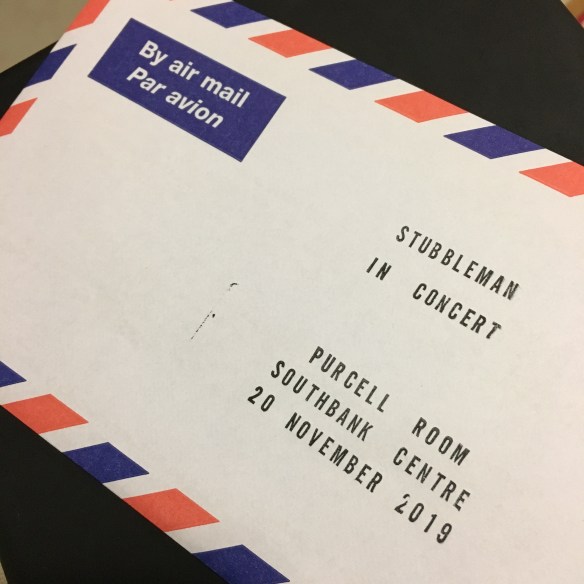
I could (half) see her point. Fisher Turner and Moody’s set was not jazz, and neither was the artist they were supporting – Pascal Gabriel, in his Stubbleman guise – but they could be forgiven for asking the question. Gabriel’s performance formed part of the EFG London Jazz Festival, and even if you took a most liberal definition of what jazz is, the music he performed – a 55-minute seamless journey through his entire Mountains And Plains album and an extract from a new work inspired by his fastest time cycling Mont Ventoux in Provence – wasn’t jazz. But hey, genres are just labels anyway.
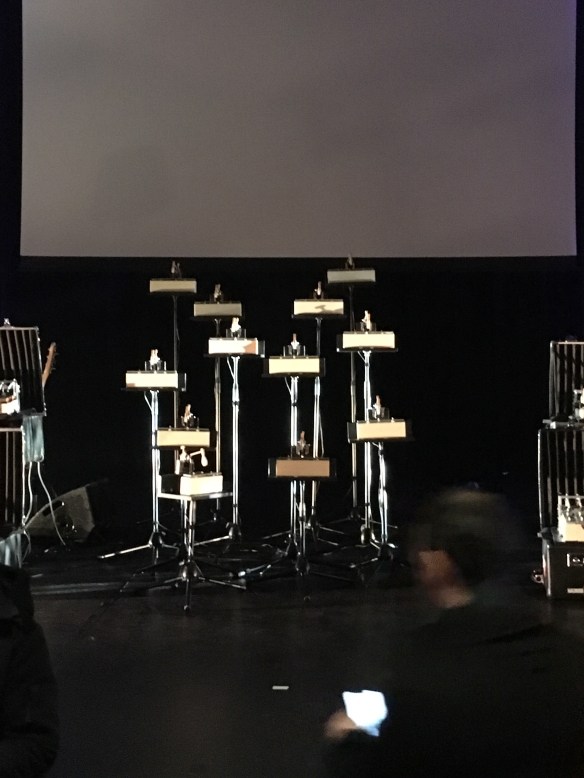
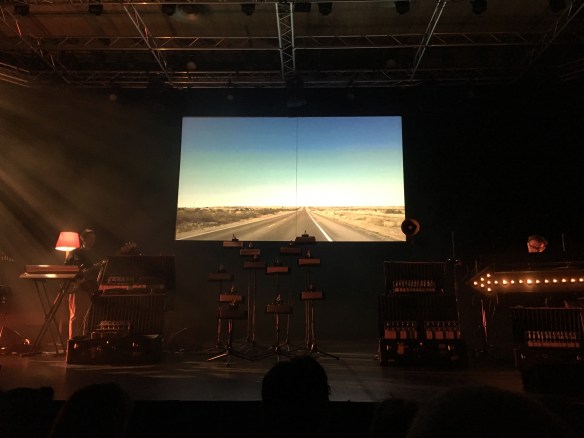
Gabriel faced a challenge with realising the many-layered sounds presented on Mountains And Plains for a live show without resorting to an unadulterated laptop playback non-performance. Instead, he painstakingly crafted a series of electrically-controlled automata housed in old-fashioned travel trunks that could be triggered to perform melodies alongside his and his Rotem Haguel’s playing. Watching a drum kit play itself on a piece like ‘South 61 West 14’ was a strange delight to behold, the kind of stuff of dreams or episodes of Bagpuss. One imagines that Luigi Russolo and his merry band of Futurists would have approved.
Watching the machines, which occupied centre stage with Haguel and Gabriel flanking them, was nothing short of mesmerising, reminiscent of Victorian player-pianos and fairground organs yet positioned within an ultra-modern context. Hearing the machines play the haunting, filigree passages of ‘Piety Wharf’ or ‘Abiquiú’, accompanied by visuals of the environments that Gabriel and his wife Pippa observed on their road trip across America was moving in a plaintive, unexpected way.
Gabriel concluded his performance with a twenty-minute concluding extract from his second Stubbleman release, titled 1:46:43. The suite is named after his best time on Mont Ventoux, and its inputs were the various metrics his bike’s onboard computer recorded throughout the best part of two hours of hard peddling – heart rate, cadence and so on – which Gabriel then turned into electronic sequences.
The extract was given extra poignancy by Gabriel’s explanation that his composition was also informed by the abortive climb of Mont Ventoux by British cyclist Tom Simpson, who died a short distance from the peak during the 1967 Tour de France. The music taken from 1:46:43 could immediately be linked to the stylistic poise of Mountains And Plains while taking on a hypnotic, meditative edge and restless drama that nodded firmly in the direction of Philip Glass and Terry Riley.
Ahead of the show, SFT has remixed ‘Abiquiú’ from Mountains And Plains.
Anton Corbijn‘s new film about Depeche Mode fans, Spirits In The Forest, is released in cinemas for one night only on Thursday November 21.
Ahead of its release I wrote a feature for Clash anticipating Corbijn’s film through two previous films – D.A. Pennebaker‘s seminal road movie 101 and the never-officially-released Our Hobby Is Depeche Mode, directed by Nick Abrahams and Jeremy Deller – as well as my own personal experiences of being a fan of this enduring Mute group.
Read the Clash feature here. Read my review of Our Hobby Is Depeche Modehere.
FITTED is a spontaneously-established quartet of Graham Lewis and Matthew Simms from the current Wire line-up, Minutemen’s Mike Watt and Bob Lee from Fearless Leader. The group came together during the LA date at The Echo on Wire’s DRILL 2017 festival tour, rehearsed just once and then took to the stage for a blistering performance loosely based on Dome’s ‘Jasz’, which, after several iterations in the studio, emerges on the group’s debut album as the biographical ‘The Legend Of Lydmar Lucia’.
That track acts as a logical centrepoint to a collection of six tracks that operate on a unique pathway between spacey, acid-fried grooves, the upstart urgency of punk and art-rock. ‘The Legend Of Lydmar Lucia’ finds Lewis intoning a diaristic spoken-word recollection of a particularly vivid art happening at Santa Lucia’s Lydmar Gallery, his delivery carrying the kind of oblique, unfathomable wordplay that is highly familiar from his occasional lead vocals with Wire. The unfamiliar aspect of this track is the swirling, turgid, many-layered bed of sound upon which his vocal rests; murky, impenetrable, thrilling and restless, the sonic stew created by the four musician’s is a breathtakingly complex listen, and a perfect foil for Lewis’s intonation.
Something similar happens on the ultimately incendiary and boisterous opening track, ‘Plug In The Jug’, with lead vocals from Mike Watt. ‘Plug In The Jug’ starts out in tentative, atmospheric territory, sound washing in and out but building, building, building toward something initially unclear but finally coalescing into a groove somewhere between The Doors at their most focussed and Sonic Youth’s Steve Shelley at his Krautrocking, cyclical drumming best.
Elsewhere, ‘The Chunk That Got Chewed’ is a sprawling, beautiful mess of a track with Watt sounding a lot like Pere Ubu’s David Thomas, while closing track ‘The First Fit’ is a mesmerisingly deep piece led by an especially emotional Lewis augmented by wandering, languid jazz rock fluidity buried under treacly reverb.
It’s not clear yet whether FITTED is a one-off project or the start of something that the group will return to whenever schedules allow. What’s immediately clear from the symbiosis of these four talented minds on the six tracks here is that their capacity to produce interesting, engaging, surprising music is probably limitless.
First Fits by FITTED is released November 8 2019 by ORG Music.
How to interpret the title of the new Swans album? Is Michael Gira – the only consistent member of the group he founded with unassailable, blistering New York No Wave urgency in 1982 – asking what the meaning of the word ‘leaving is’, in the manner of a child unwitting asking aimless questions that take on a metaphysical hue? Or is he concerned with the idea of somehow leaving a legacy? One can spend too long trying, pointlessly, trying to decode such things, but if Gira is any way concerned that Swans won’t somehow leave an enduring impression after all this time, the bold grandeur of this LP should ensure that he needn’t worry again.
We throw away adjectives in this reviewing game with careless abandon, but Leaving Meaning is unquestionably stunning and justifies the following gushing praise, and more. It is redemptive; searching; uncertain yet confident; ruminates on mortality yet is unquestionably alive; both humbled and humbling; vast yet sparse; personal yet universal; occluded throughout yet as clear as crystal; quiet yet impossibly, irrepressibly, almost violently loud. It is everything that Swans have ever proposed to be and everything Gira has ever striven toward; faithful yet original. And so on.
Perhaps the only predictable thing about Swans is Gira’s insistence on changing the band’s line-up whenever he feels like it. Leaving Meaning is the first record he’s made after dissolving the group that was Swans from 2010 to 2017 – a comparative period of stability for the band. The new line up features old friends from former iterations of Swans, as well as members of Angels Of Light, the group Gira formed when he put Swans on ice between 1999 and 2010. Gira suggests that Swans will now just consist of a “revolving cast of musicians, selected for both their musical and personal character, chosen according to what I intuit best suits the atmosphere in which I’d like to see the songs I’ve written presented.” The cast this time includes Nick Cave’s keyboard player Larry Mullins, Mick Harvey bassist Yoyo Röhm, Mute labelmate Ben Frost on synths and guitars, Swans / Angels Of Light confidante and guitarist Kristof Hahn, all three members of New Zealand’s The Necks, both members of A Hawk And A Hacksaw, Baby Dee, Anna and Maria von Hausswolff and a supporting cast that would frankly make this sentence even more obscenely long than it already is. (An accompany press photo suggests a team of 32 contributors, with Mute founder Daniel Miller occupying the lower left corner.)
The musicians and vocalists assembled for Leaving Meaning are predominantly European, with many of them living in Berlin. Consequently it’s hard not to liken this record to those pivotal albums that emerged in the early 1980s as Nick Cave and a bunch of other Aussie waifs and strays found themselves in the Kreuzberg district, fusing together punk, noise and musicianship in a way that was entirely visionary.
This is a long album, filled with several songs that effortlessly break the ten-minute mark without ever losing interest. Some of these songs are genuinely, forcibly arresting – the rest are simply brilliant. ‘The Hanging Man’ issues forth on a low-slung, unflinching groove laced with menace and vivid, uncomfortable imagery, while ‘Amnesia’ carries a strange tranquility delivered with an uncompromising, unfiltered verbal panache reminiscent of Leonard Cohen and Lou Reed at their most visceral. The title track is tranquil yet disturbing, reflecting on slipping away, its sparse, languid tonalities and gauzy fuzz akin to listening to The Doors’ ‘This Is The End’ while under the influence of heavy antidepressants. ‘The Nub’ – led by and written specifically for Baby Dee – is bewitching, theatrical and ominous as fuck, the line ‘I’m leaving by distortion’ presaging a coda of intense, heavy drone and rattling guitar and violin dissonance that the moody, haunting serenity of the the first eight or so minutes could never have anticipated.
The evocative ‘Sunfucker’ is a sort of ravaged punk blues centrepiece, like ‘Louie Louie’ recast as a pentagram for summoning all the devils of this world (and others) to cause utter, irreversible havoc. Honed yet frazzled, Gira’s voice here contains a control and even-handed resoluteness, even when the words seem turn to gibberish in his mouth.
“I was moving around Berlin a lot when I was listening to works in progress for this album. I realised that I was maxing out on the volume, and after briefly thinking about the damage that I might be causing to my ears, I also realised that I’ve never really found myself making stuff that loud before. I remember doing that as a kid – I’d push the cheap, crappy headphones against my ears to get more bass while I was listening to the version of Duran Duran’s ‘Save A Prayer’ from ‘Arena’ which I used to play over and over.”
– Alessandro Cortini (Clash interview with Mat Smith, September 2019)
VOLUME MASSIMO, the new album from Alessandro Cortini and his first for Mute, is released tomorrow.
Ahead of its release, I spoke to Alessandro for Clash about his love of vintage synths, pressing headphones against your ears to get more bass and the enduring influence of guitarist Steve Vai.
Goldfrapp’s second album finds the duo moving from the chilled ethereal ambience of Felt Mountain into a sort of robotic retro-modernism. There are moments that nod in the textural direction of their debut, such as the serene title track or the beautiful ‘Deep Honey’, but on the whole Black Cherry is a harder, more direct affair.
Black cherry was always the flavour of yoghurt that no-one else wanted from the fridge in our household, a weird vestigial throwback to 70s faux sophistication, no doubt achieved via an array of bitter E numbers; it’s one of those ‘love it or hate it’ flavours, and I guess this analogy works well regarding this album. In many ways, the disparity between Felt Mountain and this may not taste good to some who only bought their debut for its chilled vibe and its placement in the voguish late 90s chill out compilation canon. Personally, I loved black cherry, and I love Black Cherry.
Alison Goldfrapp‘s voice has always possessed a certain sensuality which has the capacity to draw you in and surround you with half-whispered temptations. That tone is best evidenced on the penultimate track, ‘Forever’, which is full of achingly seductive promise, Alison’s captivating vocal expertly accompanied by Will Gregory‘s chastened electronic textures and a sort of Beatles-y psychedelia. Elsewhere, the opener, ‘Crystalline Green’ is a hypnotic stream of words set to a jerky electro rhythm, while the prowling multiple climaxes of ‘Slippage’ that end the album edge forward with a nagging, ‘Nightclubbing’ pace and a large pinch of burlesque noir.
At times, Black Cherry is a thoroughly over-sexed, occasionally grubby affair, with the single ‘Twist’ getting as close as the duo ever dared get to the sound and imagery of Peaches. The gritty square wave-dominant sound that dominates parts of the album is both extreme and a shock to the system after their spell working the ambient torch song ephemerality of their debut. Singles like the glam-infused ‘Train’ and the deftly ubiquitous – yet utterly subversive – ‘Strict Machine’ more or less defined a new, more urgent and confrontational dimension to the Goldfrapp sound, one that allowed them to slip effortlessly – but perhaps unexpectedly – into a new and eclectic early 2000s anything-goes pop movement.
Catref: stumm196
Words: Mat Smith
Originally posted 2003; edited and re-posted 2019 to coincide with the vinyl reissue of Black Cherry.
Daniel Blumberg could well be seen as the most sonically challenging addition to Mute’s present-day roster. His prolific release schedule highlights both a limitless improvisatory imagination and also a huge amount of trust and freedom by the label that he joined last year with his Minus opus.
In parallel to his work under his own name as de facto band leader, his output as GUO with tenor saxophonist Seymour Wright represents an ever-adaptable framework that allows the pair space to collaborate with other like-minded musicians. After previous releases with friend and muse Brady Corbet, GUO4 pitches the Blumberg/Wright duo together with drummer Crystabel Riley, accompanied by a text from Fran Edgerley. The impetus for the session was a new short film by Peter Strickland concerning itself with an altercation between two men in a locker room.
Violence, then, is to be expected from this atypical soundtrack, which is, for the most part, led by Riley’s evocative, sheet metal-esque percussion. Taken as a sympathetic and wonderfully noisy response, Wright’s atonal squalls of upper-register bleating and Blumberg’s signature guitar un-playing – ranging from low distortion rumbles to metallic splinters to an undercurrent of angry note clusters – make the single 22-minute piece both expressive and beautifully uncomfortable.
To paraphrase what another of Mute’s noisier pairings might have dubbed it, this is easy listening for the hard of hearing. Whether it acts as a portent of what we can expect from Daniel Blumberg’s next LP under his own name remains to be heard.
Issue 54 of the inestimable Electronic Sound is out now, and its major focus is on the enduring legacy of Anthony Wilson’s Factory Records.
As Mute’s artist-led focus has continued since becoming a fully independent enterprise again, the borders between the Factory back catalogue and Mute have become fuzzy; New Order now call Mute home, and A Certain Ratio‘s entire back catalogue is now looked after by Daniel Miller‘s imprint. The latest issue features interviews with ACR and Stephen Morris of New Order / Joy Division, while the accompanying double 7-inch single issued with the bundle (now sold out) features the single version of ACR’s ‘Knife Slits Water’, presented alongside tracks from Factory stalwarts The Durutti Column and Section 25, as well as the oft-overlooked Minny Pops, in a gatefold sleeve that nods reverentially in the direction of the original Factory Sampler EP.
This month I contributed a short introductory feature on Alice Hubble, the alias of Alice Hubley from Arthur & Martha. You can read a short interview with Hubley over at my Further. blog as part of a series of micro-features called 3 Questions. I also reviewed albums by Pere Ubu, Tenderlonius, sometime Jaki Liebezeit collaborator Burnt Friedman, a fine Erland Apseneth album on Hubro and a various artists record fusing the natural sounds of Michigan with intelligent sound responses.
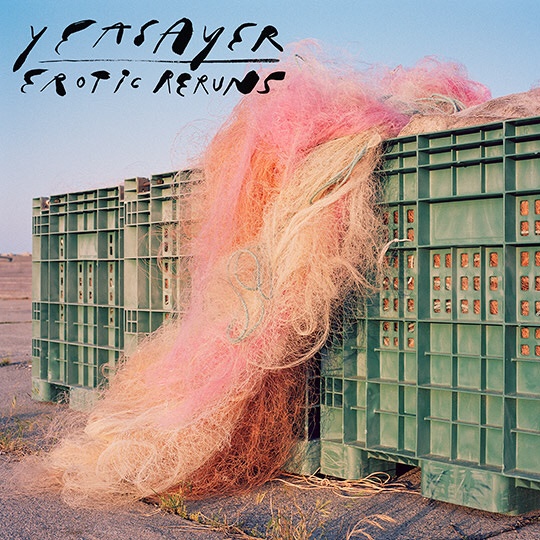
I also reviewed the excellent new Yeasayer album, Erotic Reruns. My interview with Anand Wilder from the band can be found here.
Yeasayer‘s fifth album, Erotic Reruns, was released today via their own Yeasayer Records. The LP saw the trio of Chris Keating, Ira Wolf Tuton and Anand Wilder returning to the live compositional style of their earliest releases, taking their inspiration from 70s MOR, personal relationships and the prevailing US political environment.
To coincide with the release, I spoke to the band’s Anand Wilder for Clash about the genesis of the album, leaving the comfort blanket of record labels behind and the necessary tensions within this enduring New York group.